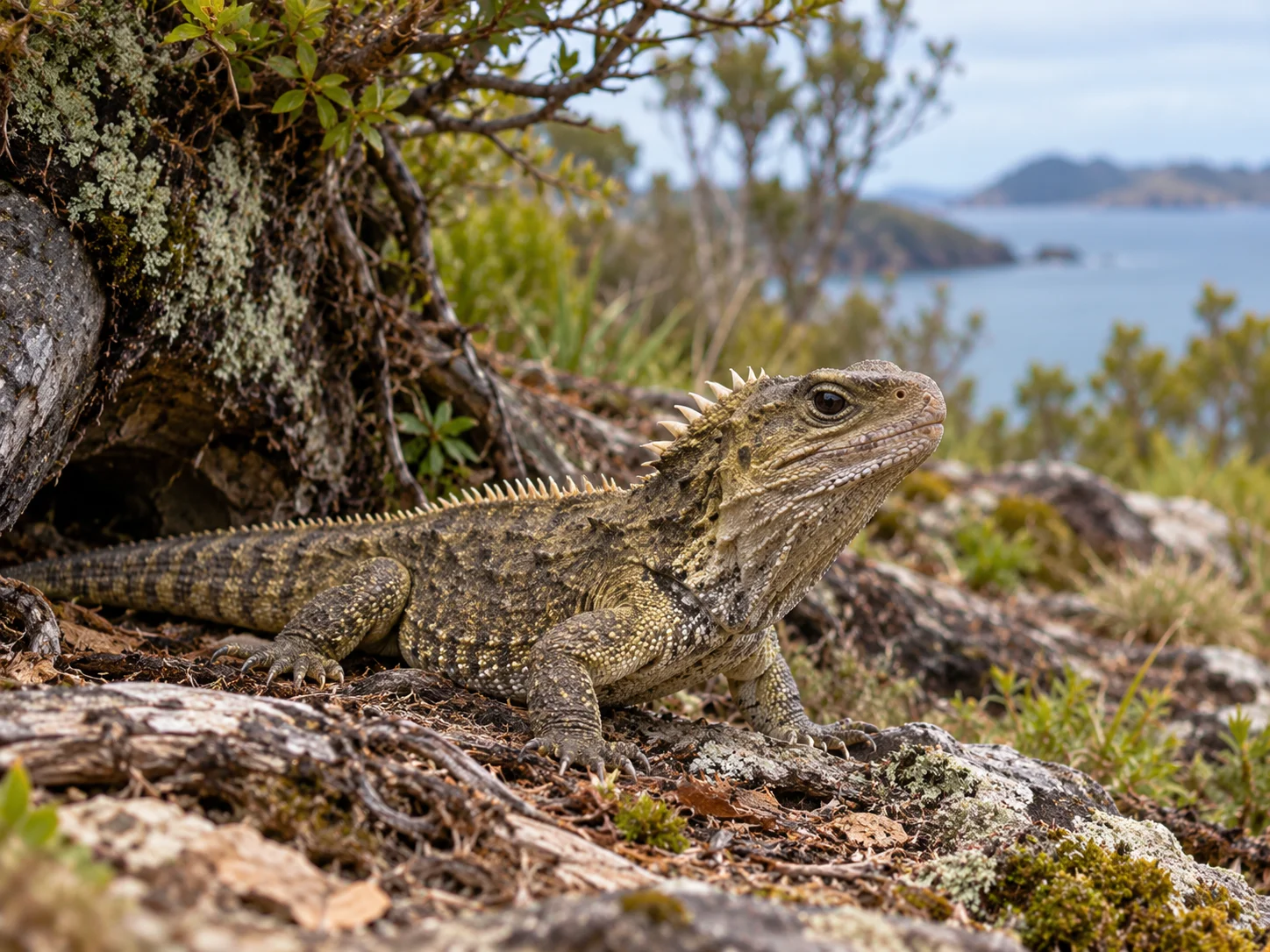
Meet the Tuatara
The tuatara looks like a lizard, and it is not one.
It belongs to an order of its own, Rhynchocephalia, which split away from the lizards and snakes around 250 million years ago, before the first dinosaur. That order once had species worldwide. Every one of them died out except this animal, which survives on about 30 islands off New Zealand.
Calling a tuatara a living fossil is a little unfair, since it has evolved since then like everything else. The accurate statement is stranger: it is the last member of a branch of reptile life that is otherwise entirely gone.
Scientific Name and Classification
The tuatara is Sphenodon punctatus. A second form on North Brother Island was once treated as a separate species and is now usually regarded as a distinct population rather than a species of its own.
- Kingdom: Animalia
- Phylum: Chordata
- Class: Reptilia
- Order: Rhynchocephalia
- Family: Sphenodontidae
- Species: Sphenodon punctatus
That order line is the whole point. Lizards and snakes are Squamata, a different order with over 11,000 species. Rhynchocephalia has one.
The name is Maori, from tua and tara, meaning peaks on the back, after the spiny crest along the spine. In Maori tradition the tuatara is a guardian, and it carries real cultural weight in New Zealand.
What Makes a Tuatara Not a Lizard?
The differences are structural, not cosmetic, and several of them are things no lizard has:
- Two rows of teeth in the upper jaw. One row in the lower jaw slots between them, and the lower jaw slides forward as it closes, so the tuatara saws its food apart. Nothing else alive chews like this.
- The teeth are not teeth. They are serrated projections of the jawbone itself, and they are not replaced. An old tuatara with worn-down jaw edges has to switch to softer food.
- No external ear opening and no eardrum, yet it still hears.
- No penis. Males have none, which is unique among living reptiles and makes mating a matter of pressing cloacas together, as in most birds.
- An extra hole in the skull and primitive ribs with features found otherwise only in fossils.
- A working third eye.
That last one deserves its own explanation.
The Third Eye
On top of a hatchling tuatara’s head, in the middle of the skull, is a parietal eye. It has a lens, a retina and a nerve connection to the brain, and it is covered by scales within about six months, after which it is no longer visible from outside.
It does not form images. What it does is detect light and dark, and it is thought to help regulate the animal’s daily and seasonal rhythms and its basking, essentially acting as a clock and a light meter rather than an eye.
Some lizards and frogs have a simpler version of the same structure, but the tuatara’s is the most fully developed in any living animal, with recognizable eye tissue rather than just a light-sensitive patch.
It is also worth being honest that its exact function is not settled, because an organ buried under scales in a nocturnal animal is difficult to test.
Appearance and Anatomy
Adults are 16 to 31 inches long including the tail and weigh 1 to 3.3 pounds (0.45 to 1.5 kg), with males notably larger than females.
They are olive, gray or brick brown, with a crest of soft spines along the back and tail that males can erect in display.
Their metabolism is the slowest of any reptile studied, and they are active at the lowest body temperature of any reptile, around 11 to 13 degrees Celsius, where most reptiles would be sluggish or dead. They have been seen moving around in near-freezing conditions.
A tuatara breathes slowly enough that an hour can pass between breaths when it is at rest, and it can shed and regrow its tail like a lizard.
Habitat and Range
Tuatara live only in New Zealand, and only on about 30 small offshore islands plus a handful of fenced mainland sanctuaries where they have been reintroduced.
They were once all over both main islands. Rats arrived with people, ate the eggs and hatchlings, and cleared them off the mainland entirely, which is the single fact that explains the tuatara’s current distribution. The islands that still have them are the islands rats never reached.
They live in coastal forest and scrub, in burrows, and often in burrows dug by seabirds, which they share with the birds. The seabird colonies matter: the birds bring in nutrients, the guano supports insects, and the insects feed the tuatara.
In 2008, a wild-hatched tuatara was found at a mainland sanctuary near Wellington for the first time in around 200 years.
Diet and Feeding
Tuatara are carnivores, eating beetles, crickets, spiders, worms, snails, lizards, frogs, seabird eggs and chicks.
The weta, a large New Zealand cricket, is a staple, and a tuatara will take a seabird chick from the burrow it is sharing with the parents.
They hunt by sitting still at a burrow entrance and ambushing whatever walks past, and their slow metabolism means they can go a long time between meals and grow very slowly on very little.
The sawing jaw action is unusual enough to be worth picturing: the lower jaw closes between the two upper rows and then slides forward, cutting rather than crushing, which lets a tuatara behead a weta or cut through a chick.
Behavior and Lifestyle
Tuatara are mostly nocturnal, though they bask by day at burrow entrances, and hatchlings are active in daylight partly to avoid being eaten by adults.
They are territorial, and males defend areas by inflating themselves, erecting the crest, darkening in color and chasing rivals, with fights that can cost a tail or a toe.
Everything they do is slow. Tuatara do not stop growing until around 35 years old, and they continue breeding into their eighties. A male at Southland Museum named Henry famously showed no interest in breeding for decades, had a tumour removed at around 70, became considerably more agreeable afterward, and fathered eleven offspring at an estimated age of 111.
They are also quiet, slow-moving and easy to overlook, which is part of why so much about them took so long to establish.
Reproduction and Life Cycle
Tuatara reproduction is the slowest of any reptile, and possibly of any land vertebrate.
Females reach maturity at 10 to 20 years and then breed only once every two to five years. They mate in late summer, and the female carries the eggs internally for seven to eight months before laying.
She lays 6 to 10 soft-shelled eggs in a burrow, covers them, and leaves. The eggs then take 11 to 16 months to hatch, which is the longest incubation of any reptile. A tuatara egg laid in one spring may hatch two summers later.
Sex is decided by temperature, and in tuatara the relationship runs the opposite way to most reptiles: warmer nests produce males. This makes a warming climate a direct threat, because it skews populations toward males, and several studies have raised exactly that concern.
Tuatara commonly live 60 to 100 years, and a century is not unusual.
Predators and Threats
Adults have almost no natural predators. Eggs and hatchlings are taken by seabirds and by adult tuatara.
The threat is introduced mammals, and specifically the Pacific rat, or kiore. Rats eat tuatara eggs and hatchlings, and because tuatara breed so slowly, a population can lose every young animal for decades while the adults carry on looking healthy. Islands have been found with plenty of old tuatara and no young ones at all, which is a population already finished.
Cats, pigs, stoats and dogs do the same where they reach them.
Beyond that: loss of the seabird colonies their food web depends on, the sex-ratio problem from warming, and small population size, with some islands holding only a few dozen animals.
Conservation Status
The tuatara is listed as Least Concern by the IUCN, which is misleading on its own and worth explaining. The listing reflects a total population of roughly 60,000 to 100,000 animals that is currently stable and protected. It does not mean the animal is secure in any ordinary sense: it is confined to islands, it cannot recolonise anything by itself, and its survival is entirely dependent on keeping rats out.
New Zealand’s conservation effort here has been genuinely impressive. Rats have been eradicated from island after island, tuatara have been bred in captivity and translocated to new sites, and fenced mainland sanctuaries now hold breeding populations. Eradicating rats from an island is hard, expensive and effective, and New Zealand has become the world’s leading practitioner of it.
Tuatara are fully protected and cannot legally be taken from New Zealand, and the few held abroad are in a small number of zoos under agreement.
Role in the Ecosystem
Tuatara are top invertebrate predators on their islands, controlling weta, beetles and snails, and their droppings return seabird-derived nutrients to the soil.
They are tangled up with the seabirds in both directions, eating some chicks while living in burrows the birds dig, and an island that loses its seabirds loses its tuatara too.
Scientifically they are close to irreplaceable. Because they are the only survivor of their order, the tuatara is the single reference point for what that whole branch of reptile evolution was like, and the tuatara genome, sequenced in 2020 in partnership with the Maori iwi Ngatiwai, turned out to be one of the largest vertebrate genomes known and showed an unusual mix of reptilian and mammalian features. That project is also cited as a model for how genomic research should be done with indigenous communities rather than on their taonga without them.
And there is a simple thing worth holding onto. An animal whose relatives all vanished before the dinosaurs got going is still out there on rocky islands, eating crickets, breathing once an hour, and sometimes fathering children at 111. It survived everything that happened to the planet, and what nearly finished it was rats arriving on boats.