Meet the Aldabra Giant Tortoise
Somewhere on a coral island in the Indian Ocean, there are tortoises alive today that hatched before the first car was built. The Aldabra giant tortoise (Aldabrachelys gigantea) is one of the largest tortoises alive, native to the Aldabra atoll in the Seychelles.
The Aldabra giant tortoise regularly passes 100 years and may reach 200. One famous individual, Jonathan, living on St Helena, hatched around 1832 and is still alive, making him the oldest known land animal on Earth.
They weigh up to 550 pounds, and roughly 100,000 of them live on a single atoll, which is more giant tortoises than anywhere else in the world.
Scientific Name and Classification
The Aldabra giant tortoise’s scientific name is Aldabrachelys gigantea.
- Kingdom: Animalia
- Phylum: Chordata
- Class: Reptilia
- Order: Testudines
- Family: Testudinidae
- Species: Aldabrachelys gigantea
It is one of only two giant tortoise species left in the world. The other is the Galapagos giant tortoise, on the opposite side of the planet.
Giant tortoises were once common on islands across the Indian Ocean. Sailors took them aboard ships as living food that survived for months without water, and within a couple of centuries almost every island population was gone. The Aldabra atoll survived because it is remote, waterless and extremely hard to land on.
How Long Do Aldabra Tortoises Live?
Longer than almost anything else with legs.
Reliable records show over 150 years, and estimates for some wild individuals go beyond 200. The trouble with measuring it is obvious: a researcher who starts the study does not live to finish it.
Jonathan, on St Helena, is the best-documented case. He arrived there as a fully grown adult in 1882 and was estimated to have hatched around 1832, which makes him well over 190 years old. He has lived through the invention of the telephone, the light bulb, powered flight and the internet.
Why they live so long comes down to a slow life. Tortoises grow slowly, mature late, have a very low metabolic rate and face almost no predators once their shell has hardened. Nothing pushes them to live fast, so they do not.
Appearance and Anatomy
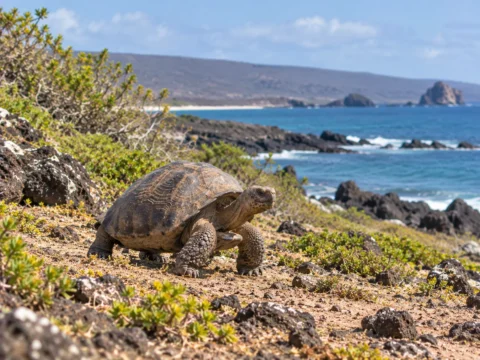
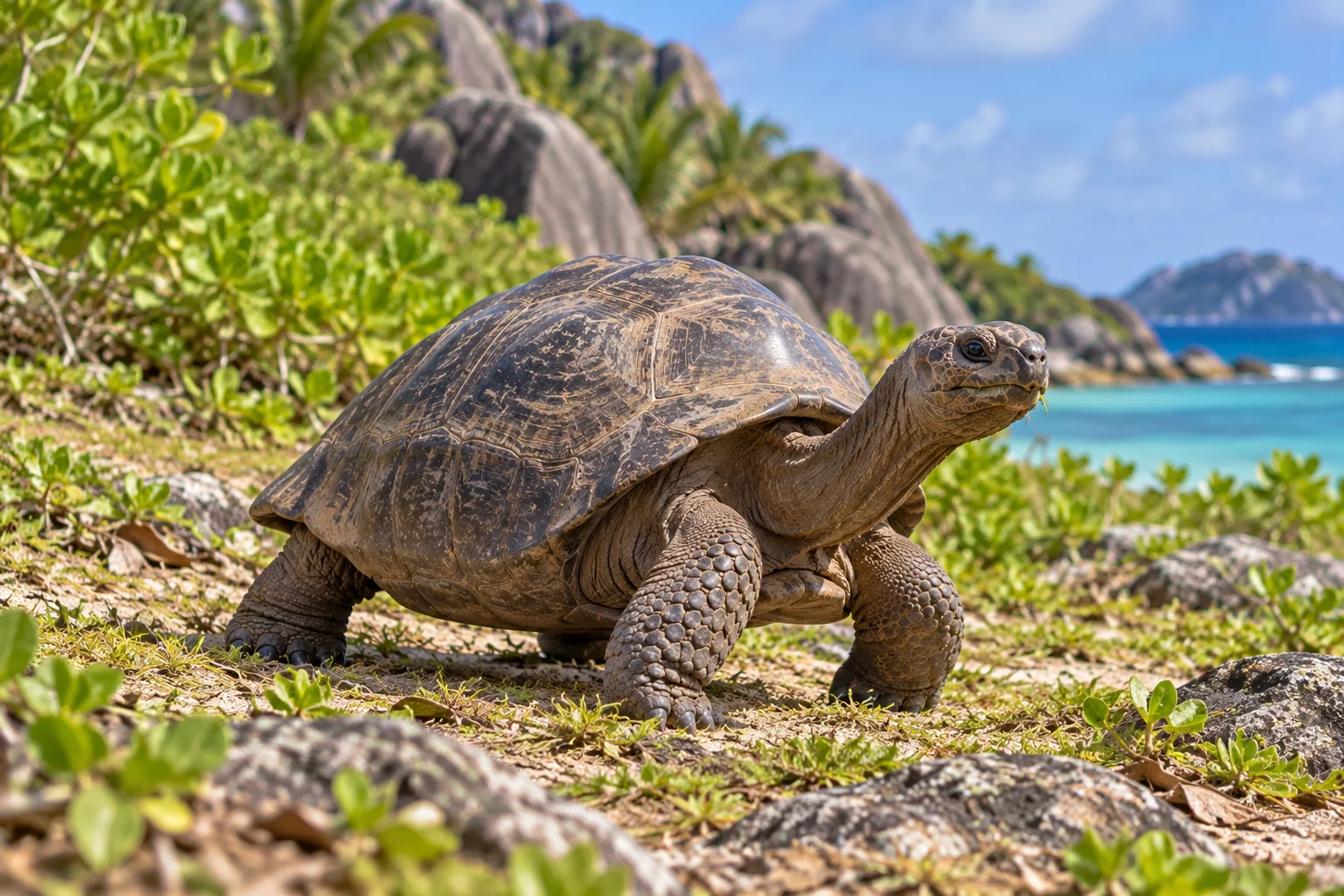
Aldabra tortoises reach 3 to 4 feet in shell length and weigh 350 to 550 pounds, with males considerably larger than females.
- Shell. High-domed, brown or gray, and fused to the skeleton. The ribs and spine are part of it, so a tortoise cannot leave its shell any more than you could leave your ribcage.
- Neck. Long for a tortoise, letting it reach branches up to 3 feet off the ground.
- Legs. Thick and pillar-like, covered in bony scales, carrying all that weight.
- Nostrils. Used for drinking. Aldabra tortoises can take up water through their nose from puddles too shallow for their mouths, which matters on an island with almost no fresh water.
- Skin. Tough and scaly on the legs and neck, protecting against sun and scratches.
They have no teeth. The jaws have sharp bony edges that work like shears for cutting plants.
Habitat and Range
Almost the entire wild population lives on Aldabra Atoll in the Seychelles, a ring of coral islands in the Indian Ocean.
The atoll is harsh ground: sharp coral rock, scrubby vegetation, intense sun and very little fresh water. The tortoises live on grassland, scrub and mangrove edges.
Smaller introduced populations exist on other Seychelles islands, on Mauritius and on St Helena, some deliberately established as insurance against disaster striking Aldabra.
Heat is their daily problem. With no way to sweat, they must find shade or water by mid-morning, and tortoises caught in the open on hot days can die of overheating.
Diet and Feeding
Aldabra tortoises are herbivores, eating grasses, leaves, stems, fruit and fallen plants.
They have created their own pasture. Centuries of grazing have produced a low, dense, tough turf unique to Aldabra, made of dwarfed grasses and herbs that survive constant cropping. Botanists call it tortoise turf, and it exists because the tortoises made it.
They will occasionally eat carrion and even the bones of dead tortoises, probably for calcium.
They can go long periods without food or water, drawing on fat reserves and on water stored in the body, which is exactly the trait that made them useful to sailors and nearly wiped them out.
Behavior and Lifestyle
Aldabra giant tortoises are active in the cool of early morning and late afternoon, and rest in shade, mud or shallow pools through the heat of the day.
They are social in a loose way, gathering in groups on open grassland, and are not territorial.
Males establish rank by height rather than fighting: two males face each other, stretch their necks as high as they can, and the taller one wins. The loser simply withdraws.
They are slow, moving at well under a mile an hour, but surprisingly determined climbers and will push through thick scrub rather than go around.
A tortoise tipped onto its back can die if it cannot right itself, and the high domed shell is partly shaped to help it roll back over.
Reproduction and Life Cycle
Female Aldabra giant tortoises lay 9 to 25 eggs in a shallow nest dug in dry ground, usually between February and May, and may lay more than one clutch a year.
Incubation takes around eight months, and the temperature of the nest decides whether the hatchlings are male or female.
Hatchlings are about 2 to 3 inches long and entirely on their own from the start. There is no parental care, and most are eaten by crabs, birds and introduced rats before their shells harden.
They grow for decades and do not breed until around 20 to 25 years old. A tortoise that survives to adulthood, though, is very hard to kill.
Predators and Threats
Adults have essentially no natural predators. Eggs and hatchlings are eaten by crabs, birds and introduced rats and cats.
Historically the threat was people. Sailors took giant tortoises in enormous numbers because they stayed alive for months in a ship’s hold without food or water, providing fresh meat on long voyages. Hundreds of thousands were taken, and most island populations were exterminated.
Today the threats are introduced rats and cats taking hatchlings, and rising sea levels, which is a serious problem for an animal living on a low coral atoll.
Conservation Status
The Aldabra giant tortoise is listed as Vulnerable, but the situation is better than that sounds. Around 100,000 live on Aldabra, and the population is stable.
The risk is that nearly all of them are in one place. A single disaster, a disease outbreak, a severe cyclone or sea-level rise flooding the atoll, could take out most of the species at once.
Aldabra Atoll is a UNESCO World Heritage Site and strictly protected, with only researchers allowed. Backup populations have been set up on other islands for exactly that reason.
Their survival is largely luck. Aldabra was too remote and too waterless to settle, and that is why these tortoises exist and almost all their relatives do not.
Role in the Ecosystem
These tortoises are the main large grazers of Aldabra, and they built the landscape they live in. The tortoise turf covering much of the atoll exists only because of centuries of their grazing.
They are also the atoll’s main seed dispersers, eating fruit and carrying seeds across the islands in their droppings. Several plants there depend on tortoises to spread at all.
They clear paths through dense scrub that smaller animals use, and their droppings fertilize thin coral soil.
Conservationists have started putting them to work elsewhere. Aldabra tortoises have been released on Mauritius and other islands to take over the ecological job of extinct giant tortoises there, grazing and spreading seeds for native plants that had lost their partner. It is one of the clearest examples of using a living species to repair a missing piece of an ecosystem.