Meet the Toad
In 1935, Australia released about 100 cane toads into Queensland to eat the beetles damaging sugar cane. Toads are dry-skinned amphibians of the family Bufonidae, around 600 species, and unlike most frogs they spend their adult lives away from water.
The toads could not reach the beetles, which live high on the cane stalks. So they ate everything else instead, bred enormously, and spread. There are now well over 200 million of them across northern Australia, and they are still advancing.
Worse, they are poisonous, and Australia’s native predators had never met anything like them.
Scientific Name and Classification
The true toads form the family Bufonidae, with around 600 species, so there is no single two-word name. The common toad is Bufo bufo and the cane toad is Rhinella marina.
- Kingdom: Animalia
- Phylum: Chordata
- Class: Amphibia
- Order: Anura
- Family: Bufonidae (true toads)
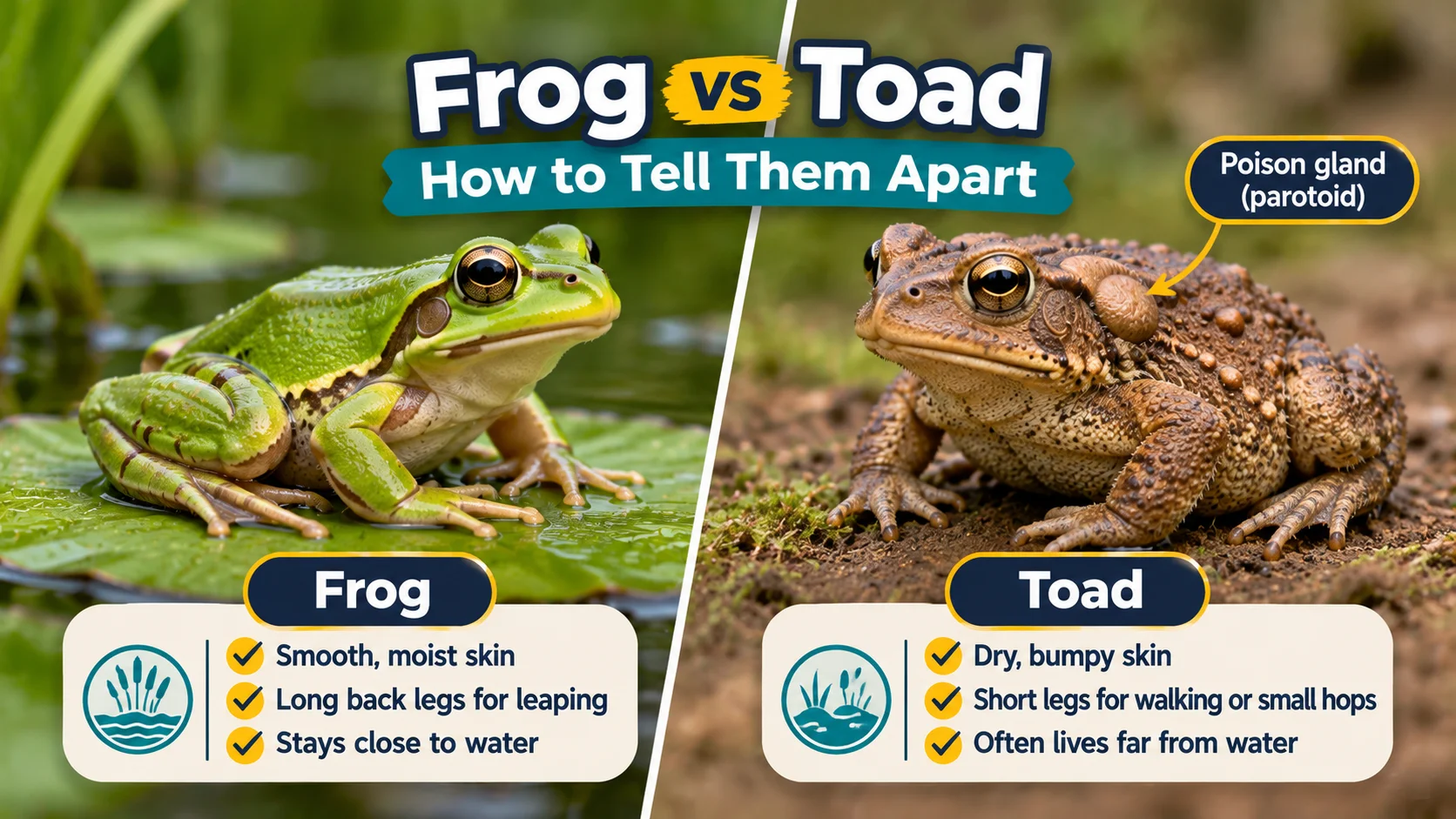
Here is the thing worth knowing: every toad is a frog. Toads sit inside Anura, the frog order. “Toad” is an everyday word for frogs with dry warty skin, short legs and a squat body, and those features evolved separately in several different frog families.
So there are true toads in Bufonidae, and there are other frogs commonly called toads that are not closely related to them at all.
What Are the Lumps Behind a Toad’s Eyes?
Those are parotoid glands, and they are the toad’s whole defense.
A toad cannot outrun anything. It has short legs, it walks rather than leaps, and it has no speed and no hiding place in the open. What it has instead is chemistry.
The two swellings behind the eyes secrete a milky toxin called bufotoxin. An animal that bites a toad gets a mouthful, and the taste alone makes most predators drop it immediately and remember not to try again. In larger doses the toxin affects the heart.
The warty bumps across the back are glands too, smaller ones, doing a similar job. They are not warts and they are not infectious. Toads do not give you warts. Human warts are caused by a virus that has nothing to do with amphibians.
Handling a toad is harmless if you wash your hands afterward, though it is bad for the toad: dry hands damage the skin it breathes through.
Why Are Cane Toads Such a Disaster?
Because the thing that protects them kills the animals that try to eat them.
Australia had no native toads, so no Australian predator had evolved any resistance to bufotoxin or any instinct to avoid it. Quolls, goannas, freshwater crocodiles and snakes grabbed cane toads as they would any frog, and died.
Northern quoll populations collapsed as the toad front advanced. Some goanna populations fell by over 90 percent.
Everything about the toad suited the invasion. A female lays up to 30,000 eggs at a time. They tolerate heat, drought and saltwater better than native frogs. They eat almost anything, including pet food and dung. And the ones at the leading edge of the spread have evolved longer legs and travel further each night than the toads behind them.
One approach is working, and it is clever. Researchers feed native predators small cane toads, or sausages made from toad, in doses large enough to make them sick but not kill them. The animals learn to avoid toads, and some teach their young. It is conservation by teaching taste aversion.
There is also evidence of natural adaptation: some snakes in long-invaded areas now have smaller heads, because the ones that could swallow a big toad died.
Appearance and Anatomy
Toads range from under an inch to the cane toad at nearly 10 inches and over 3 pounds.
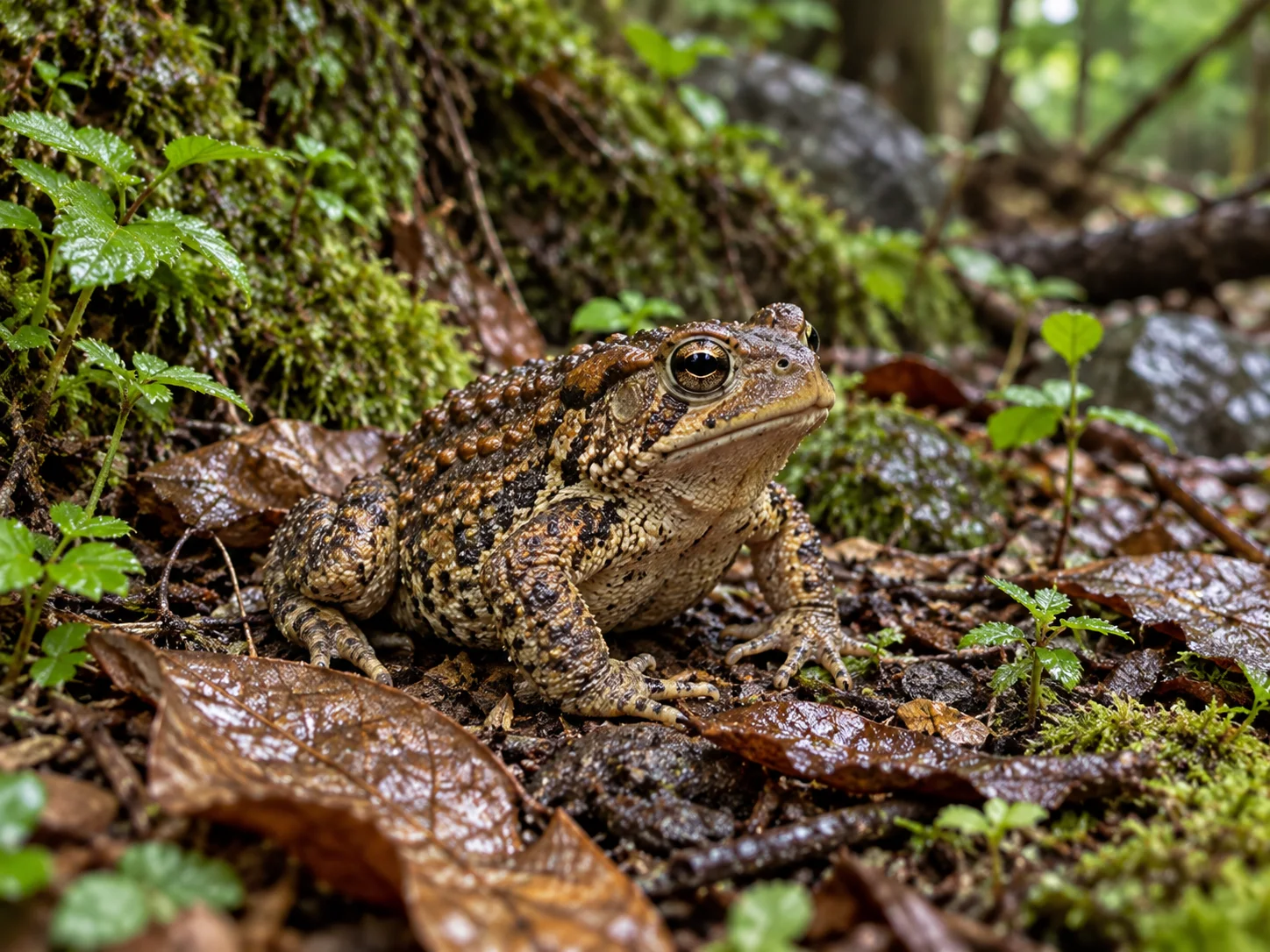
- Skin. Dry, thick and warty, which loses far less water than a frog’s and is why toads can live away from ponds.
- Parotoid glands. The two toxin swellings behind the eyes.
- Legs. Short and strong, built for walking and digging rather than leaping.
- Eyes. Often with a horizontal pupil, and gold or copper irises.
- No teeth. True toads have none at all, so prey is swallowed whole.
Many toads inflate themselves with air when threatened, which makes them harder to swallow and is often mistaken for anger.
Habitat and Range
Toads live on every continent except Antarctica, and were absent from Australia until people brought them.
They are far less tied to water than frogs. Their thick skin lets them live in gardens, woodland, grassland, farmland and even desert, returning to water only to breed.
They shelter in burrows, under stones and logs, and in flowerpots and compost heaps. In cold regions they dig down and hibernate through winter.
Some desert species spend most of the year underground and emerge only when rain arrives.
Diet and Feeding
Toads are carnivores, eating slugs, snails, worms, beetles, ants, woodlice, spiders and other insects. Large species take small mammals, birds and other amphibians.
They hunt by movement, flicking out a sticky tongue, and a still insect may be ignored entirely.
For gardeners this is the point of toads. A single toad gets through a large number of slugs and snails in a season, which makes a resident toad genuinely worth encouraging if you grow anything.
Tadpoles are different, grazing algae and plant matter.
Behavior and Lifestyle
Toads are mostly nocturnal, slow-moving and solitary, and they are creatures of habit, using the same shelter and the same hunting patch for years.
Once a year they migrate, and it is one of the most reliable events in the amphibian calendar. On the first mild damp nights of spring, toads walk back to the pond where they were born, often a mile or more, in large numbers and all on the same few nights.
Roads crossing those routes kill toads in thousands, which is why volunteer toad patrols carry them across in buckets in parts of Britain and Europe.
Males call to attract females, and a toad chorus on a spring night is loud enough to hear from a long way off.
Reproduction and Life Cycle
Toads lay their eggs in long strings wound around water plants, which is the easiest way to tell toad spawn from frog spawn: frogs lay clumps, toads lay strings.
A common toad lays a few thousand eggs, and a cane toad up to 30,000.
Tadpoles hatch within a couple of weeks, graze algae, grow legs, absorb their tails and leave the water as tiny toadlets, often all on the same day. Toad tadpoles are usually black and swim in dense shoals, and they are toxic too, which is why fish mostly leave them alone.
Toads live a long time for their size: 10 to 12 years commonly in the wild, and captive individuals have passed 30 and even 40.
Predators and Threats
Grass snakes, herons, owls, hedgehogs, rats and foxes take toads, and some have learned to work around the toxin. A few predators skin a toad before eating it, avoiding the glands entirely.
Human pressures are the loss of breeding ponds, road mortality on migration, pesticides, and tidy gardens with nowhere to shelter.
Chytrid fungus, which has devastated frogs worldwide, affects toads too, and several species have declined or disappeared because of it.
Conservation Status
There is no single status across around 600 species.
Common toads remain widespread, though numbers have fallen noticeably in parts of Europe as ponds have been filled in and roads have multiplied.
Some are gone. The golden toad of Costa Rica was discovered in 1966 and last seen in 1989, and is one of the most cited examples of modern amphibian extinction.
And the cane toad needs controlling rather than protecting across northern Australia, which is an unusual position for an amphibian.
Helping toads is easy: a pond without fish, a log pile, an unmown corner and no slug pellets.
Role in the Ecosystem
Toads are heavy-duty pest controllers, and because they live away from water they do that work across gardens, fields and woodland rather than only at the pond edge. Slugs, snails and beetle larvae are their staples, all of which damage crops.
They are prey as well, feeding snakes, birds and mammals that have learned to handle the toxin.
Their toxins have medical interest, and compounds from toad secretions have been studied for effects on the heart and for pain relief.
The cane toad is the lesson that sits behind all of it. An animal introduced on purpose to solve a pest problem became a far bigger one, because nobody checked whether it could reach the beetles or what would happen to anything that tried to eat it.