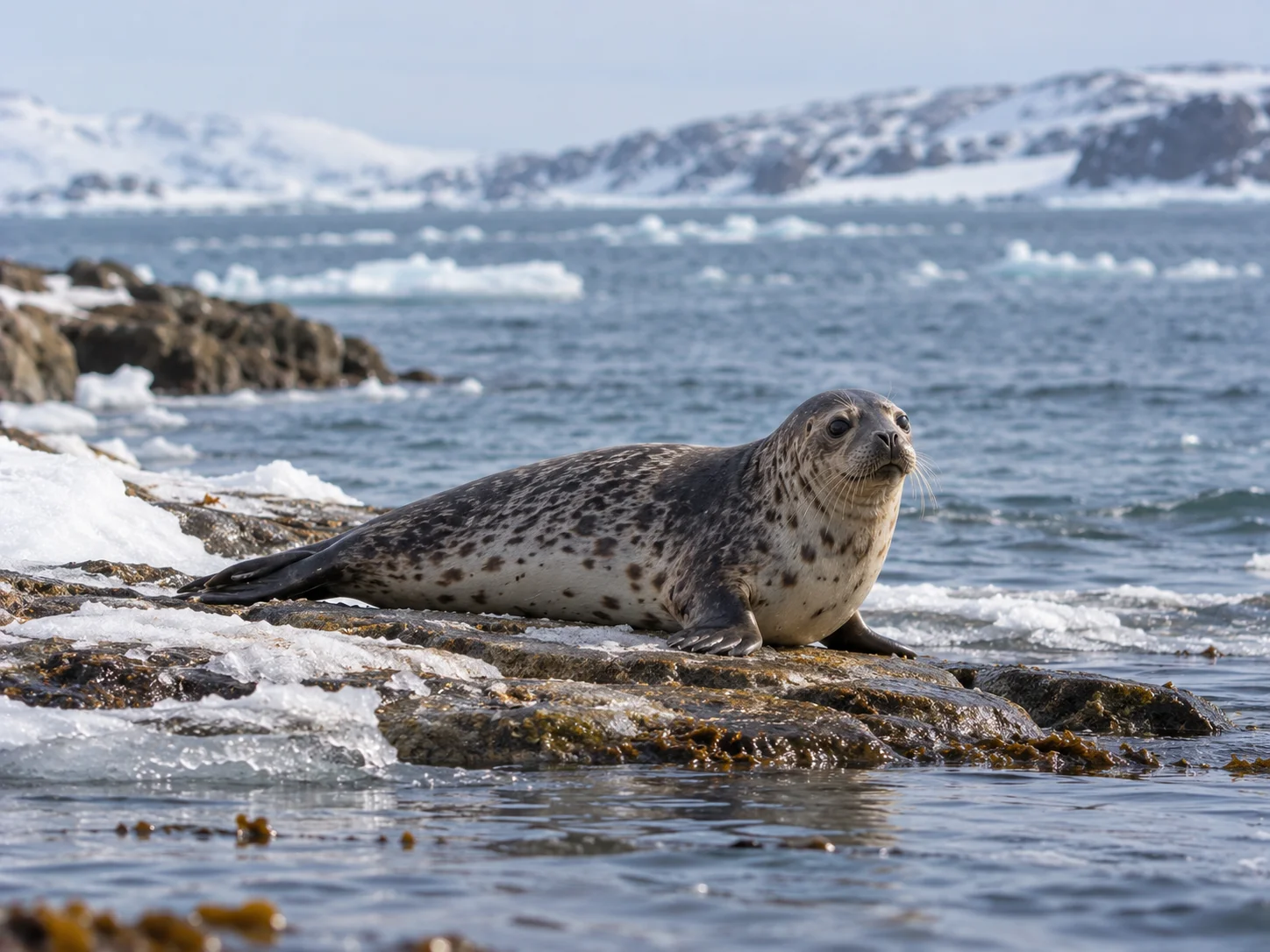
Meet the Seal
A diving seal does something that would be a medical emergency in a human. It stops breathing, slows its heart from about 100 beats a minute to as few as four, and shuts off blood flow to most of its body, keeping it for the brain, heart and eyes.
This is the dive response, and the striking part is that we have a weak version of it too. Put your face in cold water and your heart rate drops. The reflex is ancient and shared; the seal has simply taken it to the extreme.
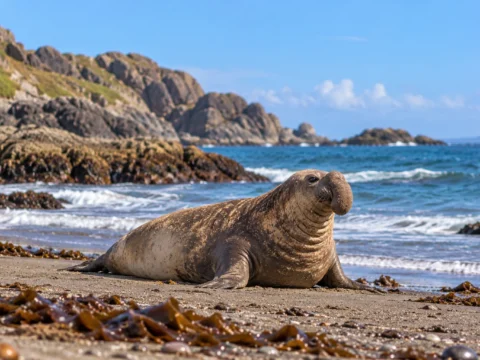
An elephant seal can stay under for two hours on one breath.
Scientific Name and Classification
Seals belong to the group Pinnipedia, which holds about 33 species in three families, so there is no single scientific name. The common or harbor seal is Phoca vitulina.
- Kingdom: Animalia
- Phylum: Chordata
- Class: Mammalia
- Order: Carnivora
- Families: Phocidae (true seals), Otariidae (fur seals and sea lions), Odobenidae (walrus)
The difference between a true seal and a sea lion is easy to check and worth knowing:
- Ears. Sea lions and fur seals have small external ear flaps. True seals have only a hole.
- Movement on land. Sea lions turn their hind flippers forward and walk. True seals cannot, and have to haul themselves along on their bellies.
- Swimming. Sea lions row with their front flippers. True seals sweep with their hind flippers and hold the front ones in.
So the performing animal balancing a ball at an aquarium is almost always a sea lion, not a seal.
Pinnipeds evolved from land carnivores, and their closest living relatives are bears and the weasel family.
How a Seal Hunts Without Seeing
Seals hunt in dark, murky and often deep water, and they are not echolocators like dolphins. They use their whiskers instead.
A fish swimming leaves a trail of turbulence behind it, a wake that lingers in the water for many seconds. A harbor seal can detect that wake and follow it, working out the direction, size and even the shape of a fish that has already gone.
Blindfolded seals in experiments have tracked hydrodynamic trails over distances of many yards. The whiskers of harbor seals have a wavy, undulating profile that reduces the vibration the seal’s own swimming creates, so the animal is not deafened by its own movement, and engineers have copied that shape to reduce drag and noise.
Their eyes are good too, with a huge lens and a reflective layer behind the retina, and they see well in dim light while remaining able to focus both in water and in air.
Appearance and Anatomy
Seals range enormously: the ringed seal at about 4 feet and 100 pounds, up to the southern elephant seal bull at 20 feet and 8,800 pounds, the largest of all pinnipeds.
- Blubber. Up to 4 inches thick, for insulation, buoyancy and stored energy. Seals can fast for weeks on it.
- Blood. Far more of it than a land mammal of the same size, with high myoglobin in the muscle to store oxygen. Seal muscle is almost black.
- Lungs. Collapsible, which avoids the nitrogen problems that give human divers the bends.
- Nostrils. Closed by default. A seal has to actively open them to breathe, which is the reverse of our arrangement and makes drowning while asleep impossible.
The elephant seal’s nose is a resonator, used by bulls to produce a roar that carries across a whole beach.
Habitat and Range
Seals live in every ocean, and are most numerous in cold water at both poles, where the food is richest.
Some are tropical, including the Hawaiian and Mediterranean monk seals, both of which are in serious trouble. A few live in fresh water: the Baikal seal is found only in Lake Baikal in Siberia, more than a thousand miles from any sea, and nobody is quite sure how its ancestors got there.
All seals need somewhere to haul out, because they breed, molt and rest out of the water, whether on ice, rock, sand or shingle.
Weddell seals in Antarctica live further south than any other mammal, keeping breathing holes open in the ice with their teeth, which wears those teeth down and eventually shortens their lives.
Diet and Feeding
Seals are carnivores, mostly eating fish, squid and crustaceans, and swallowing prey whole or in large pieces.
Some have remarkable specializations. The crabeater seal eats almost nothing but krill, which it strains from the water through teeth shaped into interlocking sieves, so despite the name it is a filter feeder. The leopard seal takes penguins, other seals’ pups, fish and krill, and is one of the Antarctic’s top predators.
Elephant seals feed on squid and fish at depths of 1,000 to 5,000 feet, diving almost continuously for months at sea with only a few minutes at the surface between dives.
Seals drink very little. They get most of their water from their food and from breaking down fat, and their kidneys produce extremely concentrated urine.
Behavior and Lifestyle
Seals vary from almost solitary to packed in colonies of hundreds of thousands, and many are social on land but hunt alone.
They sleep in the water as well as on land, sometimes floating upright with just the nose out, in a posture known as bottling, and sometimes resting on the seabed between breaths.
They are vocal and often strange-sounding. Weddell seals produce whistles and trills that sound electronic, and bearded seals make a long descending warble that carries for miles under ice.
They also learn well. A gray seal in Germany was trained to copy melodies, including recognizable tunes, which is unusual among mammals, and seals in the wild quickly learn to take fish from nets and follow boats.
Reproduction and Life Cycle
Nearly all seals breed on land or ice, in dense colonies, and most give birth to a single pup.
The nursing is extraordinarily concentrated. A hooded seal pup gets just four days of milk, the shortest lactation of any mammal, on milk that is around 60 percent fat, and doubles its weight in that time. A harp seal pup nurses for 12 days and triples its weight.
Then the mother leaves, and the pup lives on its blubber while it learns to swim and hunt alone, which is why a pup on a beach is usually not abandoned and should not be approached.
Elephant seal bulls hold harems of dozens of females and fight bloodily for them, and most males never breed at all. Many seals use delayed implantation so that birth lands in the right season. Seals live 20 to 30 years, with some species reaching 40.
Predators and Threats
Orcas, large sharks, polar bears and leopard seals are the main predators, and pups are also taken by foxes, gulls and eagles.
Commercial sealing killed seals in enormous numbers for fur, oil and skins, and drove some species to the edge: the northern elephant seal was reduced to perhaps a few dozen animals before protection, and the Caribbean monk seal was hunted to extinction, last seen in 1952.
Today the main problems are entanglement in fishing gear and ghost nets, overfishing of their prey, disease outbreaks that can kill thousands in a season, pollution concentrating in blubber, loss of breeding ice, disturbance at haul-outs, and deliberate killing where seals compete with fisheries.
Conservation Status
Most seal species are listed as Least Concern and several are increasing, which makes seals one of conservation’s better stories.
The northern elephant seal is the headline. From near-extinction it has recovered to well over 200,000, all descended from that tiny remnant, which is why the species carries unusually little genetic variation.
The exceptions are severe. The Mediterranean monk seal and the Hawaiian monk seal are both among the most endangered marine mammals in the world, with populations in the hundreds to low thousands.
The pattern is instructive. Seals recover well once hunting stops, because they breed on predictable beaches where they can be protected, and the ones still failing are the ones whose problem is not hunting but habitat and disturbance.
Role in the Ecosystem
Seals sit in the middle of marine food webs, controlling fish and squid numbers while feeding orcas, sharks and polar bears, and a decline in seals is felt in both directions.
They move nutrients from sea to land. Colonies deposit large amounts of nitrogen on coastlines, which fertilizes plants and in some places supports the whole shoreline community.
They have also become oceanographic instruments. Elephant seals fitted with sensors have returned hundreds of thousands of temperature and salinity profiles from parts of the Southern Ocean no research ship reaches, especially under winter ice, and a meaningful share of what is known about those waters was collected by seals.
And the dive response is a genuine medical lead. Studying how a seal protects its brain on no oxygen for two hours is directly relevant to understanding stroke and cardiac arrest in people, which is a reminder that the useful thing about an animal is rarely the thing you expected.