
Meet the Penguin
A male emperor penguin spends the Antarctic winter standing still in the dark, in temperatures reaching 60 degrees below zero and winds of 100 miles an hour, balancing a single egg on his feet. Penguins are a family of flightless seabirds, the Spheniscidae, living only in the southern hemisphere.
He does it for about 65 days without eating anything at all, losing nearly half his body weight. If he shuffles wrong and the egg touches the ice for more than a moment or two, it dies.
No other bird breeds in the Antarctic winter. The emperor does it because of timing: by starting in the worst season, the chick is ready to fend for itself when the summer food arrives.
Scientific Name and Classification
Penguins make up the family Spheniscidae, with 18 species, so there is no single two-word name. The emperor penguin is Aptenodytes forsteri.
- Kingdom: Animalia
- Phylum: Chordata
- Class: Aves
- Order: Sphenisciformes
- Family: Spheniscidae
Penguins are birds. They have feathers, lay eggs and have wings, and their wings are now flippers, which is why they cannot fly.
Their closest living relatives are albatrosses and petrels, birds that fly superbly, which tells you flight was lost rather than never gained. Penguin ancestors could fly, and gave it up around 60 million years ago in exchange for being able to swim properly.
Do Penguins Live at the North Pole?
No. Not one wild penguin lives anywhere in the Arctic, and no penguin and polar bear has ever met outside a zoo. They live at opposite ends of the planet.
Every penguin species lives in the Southern Hemisphere, and only two of the 18 live on the Antarctic mainland year-round.
The rest are spread much further north than most people picture, and quite a few live somewhere warm:
- The African penguin lives on the coast of South Africa and Namibia.
- The Humboldt and Magellanic penguins live along the coasts of Chile, Peru and Argentina.
- The little penguin, the smallest species, nests in burrows in Australia and New Zealand.
- The Galapagos penguin lives on the equator, and is the only penguin found in the Northern Hemisphere at all, since part of the Galapagos sits just above the line.
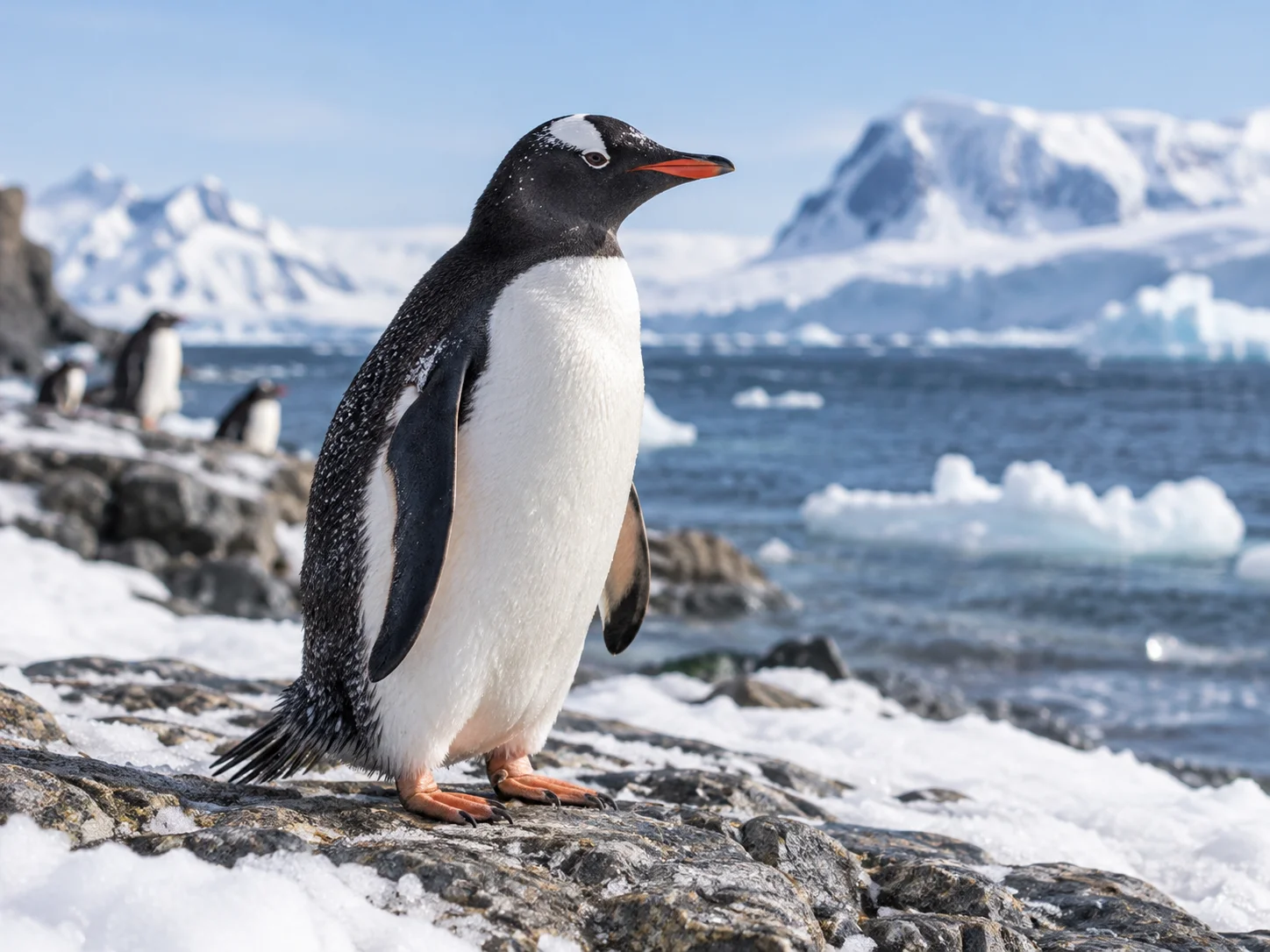
The ice-and-blizzard image comes from the emperor and the Adelie, the two true Antarctic species, which happen to be the ones the documentaries film.
Appearance and Anatomy
Penguins run from the little penguin at about 13 inches and 2.2 pounds to the emperor at 4 feet and up to 90 pounds.
Almost everything about the body is a trade: excellent in water, awkward on land.
- Solid bones. Most birds have hollow bones for flight. Penguins have dense ones, which help them sink rather than bob.
- Flipper wings. Stiff, flattened and unable to fold, driven by a powerful shoulder. A penguin flies through water.
- Feathers. Up to 100 per square inch, short, stiff and overlapping like roof tiles, oiled waterproof and trapping a layer of air underneath.
- Counter-shading. Black back, white belly. From above it blends with dark water, from below with bright sky, which works against predators and prey at once.
- Feet set far back. Good as rudders, which is exactly why penguins stand upright and waddle.
They also have a gland above the eyes that strips salt out of the blood and drips it out of the bill, so a penguin can drink seawater.
Habitat and Range
Penguins live on Antarctic ice, sub-Antarctic islands, rocky coasts, grassland, temperate beaches, desert shoreline and tropical lava fields.
What they all need is cold, productive water nearby. The African and Humboldt penguins live in hot places but fish in cold currents welling up from the deep, so the water, not the air, defines where a penguin can be.
They spend most of their lives at sea, coming ashore mainly to breed and molt, and some species stay in the water for months at a stretch.
Diet and Feeding
Penguins are carnivores, living on fish, squid and krill, with the mix depending on species and place.
They swallow prey whole and alive. A penguin’s tongue and the roof of its mouth are covered in backward-pointing spines, so a fish that goes in cannot come back out.
Their diving is extraordinary. An emperor penguin has been recorded at 1,850 feet deep and holding its breath for 27 minutes, on a single lungful, in the dark, under ice. It manages it by slowing its heart to a few beats a minute and letting its muscles run on stored oxygen while the blood is reserved for the brain.
Smaller species dive far less deeply but hunt constantly, and a little penguin may make hundreds of shallow dives in a day.
Behavior and Lifestyle
Penguins breed in colonies, some of them enormous: a chinstrap colony can hold hundreds of thousands of birds.
In that noise, parents and chicks find each other entirely by voice. An emperor chick can pick its own parent’s call out of a crowd of thousands, and the calls are individually distinctive in a way we can measure but not hear.
Emperors huddle to survive the winter, thousands pressed together, and the huddle moves. Birds on the cold outside edge shuffle inward in small waves that travel through the whole mass, so the warm positions rotate. It is not organized by anyone; it emerges from every bird doing the same selfish thing.
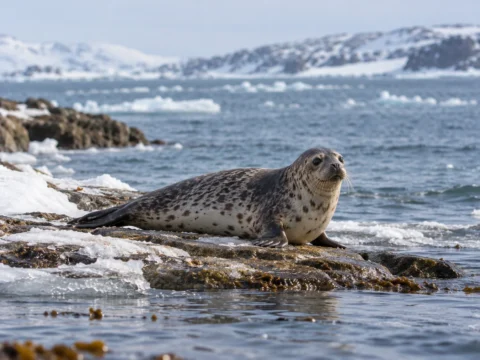
They also toboggan on their bellies to travel fast over ice, and a group will hesitate at the water’s edge for a long time before someone finally goes in, since leopard seals wait underneath.
Reproduction and Life Cycle
Most penguins are seasonally monogamous and return to the same nest site, and in some species to the same partner, year after year.
Most lay two eggs in a nest of stones, scraped earth or a burrow, and both parents take turns incubating while the other goes to sea to feed. Adelie penguins build nests of pebbles and steal them from each other constantly.
The emperor and the king penguin do it differently, with one egg and no nest at all, carried on the feet under a fold of skin.
For the emperor, the male takes the whole winter shift, fasting for roughly four months in total from courtship to the female’s return. She comes back with food just as the chick hatches, and he walks up to 60 miles to the sea to eat for the first time since fall.
Chicks gather in groups called crèches while both parents hunt. Penguins live around 15 to 20 years, with some reaching 30.
Predators and Threats
At sea, leopard seals, orcas, fur seals and sharks. On land, skuas, giant petrels and gulls take eggs and chicks, and introduced cats, rats, dogs and foxes do enormous damage to island species.
The human threats are the ones deciding their future: warming water that shifts where the fish are, loss of the sea ice emperors breed on, commercial krill and fishing fleets taking their food, oil spills, plastic, and disturbance at colonies.
The African penguin shows how fast this moves. There were well over a million breeding pairs a century ago. There are now a few thousand, and in 2024 it was reclassified as Critically Endangered.
Conservation Status
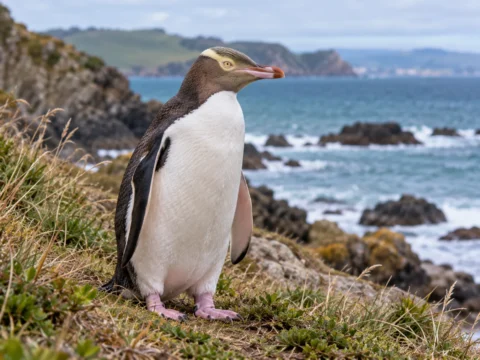
Of the 18 species, more than half are threatened. The yellow-eyed, Galapagos and African penguins are among the worst off, and the emperor was listed as threatened under the US Endangered Species Act in 2022 on the basis of projected sea ice loss.
The emperor’s problem is unusual and worth understanding. It needs stable fast ice that lasts long enough for a chick to fledge. In 2022, ice broke up early in part of the Bellingshausen Sea and several colonies lost almost every chick, drowned before they had waterproof feathers.
Satellite imagery has become the main tool here, since emperor colonies can be counted from space by the stain they leave on the ice, which is how a few previously unknown colonies were found.
Role in the Ecosystem
Penguins are the main link between krill and fish at one end of the Southern Ocean food web and seals and orcas at the other, and they eat a staggering amount: Antarctic penguins together take millions of tons of krill a year.
Their droppings fertilize the places they nest, and on some islands the whole plant and insect community runs on nutrients the penguins carried up from the sea. Penguin guano is visible from orbit.
Because they feed at sea and breed on land in countable colonies, they are one of the best monitors available for what is happening underwater. When penguin numbers drop, it is usually the fish that changed first.
And they are the clearest case of an animal that gave something up and gained something better. A penguin cannot fly, which looks like a loss until you watch one underwater, where it is doing exactly what its ancestors did in the air.