Comparison

Seal vs Sea Lion: How to Tell Them Apart

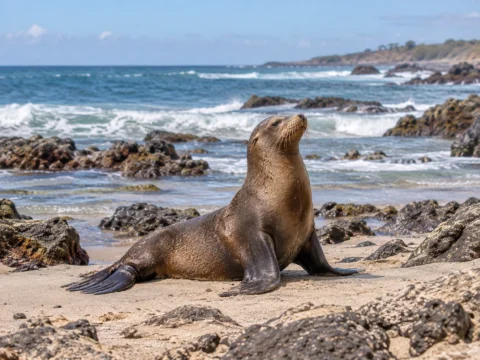
Look for ears. A sea lion has small visible ear flaps on the side of its head, walks on all four flippers with its chest off the ground, and barks loudly. A true seal has no ear flaps, only a small hole, and it cannot get its back flippers under its body, so it humps along on its belly and is generally quiet.

Side by side

Where they differ

Six things that actually tell them apart.

FeatureSealSea Lion
EarsNo flaps, just a small holeSmall visible ear flaps
Front flippersShort, furred, with clawsLong, bare and strong
On landWriggles on its bellyWalks on all four flippers
VoiceQuiet grunts and slapsLoud, carrying barks
Weight100 to 8,800 lb (45 to 4,000 kg) Heavier100 to 2,500 lb (45 to 1,100 kg)
LifespanUp to 40 years LongerUp to 30 years

Both are pinnipeds, both are carnivores that hunt fish and squid, both are superb divers, and both must come ashore to rest, to molt and to give birth.

Field guide

Which one am I looking at?

Match what you can see to the animal.

  • Small flaps of ear on the side of the headAnswer: Sea Lion
  • No ear flaps, only a holeAnswer: Seal
  • Walking on all four flippersAnswer: Sea Lion
  • Humping along on its bellyAnswer: Seal
  • Loud barking you can hear from the car parkAnswer: Sea Lion
  • Sitting up with its chest off the groundAnswer: Sea Lion
  • Short front flippers with visible clawsAnswer: Seal
  • Piled in a noisy heap on a jettyAnswer: Sea Lion
  • Lying quietly alone near the waterlineAnswer: Seal

Common mix-up

The animal balancing a ball in an old circus act is almost always a sea lion. A true seal cannot prop itself up on its front flippers, so it could never hold the pose.

Look at the Ears

This is the test biologists use, and it is why the two groups have the names they do. Sea lions and fur seals belong to the eared seals, the family Otariidae, and they have small external ear flaps you can see from a few feet away. True seals belong to Phocidae, the earless seals, and have nothing but a neat hole on each side of the head.

The flap is small, not much bigger than a thumbnail, so it helps to know you are looking for it. Once you do, it settles the question on any animal you can get a clear view of, and it works on a photograph just as well as in life.

How Each One Moves on Land

A sea lion can rotate its back flippers forward underneath its body and push itself up on long front flippers, so it walks, and it can move surprisingly fast across rock or sand. It can climb stairs, haul out onto a high jetty, and on a Californian pier it will shove its way through a crowd of its own kind without much ceremony.

A true seal cannot do any of that. Its back flippers point permanently backwards and are useless on land, and its front flippers are short and clawed. So a seal moves by flexing its whole body, a rolling caterpillar hump that looks awkward and is genuinely slow. Out of water a seal is nearly helpless, which is why they haul out on quiet beaches and ice.

The Noise Gives It Away

You will often hear a sea lion colony before you see it. Sea lions bark, constantly and loudly, and a crowded haul-out at a place like Pier 39 in San Francisco is audible for several streets. They are gregarious animals that pile on top of one another and argue about it.

True seals are comparatively quiet, producing grunts, snorts and the occasional slap of a flipper, and they tend to space themselves out rather than stack up. A beach of harbor seals is a row of separate animals, each one keeping a polite distance.

Underwater, the Roles Reverse

What a seal gives up on land it gets back in the water. True seals swim with powerful side-to-side sweeps of the back flippers, and they are the deeper, longer divers of the two. A Weddell seal can stay under for more than an hour, and an elephant seal routinely dives beyond 3,000 feet.

Sea lions swim with their long front flippers instead, rowing like a bird’s wingbeat, which makes them faster and far more agile in short bursts but less suited to the long deep dive. One is built to go down, the other to turn.

Walruses, and Where They Fit

There is a third branch, with exactly one living member. The walrus sits in its own family, Odobenidae, and borrows from both sides. It has no ear flaps, like a true seal, but it can rotate its back flippers forward and walk, like a sea lion.

Fur seals catch people out too. Despite the name they are eared seals, which puts them with the sea lions rather than the true seals. If it has ear flaps and walks, it is on the sea lion side of the family whatever its common name says.

Questions & Answers

What people ask

What is the easiest way to tell a seal from a sea lion?

Look for small ear flaps. Sea lions have them, true seals do not. If you cannot see the head clearly, watch it move on land: a sea lion walks on all four flippers, a seal wriggles on its belly.

Are fur seals seals or sea lions?

Sea lions, in effect. Fur seals belong to Otariidae, the eared seals, which is the sea lion family. The name is misleading.

Which is bigger, a seal or a sea lion?

The seal, at the top end. The southern elephant seal reaches around 8,800 pounds, far beyond the largest sea lion at roughly 2,500 pounds. Most seal species are much smaller than that.

Can seals walk on land?

Not properly. A true seal cannot bring its back flippers under its body, so it moves by humping along on its belly and is slow and vulnerable out of water.

Which dives deeper?

True seals. Elephant seals routinely dive beyond 3,000 feet and Weddell seals can stay under for over an hour. Sea lions are faster and more agile but make shorter, shallower dives.

Is a walrus a seal?

Not quite. The walrus is a pinniped like both, but sits in its own family. It has no ear flaps like a true seal yet walks on all fours like a sea lion.

Full Profiles

Meet each animal properly