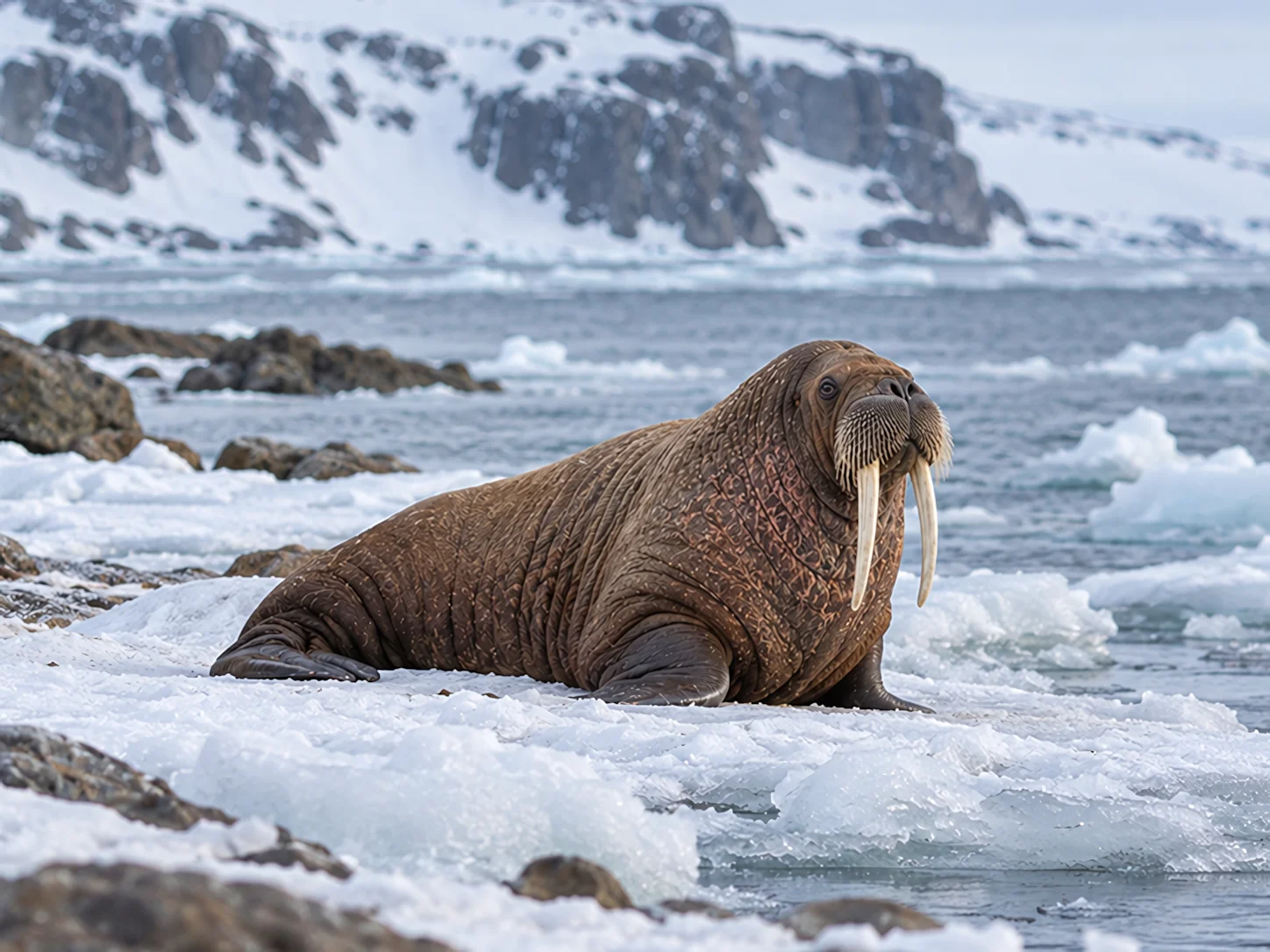
Meet the Walrus
A walrus does not hunt clams by looking for them. The water on the Arctic seafloor is dark and clouded with silt, and its eyes are nearly useless down there. The walrus (Odobenus rosmarus) is a huge tusked seal of the Arctic, feeding along the sea floor.
It uses its mustache. Those bristles are about 450 vibrissae, each with its own blood supply and nerve bundle, and they are sensitive enough to identify a shell by shape and size through mud.
The walrus sweeps its face across the bottom like a detector, finds a clam, and then sucks the animal straight out of its shell with a piston-like withdrawal of the tongue. It can do this hundreds of times in a single dive.
Scientific Name and Classification
The walrus is Odobenus rosmarus, which means tooth-walking sea horse, after its habit of hauling itself out of the water on its tusks. It is the only living species in its family.
- Kingdom: Animalia
- Phylum: Chordata
- Class: Mammalia
- Order: Carnivora
- Family: Odobenidae
- Species: Odobenus rosmarus
Walruses are pinnipeds, the group that also contains seals and sea lions, and the walrus sits between the two: it can turn its hind flippers forward and walk on all fours like a sea lion, but it swims mostly with its hind flippers like a true seal.
There are two subspecies, the Atlantic and the larger Pacific walrus, and a possibly distinct population in the Laptev Sea.
What Are the Tusks Actually For?
The tusks are canine teeth that keep growing, reaching 3 feet in a large male and weighing up to 12 pounds each. Both sexes have them.
They are not digging tools, which is the common assumption. A walrus finds its food with its whiskers and takes it with suction. What the tusks do is rather different:
- Status. Tusk size sets rank in a herd. The biggest tusks get the best spots and the least trouble, so most disputes are settled by display rather than fighting.
- Weapons. When display fails, males fight with them, and old bulls are heavily scarred.
- Ice picks. A walrus uses them to haul its enormous body out of the water onto ice, which is the behavior the scientific name records.
- Breathing holes. They can break through ice several inches thick from below to keep a hole open.
They also do something stranger. Male walruses inflate air sacs in the throat, which work as a flotation device so a bull can sleep upright in the water, and also as a resonator, letting him produce a bell-like gong underwater during the breeding season. Those songs can go on for hours.
Appearance and Anatomy
Males are 9 to 12 feet long and weigh 1,800 to 3,700 pounds (800 to 1,700 kg). Females are around two thirds of that. Only elephant seals are bigger among pinnipeds.
- Skin. Up to 2 inches thick, over 6 inches of blubber. Males grow heavy knobbly lumps on the neck and shoulders called bosses.
- Color change. In cold water, blood is pulled away from the skin and a walrus looks pale gray or almost white. Resting in the sun, the vessels open and it turns a startling pinkish brown.
- Whiskers. About 450 stiff vibrissae, each separately nerved.
- Eyes. Small and bulging, and they can protrude outward, which helps a short-necked animal see around itself.
Walrus calves are born with a short coat and lose it; adults are nearly naked, relying on blubber instead of fur.
Habitat and Range
Walruses live around the Arctic, in the shallow seas over the continental shelves of Russia, Alaska, Canada, Greenland and Svalbard.
What they need is a specific combination: shallow water, because they feed on the bottom and rarely dive past 300 feet, plus sea ice floating above that shallow water to rest on between dives.
That combination is exactly what is disappearing, and it explains the walrus’s particular vulnerability. Ice over deep ocean is no use to them, because they cannot reach the bottom there.
They are highly social, hauling out in herds, and in some places tens of thousands pack onto a single beach, lying in contact with each other.
Diet and Feeding
Walruses are carnivores that feed on the seafloor, and clams are the staple, along with worms, snails, crabs, shrimp, sea cucumbers and the occasional fish.
A single adult eats around 4,000 to 6,000 clams in one feeding session. It never opens a shell: it seals its lips around the exposed foot and pulls its tongue back like a piston, and the suction is strong enough to pull the animal out intact or to blast a buried clam loose with a jet of water.
Dives are short and shallow by marine mammal standards, usually a few minutes at 30 to 200 feet, repeated continuously.
A small number of individuals turn predator and take seals, and they tend to be large males, noticeably thin, with tusks and skin stained by seal fat. It appears to be a learned specialization rather than normal walrus behavior.
Behavior and Lifestyle
Walruses are among the most social of all marine mammals, and the physical contact is the point: lying piled together conserves heat and reduces the surface exposed to wind.
Herds are noisy. Walruses bark, grunt, roar, whistle and clack their teeth, and the underwater gonging of breeding males carries for miles.
They are easily panicked, and that matters more than it sounds. A disturbance at a crowded haul-out, from an aircraft, a boat or a predator, can set off a stampede in which calves are crushed. Several mass mortality events have happened this way.
They migrate with the ice, moving north as it retreats in summer and south as it advances in the fall, and most of the Pacific population passes through the Bering Strait twice a year.
Reproduction and Life Cycle
Walruses breed in winter, in the water, with males competing by singing and fighting beside the groups of females.
Gestation lasts 15 to 16 months, including a delayed implantation of several months, and a single calf is born on the ice in spring at about 100 to 150 pounds.
The mother’s investment is extraordinary. A calf nurses for up to two years and sometimes three, stays with her for three to five years, and rides on her back in the water. She will defend it fiercely, and other females often help.
A female raises a calf only every two to three years, and does not start until she is about seven. That slow rate is why walrus populations recover so sluggishly from any loss. Walruses live 20 to 30 years, occasionally 40.
Predators and Threats
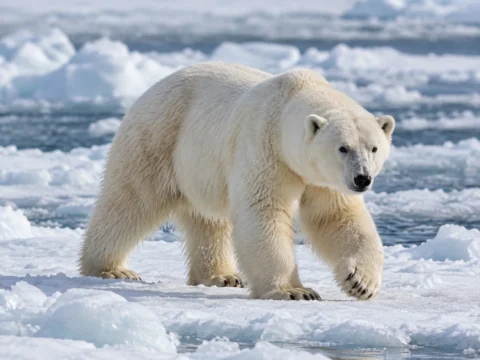
Polar bears and orcas are the only predators, and both go for calves or sick adults, because a healthy bull walrus with 3-foot tusks is dangerous. Polar bears often cause more deaths by triggering a stampede than by catching anything.
Commercial hunting for ivory, oil and hide nearly wiped out the Atlantic walrus and badly reduced the Pacific population, and hunting is now restricted mainly to indigenous Arctic communities, for whom the walrus remains a central food and material.
The current threat is the loss of sea ice over shallow water. Without ice to rest on between dives, walruses are forced to haul out on land, and that creates two problems: the crowds are vastly bigger and more dangerous, and the animals must swim much further from the beach to reach feeding grounds. Beaches in Alaska and Russia have held tens of thousands of walruses in recent years where there were once none.
Conservation Status
The walrus is listed as Vulnerable. The Pacific population is usually put at around 200,000 and the Atlantic at around 25,000, with wide uncertainty, because counting animals that move across ice in the Arctic is extremely difficult.
Satellite tagging and aerial survey work have improved the picture, and some of the most useful data has come from working with Chukchi and Inupiat hunters, whose observations go back generations.
The honest summary is that the walrus is not in immediate danger of extinction but is losing the habitat its whole feeding strategy depends on, and nothing about its biology lets it adapt quickly. A bottom-feeder that needs ice above shallow water has very little room to maneuver.
Role in the Ecosystem
Walruses are ecosystem engineers of the seafloor. Plowing their faces through the sediment in search of clams turns over huge areas of seabed, releasing nutrients and bringing buried animals within reach of other species, so a walrus feeding ground is richer than the ground around it.
They also move nutrients from the bottom to the surface, and their haul-outs fertilize coastal water.
For Arctic peoples the walrus has been food, ivory, rope, boat skin and lamp oil for thousands of years, and it remains central to Chukchi, Yupik and Inuit life.
And it is one of the clearest illustrations of how specific an animal’s needs can be. The walrus does not simply need the Arctic to be cold. It needs ice and shallow water in the same place, which is a far narrower requirement, and the kind of detail that decides whether a species survives a changing climate.