Meet the Seahorse
In seahorses, the male gets pregnant.
This is not a loose way of saying he guards the eggs. The female deposits eggs into a pouch on his belly, the pouch seals, and tissue inside it grows around the embryos, supplying them with oxygen and nutrients and regulating the fluid they sit in. Weeks later he goes into labor and pushes out live young.
No other animal does it this way. Seahorses are the only group in which the male carries a true pregnancy.
Scientific Name and Classification
Seahorses form the genus Hippocampus, with around 45 species, so there is no single two-word name. The name comes from the Greek for horse and sea monster.
- Kingdom: Animalia
- Phylum: Chordata
- Class: Actinopterygii (ray-finned fish)
- Order: Syngnathiformes
- Family: Syngnathidae
- Genus: Hippocampus
Seahorses are genuinely fish, which surprises people. They have gills, a swim bladder and fins, and they are related to pipefish and seadragons.
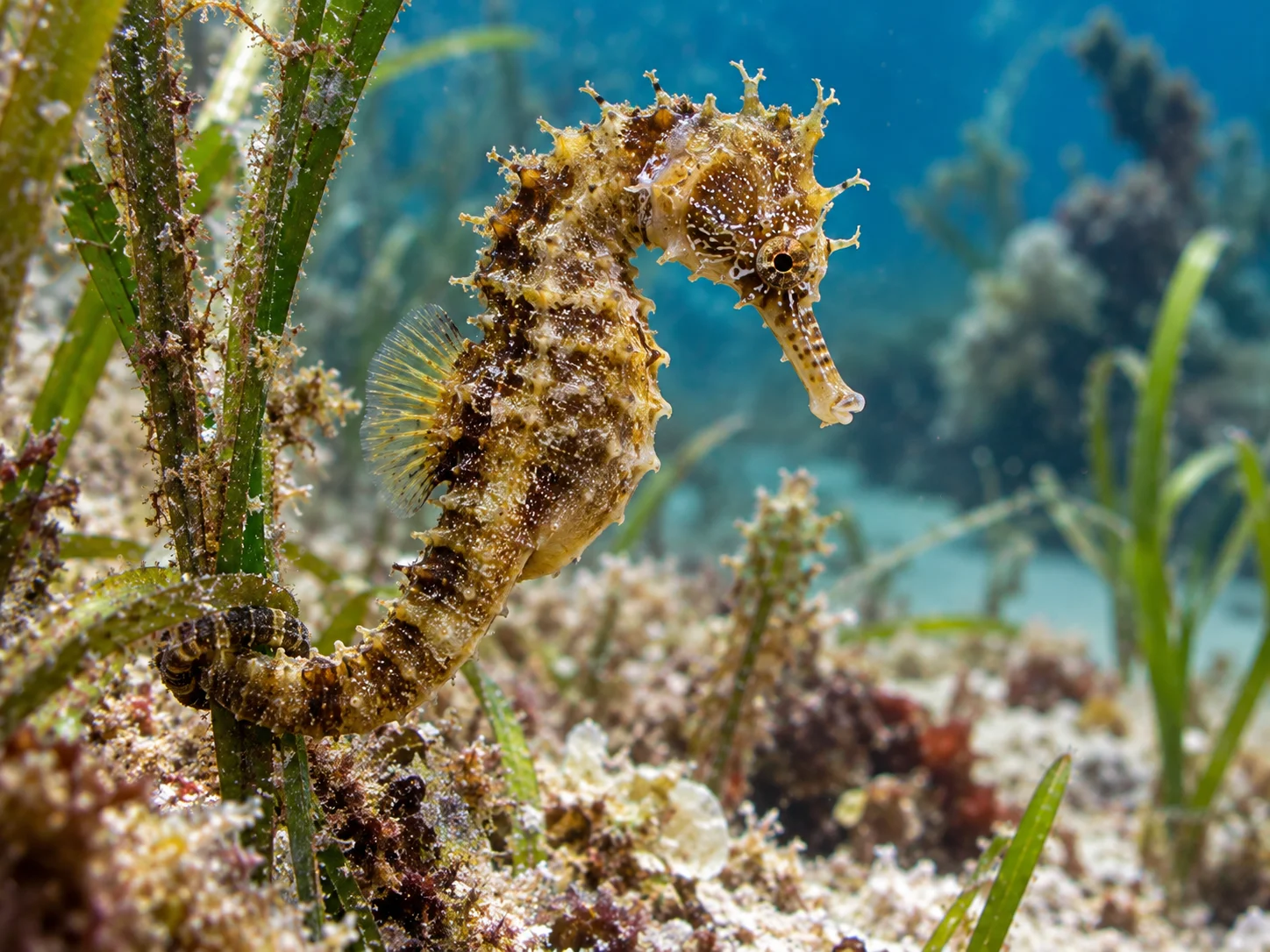
They are very strange fish, though. A seahorse swims upright, has no scales, has a neck, and has a prehensile tail, none of which is normal for a fish.
Do Male Seahorses Really Give Birth?
Yes, properly, and the biology is more thorough than most people expect.
The female produces the eggs and transfers them into the male’s brood pouch, so she supplies the eggs and he supplies everything after that.
The pouch then does the work of a womb. Its lining becomes rich in blood vessels and grows around the embryos, delivering oxygen and nutrients and removing waste. The male adjusts the salinity of the fluid inside, gradually shifting it toward seawater so the young are ready for the ocean when they emerge. He even produces a hormone involved in mammal pregnancy.
After two to four weeks, depending on species and temperature, he goes into muscular contractions and expels the young, sometimes hundreds of them, over minutes or hours. It visibly costs him effort.
Why evolution arranged it this way is still debated. The leading idea is efficiency: while the male carries one brood, the female is already producing the next batch of eggs, so the pair can turn broods around faster than if she carried them.
Appearance and Anatomy
Seahorses range from Satomi’s pygmy seahorse at well under an inch to the big-belly seahorse at around 14 inches. They weigh only a few grams; even the largest is a fraction of an ounce.
- No scales. Instead, bony plates covered in thin skin, forming a kind of armor. A seahorse is surprisingly hard to crush.
- Prehensile tail. Square in cross-section rather than round, which grips better and resists crushing. Seahorses anchor to seagrass and coral with it and sleep holding on.
- Eyes. Move independently, like a chameleon’s, so one can watch for food while the other watches for danger.
- Snout. A long tube used as a straw. It cannot chew.
- No stomach. Food passes through the gut so quickly that a seahorse must eat almost constantly.
- Fins. A small dorsal fin beating up to 35 times a second, and tiny pectoral fins behind the head for steering.
Many can change color to match their surroundings, and the pygmy seahorses that live on sea fans match their host so precisely that they were only discovered when the coral was examined in a laboratory.
Habitat and Range
Seahorses live in shallow tropical and temperate seas worldwide, in seagrass meadows, coral reefs, mangrove roots and estuaries.
They need something to hold on to, which is the single most important thing about their habitat. A seahorse is a poor swimmer and relies on anchoring itself rather than fighting a current.
That makes them completely dependent on habitats that are disappearing fast. Seagrass meadows and mangroves are being lost worldwide, and a seahorse in open water with nothing to grip is in serious trouble.
Most stay within a very small home range, sometimes only a few square yards for life.
Diet and Feeding
Seahorses are carnivores, eating tiny crustaceans, especially copepods and mysid shrimp, plus fish larvae and plankton.
Having no stomach means food is barely stored at all, so a seahorse eats 30 to 50 times a day and an adult may get through thousands of tiny animals daily.
Its hunting technique is exceptional, and it has to be. Copepods are among the most alert prey in the ocean, able to detect water movement and jump away in milliseconds.
The seahorse solves this with the shape of its head. The long snout and curved head create almost no disturbance in the water as it approaches, so the copepod does not sense it coming. The seahorse eases within striking range and then sucks it in. Researchers studying this call it hydrodynamic stealth, and the seahorse catches its prey the great majority of the time, which for a fish that can barely swim is remarkable.
Behavior and Lifestyle
Seahorses are famously bad swimmers. The dwarf seahorse holds the record as the slowest fish in the sea, moving at around 5 feet per hour.
They do not need speed, because they do not chase anything and they hide rather than flee.
Many species are monogamous, at least for a breeding season and in some cases for life. Pairs perform a greeting ritual each morning, swimming together, changing color, and sometimes linking tails and spiralling around a strand of seagrass. It lasts several minutes and appears to maintain the bond and keep their breeding cycles in step.
They are territorial in a modest way: males hold a small patch, females range a little wider.
They make small clicking and growling sounds, produced by grinding bones in the skull, used during courtship and feeding.
Reproduction and Life Cycle
Courtship takes days, with the pair dancing together repeatedly before the female transfers her eggs.
Broods range from a handful in pygmy species to over 1,000 in the largest.
Then comes the hard truth about seahorses. The young are released fully formed and completely independent, with no parental care at all, and almost all of them die. Survival to adulthood is estimated at well under one percent, which is why a male carries hundreds at a time.
Often the pair mate again within hours of the birth, and the male is pregnant once more.
Seahorses live 1 to 5 years, with the larger species at the top of that range.
Predators and Threats
Crabs, rays, tuna, skates and penguins eat seahorses, and the bony armor helps less than it sounds. Camouflage is their real defense.
Human pressures are heavy. Tens of millions of seahorses are taken each year for traditional medicine, mostly dried, and large numbers more are caught as bycatch in trawl nets dragged across seagrass beds, which destroys the habitat and the animals in one pass.
They are also sold dried as curios and souvenirs, and collected live for aquariums, where they are difficult to keep and most die.
Habitat loss is the quiet one that matters most: without seagrass, mangroves or coral to hold, there is nowhere for a seahorse to live.
Conservation Status
There is no single status across around 45 species, and a large share are listed as Vulnerable or Data Deficient, meaning nobody knows enough to judge.
All seahorses are listed under CITES, the international wildlife trade convention, which regulates exports. Enforcement is difficult, because dried seahorses are small, easily hidden and traded in enormous volume.
Their biology makes them harder to protect than most fish: small home ranges, low mobility, monogamous pairs and few surviving young mean a local population wiped out does not simply refill from next door. And removing one of a pair can stop the other breeding at all.
What helps most is protecting seagrass meadows and banning trawling over them, which protects every species living there rather than just one.
Role in the Ecosystem
Seahorses are predators of tiny crustaceans, and because they eat so constantly they shift a real quantity of small animals through the seagrass food web.
They are prey too, and part of the chain that connects plankton to larger fish and birds.
Their most useful role, though, is as a flagship. Seagrass meadows are among the most valuable habitats on the planet, storing carbon, sheltering young fish and protecting coastlines, and almost nobody campaigns to save a meadow of grass. A seahorse gives them a face. Protecting seahorse habitat has become one of the most effective arguments for protecting seagrass itself.
They have also taught biologists a great deal about pregnancy, because the seahorse evolved it separately from mammals and arrived at many of the same solutions.