Meet the Sea Lion
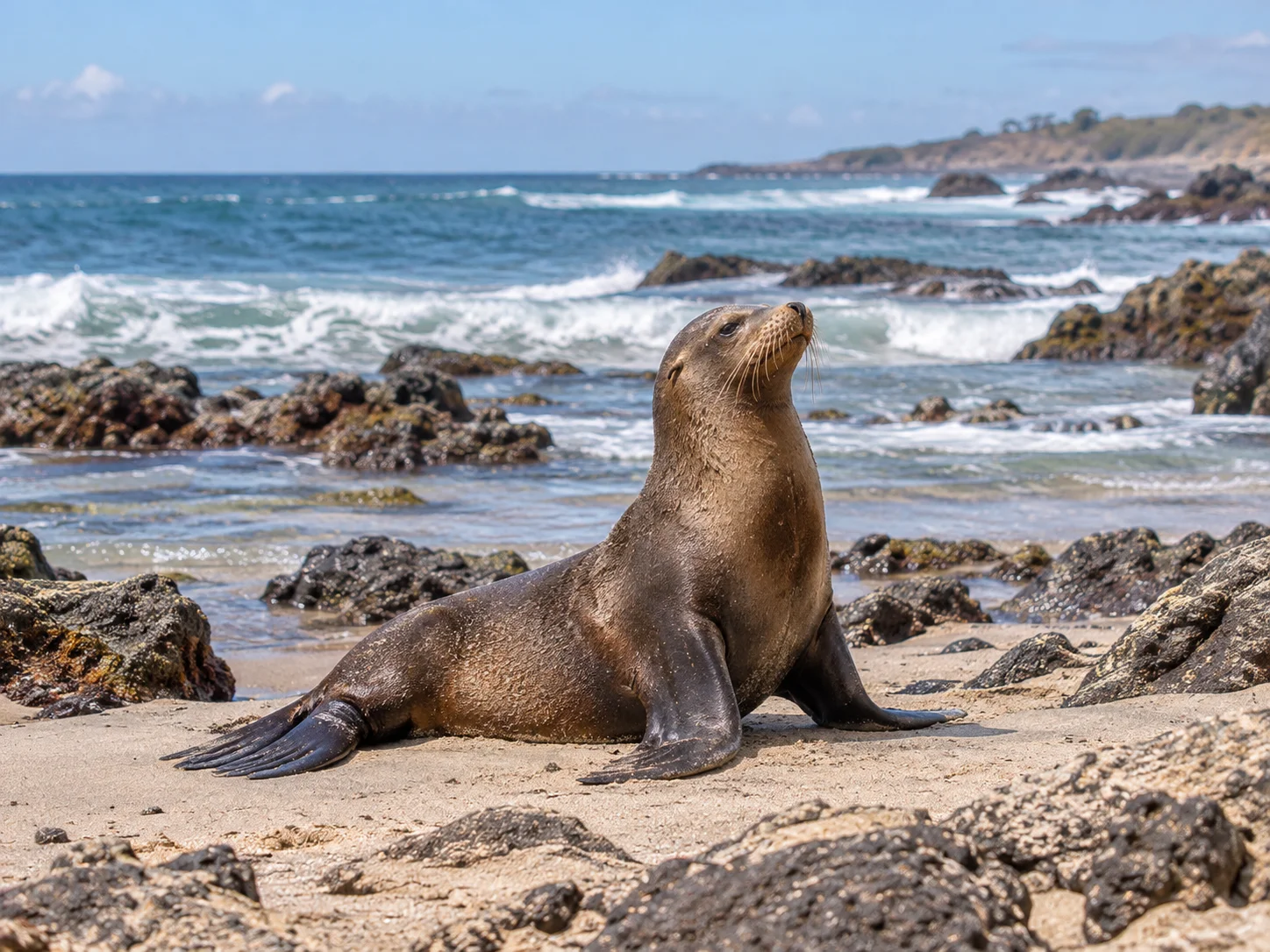
A sea lion can walk. Not waddle on its belly like a seal, but properly walk, turning its back flippers forward and moving on all fours. That single difference separates sea lions from true seals, and it is why sea lions are the ones balancing balls in old circus posters.
They are also exceptionally clever. Sea lions have been trained by navies, and one named Rio learned logical reasoning that scientists had thought was limited to primates.
And they can sleep with half a brain, keeping one eye open while floating offshore.
Scientific Name and Classification
Sea lions form the subfamily Otariinae, with six living species, so there is no single two-word name.
- Kingdom: Animalia
- Phylum: Chordata
- Class: Mammalia
- Order: Carnivora
- Family: Otariidae (eared seals)
- Subfamily: Otariinae
The family name is the key. Otariidae means “eared seals”, and it holds both the sea lions and the fur seals. True seals belong to a separate family, Phocidae.
The six species are the California, Steller, South American, Australian, New Zealand and Galapagos sea lions. A seventh, the Japanese sea lion, was hunted to extinction in the 1970s.
Appearance and Anatomy
Sea lions range from the Galapagos species at around 100 pounds to the Steller sea lion, where a bull reaches 11 feet and 2,500 pounds. Males are far larger than females in every species.
- Front flippers. Long and powerful, used both for swimming and for walking, and strong enough to lift the whole body upright.
- Back flippers. Rotate forward underneath the body, which is the anatomical trick that lets them walk.
- Ear flaps. Small, external, and the easiest identification mark.
- Whiskers. Extremely sensitive, detecting the trail of disturbed water a fish leaves behind, which lets a sea lion hunt in darkness or murk.
- Mane. Adult males of several species grow a thick neck mane, which is where the name comes from.
They are fast, reaching about 25 miles an hour, and can dive several hundred feet.
Habitat and Range
Sea lions live along coasts of the Pacific and the southern oceans: western North America, South America, Australia, New Zealand and the Galapagos.
There are none in the North Atlantic, which is a notable gap.
They need rocky shores, beaches or islands to haul out on, and productive water nearby. They are coastal animals and rarely stray far out to sea.
California sea lions have adapted enthusiastically to people, taking over docks, jetties, navigation buoys and marina pontoons, to the frequent annoyance of boat owners.
Diet and Feeding
Sea lions are carnivores, eating fish, squid, octopus, crabs and clams.
They hunt by sight in clear water and by whisker in murky water, following the invisible trail of turbulence a swimming fish leaves behind. Those whiskers are sensitive enough to tell the size and shape of what made the trail.
They swallow fish whole, head first, and their teeth are for gripping rather than chewing.
Some hunt cooperatively, herding shoals of fish into tight balls against the surface, and they will follow fishing boats for an easy meal.
Behavior and Lifestyle
Sea lions are intensely social and pile together on shore in heaps, often lying on top of one another.
They are loud. Colonies bark constantly, and mothers and pups find each other in a crowd of hundreds by voice alone.
Their intelligence is well documented. A California sea lion called Rio was taught that if A matches B and B matches C, then A matches C, a form of reasoning previously demonstrated mainly in primates, and she retained it for years.
One sea lion has also been shown to keep time to a musical beat, which is rare outside humans and parrots.
Like ducks, they can rest one half of the brain at a time while floating at sea, with the matching eye open.
Reproduction and Life Cycle
Bulls arrive at breeding beaches first and claim territory, then defend it against rivals by roaring, posturing and occasionally fighting hard.
Pregnancy lasts about 11 months and produces a single pup.
Mothers nurse for a few days, then begin alternating: several days at sea feeding, then back to shore to feed the pup. She calls on arrival and her pup answers, and the two recognize each other’s voices immediately among hundreds of near-identical animals.
Pups nurse for six months to a year, sometimes longer. Sea lions live 20 to 30 years, with females generally outliving males.
Predators and Threats
Great white sharks and orcas are the main predators, and both concentrate around sea lion colonies.
Human pressures include entanglement in fishing gear and plastic, which is a common cause of injury and slow death, plus collisions with boats and conflict with fisheries.
Toxic algal blooms are an increasing problem. Blooms produce a neurotoxin that accumulates in fish, and sea lions that eat them suffer seizures and brain damage. Hundreds strand on Californian beaches in bad years.
Warming ocean water also moves fish away from colonies, leaving mothers unable to find food within range of their pups.
Conservation Status
Statuses differ sharply between the six species.
The California sea lion is abundant and increasing, having recovered strongly under legal protection.
Others are in trouble. The Galapagos sea lion and the Australian sea lion are both Endangered, with small populations and very slow breeding, and the New Zealand sea lion is also at risk. Steller sea lions declined sharply in parts of Alaska for reasons still debated.
The Japanese sea lion is the warning. It was common enough to be hunted commercially, and it was gone by the 1970s.
Role in the Ecosystem
Sea lions are significant predators of fish and squid, helping keep those populations in balance along productive coastlines.
They are also prey, supporting white sharks and orcas, and their colonies feed gulls and scavengers.
Their droppings fertilize coastal waters, adding nutrients that feed the plankton at the base of the whole system.
Because they feed near the top of the food chain and live close to shore, sea lions concentrate whatever is in the water. That makes them a useful warning system: the algal blooms poisoning sea lions in California are measuring a change in the ocean that is harder to see any other way.