Meet the Duck
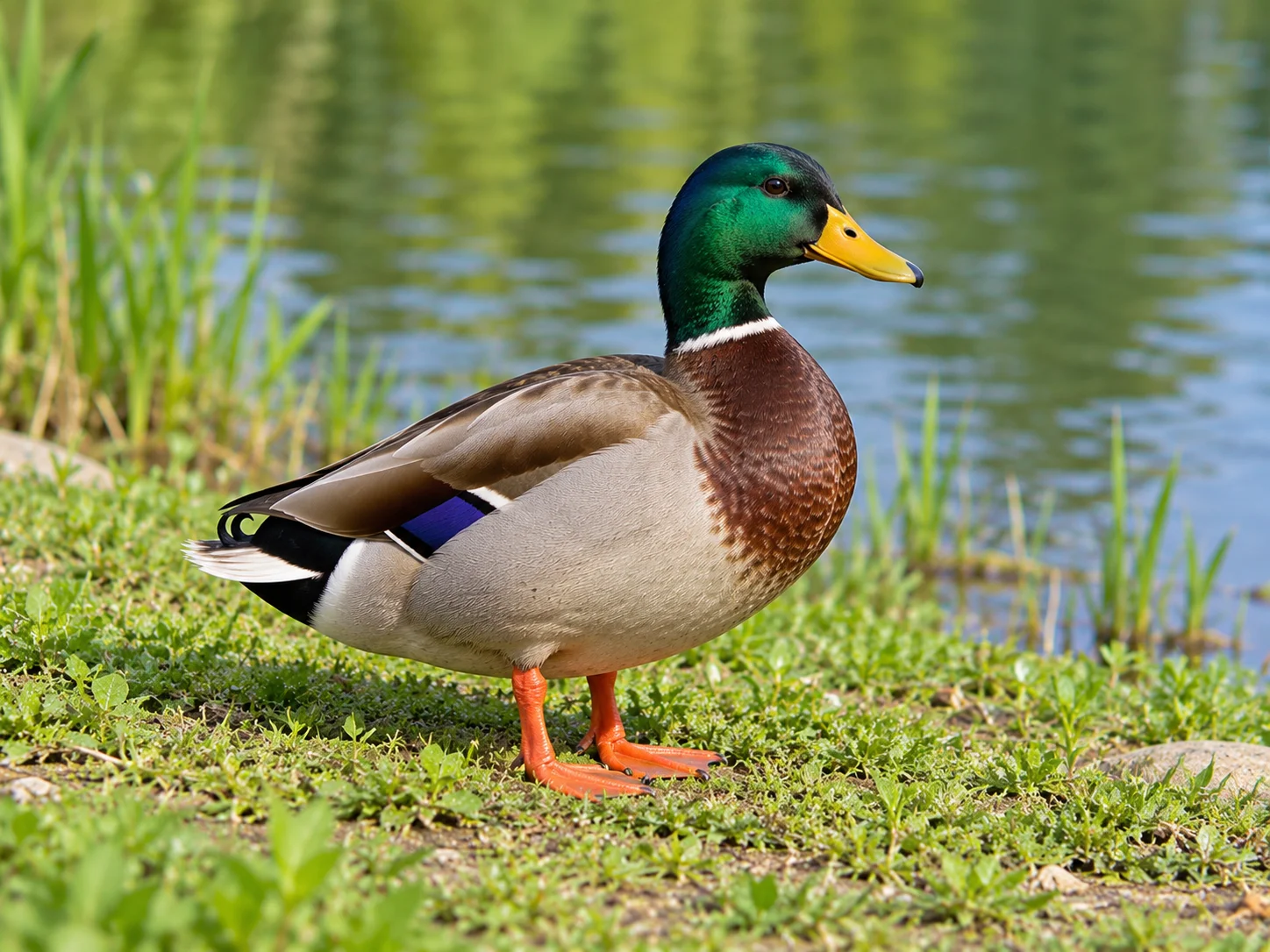
A duck can put half its brain to sleep and keep the other half awake. Ducks sleeping in a row do exactly this: the ones on the ends keep one eye open, watching outward, while the birds in the middle sleep properly. Ducks are waterbirds of the family Anatidae, around 120 species, including the mallard (Anas platyrhynchos) that most farmyard ducks descend from.
They also feel nothing in their feet. A duck stands on ice all day because its feet have almost no nerves and almost no blood flow, and warm blood going down is cooled by cold blood coming back up.
There are around 120 species of duck, on every continent except Antarctica.
Scientific Name and Classification
“Duck” covers many genera in the family Anatidae, so there is no single two-word name. The mallard, Anas platyrhynchos, is the most familiar and the ancestor of nearly every domestic duck.
- Kingdom: Animalia
- Phylum: Chordata
- Class: Aves
- Order: Anseriformes
- Family: Anatidae
The family also holds geese and swans. Ducks are generally the smaller, shorter-necked members, but it is a loose grouping rather than a precise one.
Ducks divide roughly into dabblers, which tip up to feed at the surface, and divers, which go fully under.
Why Don’t Ducks Get Cold or Wet?
Two separate pieces of engineering, both worth knowing.
Staying dry. A duck has a gland near its tail that produces oil, and it spends a long time each day spreading that oil through its feathers with its beak. The feathers themselves interlock with microscopic hooks into a surface water cannot penetrate. Underneath is a layer of down that stays completely dry.
Standing on ice. This is the clever one. A duck’s feet have very few nerves and blood vessels, so there is little to feel the cold with. More importantly, the arteries carrying warm blood down run right alongside the veins bringing cold blood back, and heat passes from one to the other. The blood reaching the foot is already cool, so the duck loses almost no body heat through it.
The system is called countercurrent heat exchange, and a duck’s feet sit just above freezing while its body stays warm.
Appearance and Anatomy
Ducks measure 12 to 26 inches and weigh 1.5 to 7 pounds depending on species, with some domestic breeds heavier.
- Bill. Broad and flat, with comb-like plates called lamellae along the edges that strain food out of water, the same principle a flamingo uses.
- Feet. Webbed, working as paddles, and set well back on the body, which is why ducks waddle on land.
- Feathers. Waterproofed with oil, over a layer of down for insulation.
- Eyes. On the sides of the head, giving close to 340-degree vision without moving.
- Plumage. Males of many species are brightly colored and females drab, since she must sit camouflaged on a nest for weeks.
Once a year ducks molt all their flight feathers at once and cannot fly for several weeks. Males often lose their bright colors at the same time, turning drab in what is called eclipse plumage, which is sensible for a bird that cannot escape.
Habitat and Range
Ducks live on every continent except Antarctica, on ponds, lakes, rivers, marshes, estuaries and coasts.
Many are long-distance migrants, following traditional routes between northern breeding grounds and warmer wintering waters, sometimes thousands of miles.
Some are remarkably specialized. Harlequin ducks live in fast whitewater rivers and break bones regularly doing it. Torrent ducks in the Andes swim against rapids that would sweep a person away.
Diet and Feeding
Ducks are omnivores, eating water plants, seeds, grass, insects, worms, snails, small fish and crustaceans.
Dabbling ducks tip forward, tail in the air, to reach plants just below the surface. Diving ducks go fully under and swim down, some to considerable depth.
They have no teeth. The lamellae along the bill strain food from water, and a muscular gizzard grinds it up with the help of swallowed grit.
One important point for anyone with a pond nearby: do not feed ducks bread. It fills them without nourishing them, causes wing deformities in growing ducklings, and rots in the water, fouling it and spreading disease. Oats, sweetcorn, peas, lettuce and birdseed are all far better.
Behavior and Lifestyle
Ducks are social and gather in flocks, often of mixed species.
They sleep with half the brain at a time, and arrange themselves accordingly. In a row of sleeping ducks, the birds at each end keep the outward eye open and that half of the brain awake, while the ones in the middle shut down completely. They swap positions so everyone gets a turn.
Quacking is mostly female. The classic loud quack is the female mallard; males make a quieter, raspier sound. The old claim that a duck’s quack does not echo is simply false, and has been tested.
Ducklings imprint, following the first moving thing they see after hatching and treating it as their mother. It usually is.
Reproduction and Life Cycle
Females build a nest on the ground, among reeds or occasionally in a tree hollow, lined with down plucked from their own breast.
Clutches run to about 8 to 13 eggs, incubated for roughly 28 days by the female alone. Most males leave entirely.
Ducklings hatch covered in down with their eyes open, and leave the nest within a day. They can swim almost immediately but cannot fly for about two months.
Wood ducks nest in tree holes high above the ground, and the ducklings jump. A day-old duckling leaps from up to 50 feet, bounces, and walks away unhurt, because it is small, light and well padded with down.
Ducks live 5 to 10 years in the wild and longer in captivity.
Predators and Threats
Foxes, raccoons, mink, eagles, hawks, owls, large fish, turtles and crocodiles all take ducks or ducklings. Very few ducklings in a brood survive to adulthood.
The molting period, when they cannot fly, is the most dangerous few weeks of a duck’s year.
Human pressures are wetland drainage, pollution, lead shot left in the water, hunting, and avian influenza, which has hit wild waterfowl hard in recent years.
Conservation Status
There is no single status across around 120 species.
Mallards and other common ducks are abundant, and mallards have spread worldwide, in some places interbreeding with local species and diluting them.
Others are in serious trouble. The Madagascar pochard was thought extinct for 15 years before a handful were rediscovered in 2006, and the Laysan duck survives on a few Pacific islands.
Wetland conservation is the key for all of them, and wildfowl reserves, often originally set up by hunters, have protected a great deal of habitat.
Role in the Ecosystem
Ducks move plants and animals between waters in a way few creatures can. Seeds, and even the eggs of fish and invertebrates, survive passing through a duck’s gut, and a duck that feeds in one pond and flies to another carries life with it. Isolated ponds get stocked largely this way.
They control insects, including mosquito larvae, and their grazing shapes which water plants dominate.
They are also an important food source for predators, and in rice-growing regions ducks are deliberately released into paddies to eat pests and weeds while fertilizing the crop.
For a great many people, a duck on a local pond is the first wild bird they ever watch closely, which is worth something on its own.