Meet the Salamander
Cut off a salamander’s leg and it grows a new one. Not a stump, not a scar: a complete leg, with the right bones, muscles, nerves and skin, in the right places. Salamanders are an order of tailed amphibians, the Caudata, with around 800 species in damp places across the northern hemisphere and South America.
It can do the same for a tail, parts of its eye, sections of its heart and even portions of its spinal cord, and it can do it over and over again.
No mammal comes close. This is why laboratories around the world keep salamanders, and why one of them, the axolotl, may be the most studied amphibian on Earth.
Scientific Name and Classification
Salamanders form the order Caudata, with around 800 species, so there is no single two-word name. The name means “tailed”, which is what separates them from frogs.
- Kingdom: Animalia
- Phylum: Chordata
- Class: Amphibia
- Order: Caudata
Newts are salamanders. They are not a separate group, just the members of one family that spend more of their lives in water.
Salamanders are one of the three amphibian orders, alongside frogs and the almost unknown caecilians.
Can Salamanders Really Regrow Limbs?
Yes, properly and repeatedly, and how they do it is one of the real open questions in biology.
When a salamander loses a limb, the cells near the wound do something our cells cannot. They revert to a flexible, unspecialised state, forming a mass called a blastema at the stump. That blastema then rebuilds the limb from scratch, in the correct order, somehow knowing how much leg is missing and where the toes go.
A mammal in the same situation forms scar tissue and stops. Scarring seals a wound quickly, which is good for surviving an injury, and it appears to be incompatible with regrowing the part. Salamanders barely scar at all.
The list of what they can rebuild is startling: limbs, tail, jaws, parts of the eye including the lens and retina, sections of heart muscle, and parts of the spinal cord. A salamander with a severed spinal cord can recover the use of its tail.
Medical researchers study this closely. We carry many of the same genes; the question is why ours do not switch on this way, and whether they could.
Types of Salamander and Their Characteristics
| Salamander | Size | Notable for |
|---|---|---|
| Chinese giant salamander | Up to 6 ft | The largest amphibian alive; Critically Endangered |
| Axolotl | About 9 in | Stays a larva for life; champion regenerator |
| Olm | About 12 in | Blind cave dweller; may live 100 years |
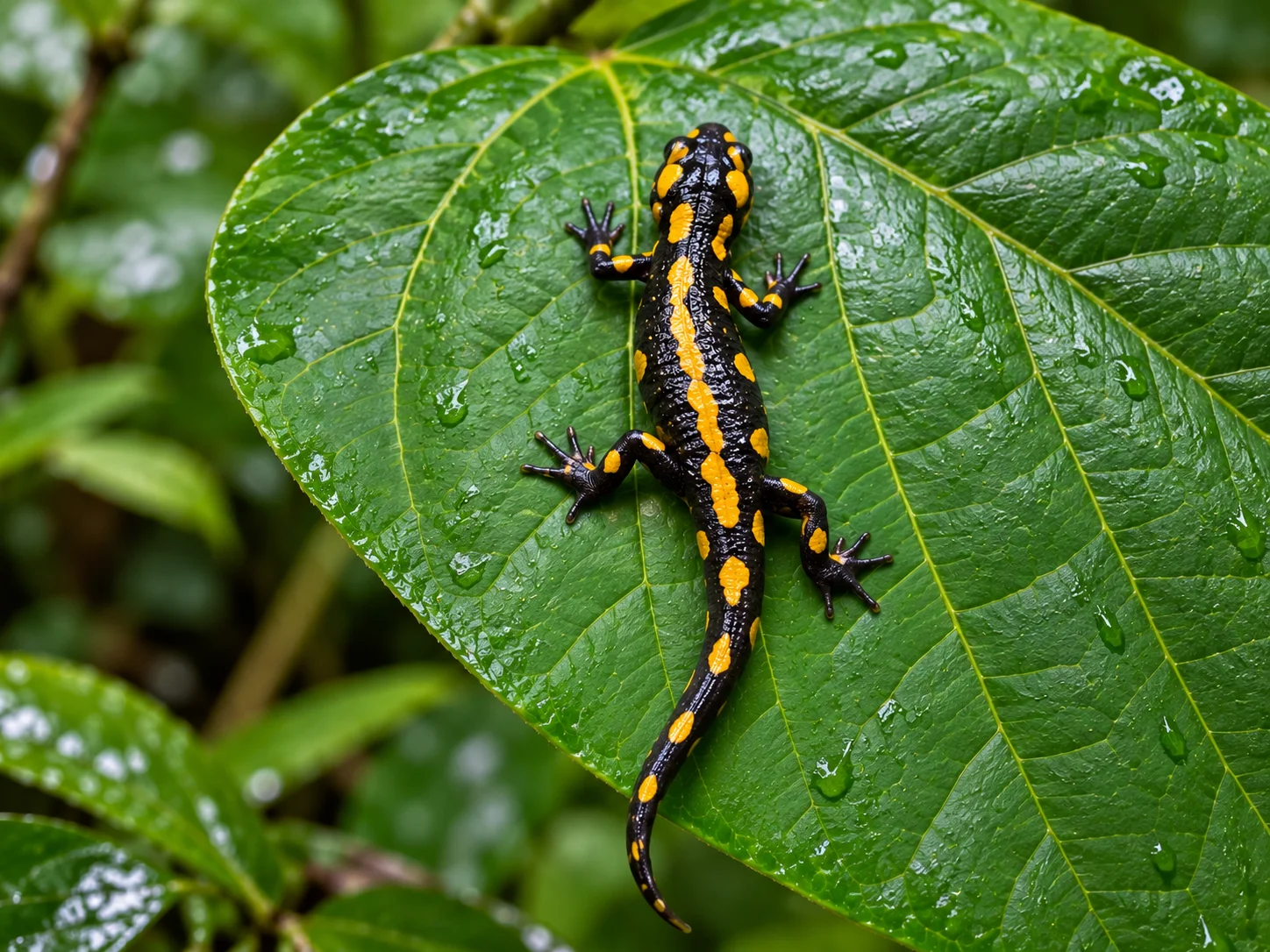
| Fire salamander | 8-12 in | Black and yellow warning colors; toxic skin |
| Hellbender | Up to 2.5 ft | North America’s giant; breathes through skin folds |
| Lungless salamanders | 2-8 in | No lungs at all; the largest salamander family |
The axolotl is unusual twice over. It never grows up, keeping its feathery external gills and staying aquatic for life, a condition called neoteny. And while it is everywhere in laboratories and aquariums, it is Critically Endangered in the wild, surviving in a few canals near Mexico City.
Appearance and Anatomy
Salamanders range from under an inch to the Chinese giant salamander at nearly 6 feet and over 100 pounds.
- Skin. Moist, permeable and glandular. Most salamanders absorb oxygen straight through it, and the lungless family does all its breathing this way.
- Tail. Always present, used for swimming, balance, fat storage and in some species shed to distract a predator.
- Legs. Four short limbs in most species, though a few have tiny or absent hind legs.
- Toxins. Many have poison glands. The rough-skinned newt carries a toxin powerful enough to kill most animals that swallow it.
- Color. Often bright in toxic species, as a warning, and well camouflaged in the rest.
Some can also produce a glue-like secretion that sets hard in seconds and gums up a predator’s jaws.
Habitat and Range
Salamanders live mainly in the temperate northern hemisphere: North America, Europe and Asia, with some reaching Central and South America.
There are none in Australia and almost none in Africa south of the Mediterranean fringe, which is an unusual distribution for a successful group.
The Appalachian Mountains of the eastern United States are the world capital of salamanders, holding more species than anywhere else on Earth.
They need damp: streams, springs, leaf litter, rotting logs, caves and ponds. A salamander that dries out cannot breathe.
Diet and Feeding
Salamanders are carnivores, eating insects, worms, slugs, snails, spiders, small crustaceans and, in the larger species, fish, crayfish and smaller amphibians.
Many have projectile tongues. Some lungless salamanders can fire a tongue out faster than the eye can follow, using stored elastic energy rather than muscle power, and in a few the tongue shoots out more than half the animal’s body length.
They are patient ambush hunters, and being cold-blooded they need very little food. Some can go months without eating.
Giant salamanders feed by suction, opening the mouth fast to pull in water and whatever is in it.
Behavior and Lifestyle
Most salamanders are nocturnal and secretive, spending the day under logs, stones and leaf litter.
They are far more numerous than anyone notices. In some eastern American forests, the combined weight of salamanders in the leaf litter exceeds that of all the birds and mammals in the same woodland put together. The forest is full of them and they are almost never seen.
Many migrate on the first warm wet nights of spring, walking in numbers to the pond where they breed. Roads crossing those routes kill enormous numbers, which is why some towns close streets for a few nights a year or build tunnels under them.
Defenses are chemical rather than physical: toxic skin, bright warning colors, playing dead, glue secretions and a shed tail.
Reproduction and Life Cycle
Most salamanders lay eggs in water, and the larva that hatches has feathery external gills and swims, gradually growing legs and absorbing the gills to become a land animal.
Unlike frogs, the change is gradual rather than a dramatic rebuild. A salamander larva already looks like a salamander.
Some skip water entirely. Lungless salamanders lay eggs in damp soil or rotting wood, and the young hatch as miniature adults with no aquatic stage at all. A few give birth to live young.
And some never leave the larval stage, like the axolotl and the olm, breeding while still looking like juveniles.
Lifespans are long for small animals: 3 to 20 years commonly, Chinese giant salamanders over 50, and olms possibly approaching 100.
Predators and Threats
Snakes, birds, fish, raccoons, shrews and larger salamanders all eat them, and introduced fish wipe out larvae in ponds that previously had none.
Human pressures are habitat loss, stream pollution and sedimentation, road mortality on breeding migrations, and collection for the pet trade. Giant salamanders in China have been hunted heavily for food.
The newest danger is a fungus. Batrachochytrium salamandrivorans, a close relative of the chytrid fungus that devastated frogs, attacks salamander skin and kills quickly. It has already caused severe declines in European fire salamanders, and because North America holds the world’s greatest salamander diversity, keeping the fungus out of it is treated as urgent.
Conservation Status
There is no single status across around 800 species, and the overall picture is poor. Amphibians are the most threatened vertebrate group on Earth, and salamanders are no exception.
The Chinese giant salamander is Critically Endangered, hunted for food and now barely present in the wild despite being farmed in huge numbers.
The axolotl is the strangest case in conservation: millions exist in tanks and laboratories worldwide, while the wild population near Mexico City has collapsed to perhaps a few dozen animals. A species can be simultaneously everywhere and nearly gone.
Many lungless salamanders live on single mountains or in single valleys, which means a species can be wiped out by one event.
Role in the Ecosystem
Because there are so many of them, salamanders move a surprising amount of energy through a forest. They eat vast numbers of leaf-litter invertebrates and are eaten by birds, snakes and mammals in turn.
Research has found they affect how fast a forest floor decays. By eating the invertebrates that shred fallen leaves, salamanders slow the breakdown of litter, which keeps more carbon in the forest floor rather than releasing it. A small animal with a measurable effect on carbon.
In streams they control insect larvae and are sensitive to pollution, so their presence is a reliable sign of clean water.
Their scientific value is in a class of its own. What salamanders can do with a lost limb is the closest thing in nature to the regeneration medicine would like to achieve, and most of what is known about how regeneration works at all has been learned from them.