Meet the Newt
A newt can grow a new leg. Cut one off and the cells at the wound go backward, losing their specialized role, dividing, and rebuilding the limb from scratch, bone and muscle and skin in the right order. Newts are a group of salamanders, the subfamily Pleurodelinae, with around 100 species across Europe, Asia, North America and North Africa.
It can do the same to part of its heart. Puncture the ventricle and a newt will regrow the chamber wall, which is why these small amphibians sit at the center of an enormous amount of medical research.
They also live three separate lives: a gilled larva in water, a brightly colored juvenile on land, and an aquatic adult. The middle stage even has its own name. It is called an eft.
Scientific Name and Classification
Newts are not a species but a group: the subfamily Pleurodelinae, with roughly 100 species in about sixteen genera.
- Kingdom: Animalia
- Phylum: Chordata
- Class: Amphibia
- Order: Urodela
- Family: Salamandridae
- Subfamily: Pleurodelinae
So every newt is a salamander, but not every salamander is a newt. What sets newts apart within the family is the double life: they alternate between water and land, and return to water to breed. An aquatic salamander is not automatically a newt.
They are spread across North America, Europe, North Africa and Asia. East Asia has the most, with over 40 species; Europe and the Middle East have around 30; North America has seven.
Three Lives: Larva, Eft and Adult
Most amphibians change shape once. A newt does it twice.
Eggs hatch in about three weeks into larvae with feathery external gills, which spend two to five months in the water growing legs and swapping those gills for lungs.
Then they leave. The juvenile crawls out and lives on land, and in the eastern newt of North America this stage is a startling orange-red animal called a red eft, which wanders the forest floor for two or three years before finding a pond and changing one more time into the aquatic adult.
That is an unusual way to grow up: a childhood in water, a long adolescence on land, and adulthood back in the water where it started. European newts generally reverse the emphasis, living on land as adults and visiting ponds only to breed.
Appearance and Anatomy
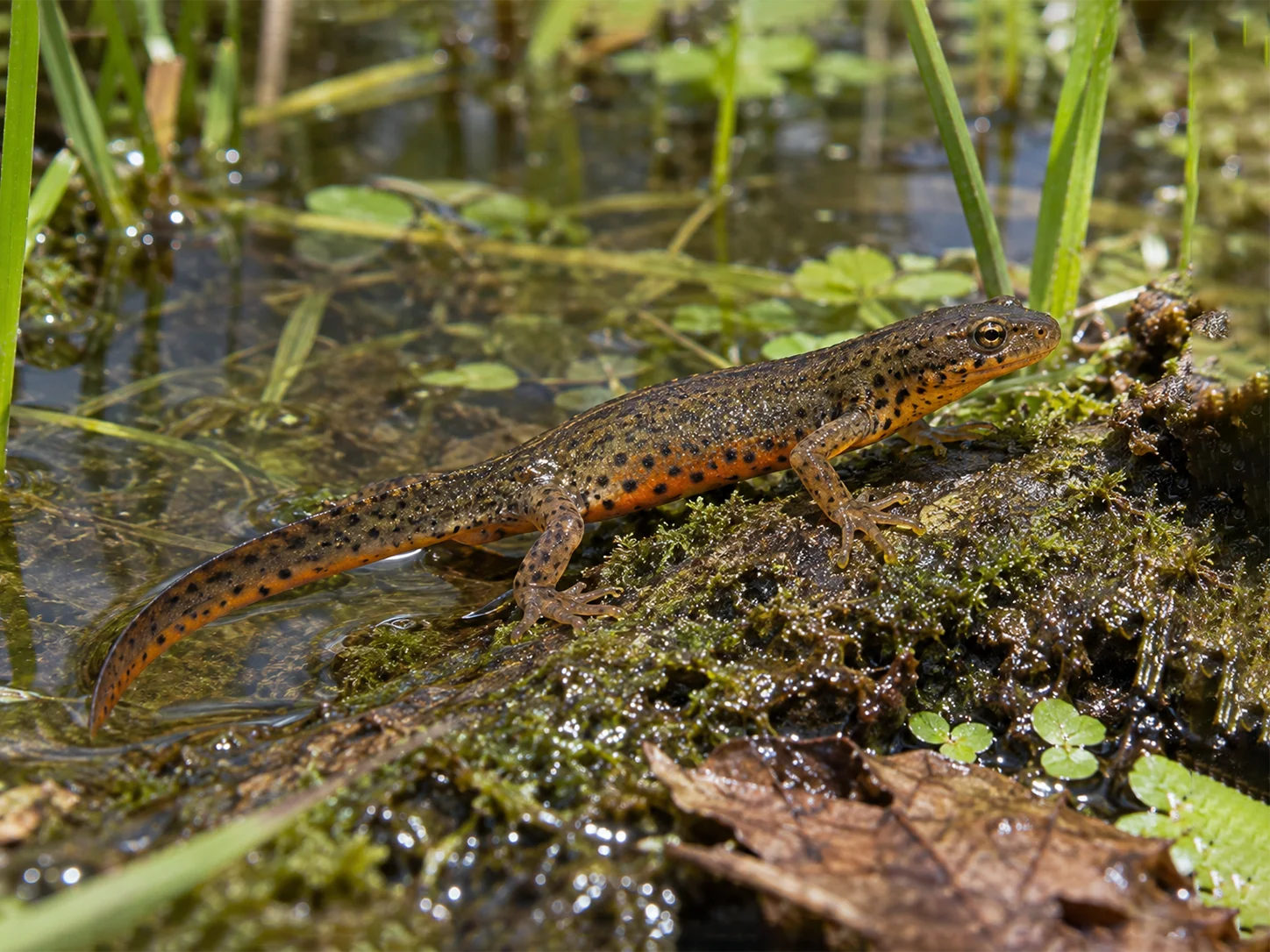
Most newts are small, around 3 to 7 inches (7 to 18 cm) including the tail, and weigh well under an ounce. The eastern newt reaches about 5 inches (13 cm).
- Lizard-like body with four legs and a long flattened tail
- Rougher, more granular skin than other salamanders
- Skin dotted with glands
- Bright warning colors in many species
- Males of some species grow a crest in the breeding season
The skin does far more than cover the animal. It is semipermeable, so a newt absorbs oxygen and water straight through it. Adult crested newts breathe mainly this way, using their lungs only when oxygen runs short or they are working hard.
That permeability is also the catch. Anything in the water or on a surface goes into the newt as easily as oxygen does, which is why amphibians are so badly affected by pollution.
Regeneration
When a newt loses a limb, cells near the injury dedifferentiate: they abandon the specialized job they had been doing, multiply, and then redifferentiate into the various tissues a new limb needs.
It is not limited to legs. A newt can regenerate heart tissue, rebuilding the ventricle and the muscular wall after the chamber has been punctured.
Humans cannot do this, which is exactly why the newt is studied so intensively. Our cells generally cannot reverse out of their specialized role once they have committed to it, and the newt is a working example of an animal whose cells can.
Newt Poison
Many newts defend themselves with toxins in the skin, and some are genuinely dangerous. The rough-skinned newt of western North America carries more than enough tetrodotoxin, the same poison found in pufferfish, to kill an adult human.
The important qualification is how it works. The toxin is a problem if it is swallowed or gets into the body through a cut, not simply from a newt sitting in a hand. The bright orange and red of an eft is a warning to anything thinking about eating it.
One animal eats them anyway. Garter snakes are effectively the only predator of these newts, and some populations have developed resistance to the toxin, a case of a predator keeping pace with a defense that stops everything else.
Habitat and Diet
Most newts breed in still water: ponds, ditches, flooded meadows. Some use slow rivers, and the brook and mountain newts live in cold, fast, oxygen-rich streams. On land they need damp ground with plenty of cover.
They are carnivores from the moment they hatch. Larvae take algae and small invertebrates, including other amphibian larvae, and adults eat insects, worms, snails and whatever small animals they can catch, typically a meal every two or three days rather than constant grazing.
Reproduction and Life Cycle
Adults return to water each year to breed. After a courtship display, the male passes the female a packet of sperm which she takes up, so fertilization happens inside her rather than in the water as it does for most frogs.
Then comes a slow, careful job. The female lays her eggs one at a time, attaching each to a water plant and often folding a leaf over it for protection. A warty newt lays 200 to 300 eggs this way; an eastern newt 200 to 400. They hatch in three to eight weeks.
Newts are long-lived for their size. Eastern newts commonly reach 12 to 15 years, which is a great deal for an animal that would fit in a teacup.
Conservation and Threats
Because newts are a group of about 100 species, there is no single conservation status. Many are common; a number are in trouble.
The Yunnan lake newt has been considered extinct since 1979. The Montseny brook newt, Kaiser’s spotted newt and the Edough ribbed newt are all listed as threatened.
The pressures are the familiar ones for amphibians: breeding ponds drained or built over, habitat broken into fragments too small to cross safely, and pollution that a permeable-skinned animal absorbs directly.
Role in the Ecosystem
Newts work both ends of a pond. As larvae they eat small invertebrates; as adults they keep eating them, and in between, as efts, they do the same job on the forest floor.
They also move energy between water and land in both directions, which few animals do. A newt that grew up in a pond spends years feeding in the woods and then returns to the water to breed, carrying the results with it.
And their skin makes them a measuring instrument. Because they absorb whatever is around them, a pond with a healthy newt population is a pond with clean water, which is why a frog or a newt disappearing from somewhere is usually the first sign of a problem rather than the last.