Meet the Kingfisher
In the early 1990s, Japan’s new bullet trains had a problem. Entering a tunnel at speed, a train pushed a wall of air ahead of it, and when that pressure wave burst out the far end it produced a boom loud enough to be heard a quarter of a mile away. The trains worked. The noise was unacceptable.
One of the engineers on the project, Eiji Nakatsu, was a birdwatcher. He thought about a bird that goes from air into water, a much bigger density change than air into a tunnel, without a splash.
The nose of the 500 Series Shinkansen was redesigned on the shape of a kingfisher’s beak. The boom went away, and the train used less power and ran faster than before.
Scientific Name and Classification
Kingfishers are not a single species but about 114 of them, grouped into three families: Alcedinidae (the river kingfishers), Halcyonidae (the tree kingfishers) and Cerylidae (the water kingfishers).
- Kingdom: Animalia
- Phylum: Chordata
- Class: Aves
- Order: Coraciiformes
- Families: Alcedinidae, Halcyonidae, Cerylidae
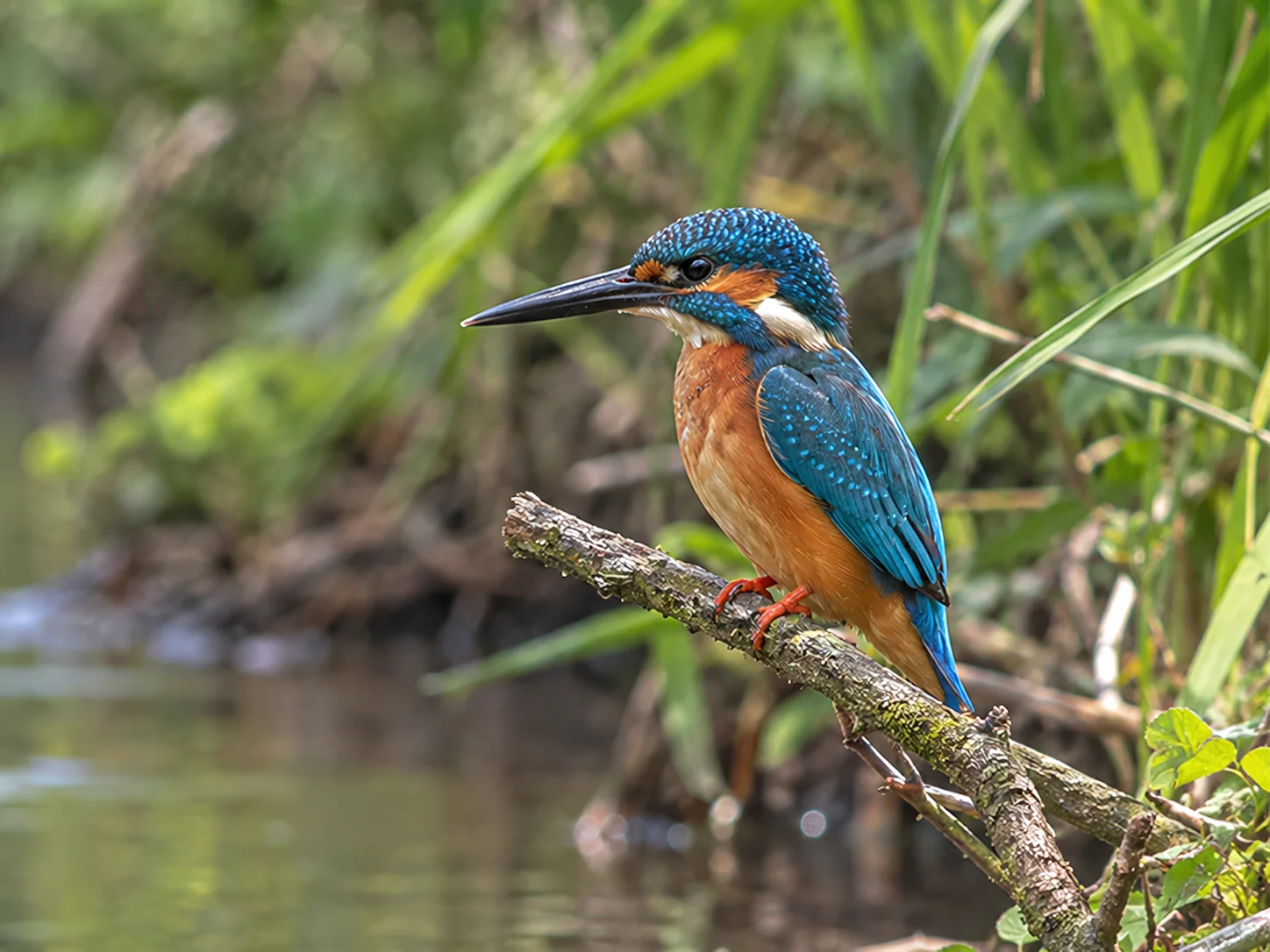
The common kingfisher, the electric-blue bird of European rivers, is Alcedo atthis. The belted kingfisher of North America is Megaceryle alcyon.
Their closest relatives are bee-eaters, rollers and motmots, all birds with the same sit-and-watch hunting style.
Do All Kingfishers Eat Fish?
No. Most of them do not, and the name is one of the great misnomers in birding.
The majority of kingfisher species live in forests, often nowhere near water, and eat insects, lizards, frogs, snakes, worms and small birds. Only about a third are serious fish specialists.
The best example is the laughing kookaburra of Australia. It is a kingfisher, the largest in the world, it lives in dry woodland, and its diet is mostly lizards, snakes, insects and mice. The famous cackling laugh is a kingfisher call.
There is a shovel-billed kookaburra in New Guinea that digs in forest mud for earthworms with a beak shaped like a spade, and a handful of species that specialize in hunting other birds.
The family name came from Europe, where the one local species does fish, and the name traveled with the explorers who found every other kind.
The Dive
A fishing kingfisher solves a problem that should be very hard. Water bends light, so a fish seen from above is not where it appears to be, and the bird is arriving at around 25 miles an hour with no chance to correct.
- It judges the refraction. A kingfisher corrects for the bending of light before it leaves the perch, and it has to, because once committed it cannot steer.
- It has two fovea in each eye. One for sighting forward in air, one it switches to underwater. The bird effectively changes visual systems in mid-dive.
- It closes its eyes on impact. A nictitating membrane slides across, so the final approach is flown blind on the aim it set from the branch.
- It enters cleanly. That dagger beak opens the water with almost no splash and almost no deceleration, which is the part the Shinkansen engineers borrowed.
Back on the perch it beats the fish against the branch to kill it, then flips it to swallow head first so the fins and scales go down smoothly.
Learning this is hard, and many young kingfishers die within days of leaving the nest because they cannot yet catch enough.
Appearance and Anatomy
Kingfishers range from 4 to 18 inches long and weigh half an ounce to 12 ounces, from the African dwarf kingfisher to the giant kingfisher and the kookaburra.
The shape is consistent across the family: large head, long heavy beak, short neck, compact body, short tail and surprisingly small feet.
Here is the detail worth knowing about that famous color. Most kingfishers have no blue pigment at all.
The blue is structural. The feather barbs contain tiny air pockets and layers of keratin arranged so that they scatter blue wavelengths back at your eye and let the rest pass through to a dark layer behind. The same bird can look turquoise, deep blue or almost black depending on where you stand, which pigment could never do.
Their toes are partly fused, which is useless for walking but makes a good shovel for digging a nest tunnel.
Habitat and Range
Kingfishers live on every continent except Antarctica, though they are far more diverse in the tropics than anywhere else.
The center of kingfisher diversity is Australasia, especially New Guinea, which has more species than anywhere. Europe has one. North America has three.
Fishing species need clear, slow water with perches over it and a vertical earth bank nearby for nesting, which is a fairly specific set of requirements and part of why they are good indicators of river health.
Forest species need none of that, and some live in dry woodland and rainforest with no standing water in their territory at all.
Diet and Feeding
All kingfishers are carnivores, but what that means varies enormously across the family.
Fish specialists take minnows, sticklebacks and other small fish, plus aquatic insects, tadpoles and small crayfish. A common kingfisher eats roughly its own body weight in fish every day.
Forest species take grasshoppers, beetles, cicadas, spiders, scorpions, lizards, frogs, small snakes, mice and nestling birds. Kookaburras are well known for killing snakes by battering them against a branch.
Whatever the prey, the method is the same throughout the family: perch, watch, drop, strike, return, beat it against something hard, swallow head first.
Behavior and Lifestyle
Most kingfishers are solitary and sharply territorial, and a fishing kingfisher will defend a stretch of riverbank aggressively, because a territory is a food supply.
They are usually seen as a flash of blue going downstream, and heard before that: a thin high whistle that carries well over running water.
In winter, fishing species face a hard problem, because frozen water means no access to food and a cold snap can kill a large share of a local population in a few days.
Kookaburras break the solitary pattern. They live in family groups, hold territory with the famous chorus of laughing, and keep grown offspring on as helpers at the nest.
Reproduction and Life Cycle
Kingfishers nest in burrows, which is unusual for such a colorful bird.
The pair digs a tunnel into a vertical riverbank, 1 to 4 feet long, ending in a chamber. They dig with the beak and kick the soil out with those fused feet, and it takes one to three weeks. Forest species dig into termite mounds, rotten trees or earth banks instead.
The female lays 2 to 10 white eggs on the bare floor of the chamber, and both parents incubate for 19 to 21 days.
The nest becomes genuinely foul. With no lining and a diet of fish, the chamber fills with droppings and fish bones, and the adults sometimes have to bathe after feeding the young.
Chicks fledge at 24 to 27 days. The parents give them a few days of help, then drive them off the territory, and the first week alone kills most of them. Kingfishers that survive it live around 6 to 10 years, though the average is far lower.
Predators and Threats
Hawks, owls, cats, rats, snakes and mink take kingfishers or raid their burrows.
The larger threats are human. River pollution kills the small fish they live on. Canalising and concreting riverbanks removes the vertical earth faces they need for nesting, so a clean river with engineered banks can still be useless to them. Dredging clouds the water so they cannot see. Harsh winters kill them outright.
Island species are the most vulnerable of all. The Guam kingfisher was driven out of the wild entirely by introduced brown tree snakes and survived only in captivity, with a reintroduction effort beginning on a different, snake-free island in 2024.
Conservation Status
Most kingfishers are listed as Least Concern, including the common kingfisher and the kookaburra, both of which are widespread.
Around a dozen species are threatened, and nearly all of them are island birds with small ranges, hit by habitat clearance and introduced predators.
Because no single status covers 114 species, the kingfisher as a group is best thought of as secure overall with specific, severe problems at the edges.
The useful conservation lesson is the riverbank one. Protecting water quality is not enough on its own if the banks have been engineered flat, because the bird needs somewhere to dig as much as it needs something to eat.
Role in the Ecosystem
Fishing kingfishers are mid-level predators on small fish and aquatic insects, and because they need clear water, healthy fish stocks and intact banks all at once, their presence is a quick summary of whether a river is working.
Forest kingfishers do a different job, holding down insect, lizard and small snake numbers across a lot of tropical woodland.
Their abandoned burrows get reused by other animals, so a pair of kingfishers leaves behind housing.
And then there is the train. A bullet train that is quieter, faster and more efficient because an engineer watched a bird catch a fish is the single best argument anyone has for why knowing about animals turns out to matter.