Meet the Quetzal
The resplendent quetzal is a bird that two whole civilizations decided was too important to kill.
The Maya and the Aztecs prized its green tail feathers above gold, and because killing a quetzal was forbidden, they caught the birds, pulled the feathers they wanted, and let them go. The feathers then circulated as money, which is why, today, the currency of Guatemala is called the quetzal.
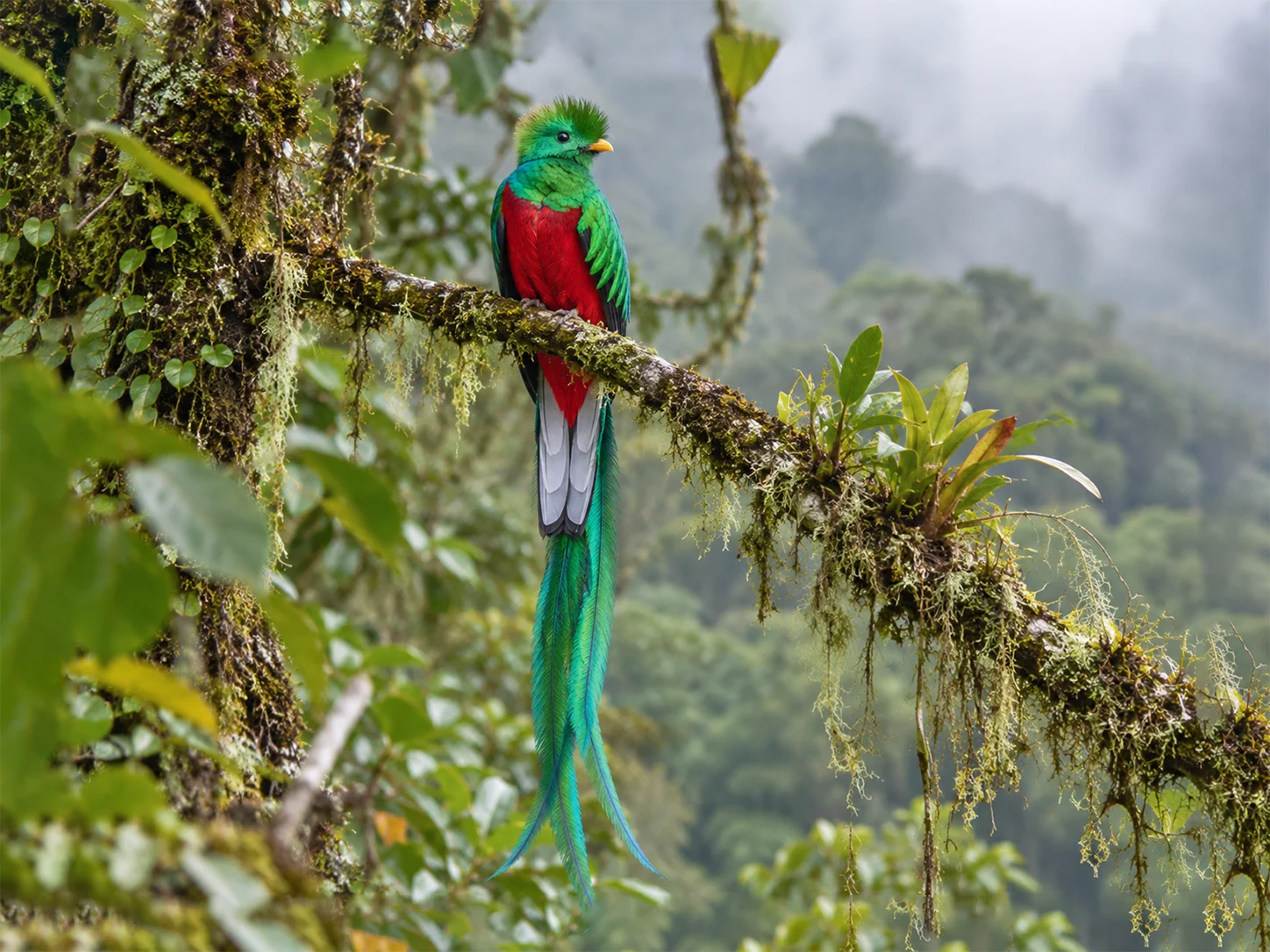
It is also simply a spectacular animal. A breeding male is iridescent green with a crimson belly, a helmet-shaped crest, and two streamers trailing from his tail that can reach over three feet, twice the length of the rest of him.
Scientific Name and Classification
This page is about the resplendent quetzal, Pharomachrus mocinno, the most famous of several quetzal species in the trogon family.
- Kingdom: Animalia
- Phylum: Chordata
- Class: Aves
- Order: Trogoniformes
- Family: Trogonidae
- Genus: Pharomachrus
- Species: Pharomachrus mocinno
Trogonidae is the trogon family, a group of brightly colored forest birds that sit still for long stretches and snatch food in short bursts of flight. The quetzals are its showiest members.
Appearance and Anatomy
The body is 14 to 16 inches (36 to 40 cm) long and weighs about 7.4 ounces (210 g). Then there is the tail. A male’s streamers run from 12 inches to a remarkable 39 inches (31 to 100 cm), with about 30 inches (75 cm) being typical.
- Male: iridescent green head, back and wings with a red lower breast and belly
- Male: rounded helmet-like crest and a yellow bill
- Male: white undertail beneath the long streamers
- Female: bronze-green head, duller body, gray breast and belly, dark bill
- Female: much shorter tail with no streamers
Two details are worth knowing. The streamers are not actually tail feathers. They are extra-long covert feathers growing over the top of the tail. And the green is not a pigment: the feathers are built so that they scatter light, which is why a quetzal can look emerald, gold or deep blue as it turns.
A young male does not get the full display at once. It takes about three years for the streamers to grow to their adult length.
Habitat and Range
Quetzals live in the mountains of Central America and southern Mexico, from Oaxaca and Chiapas through Guatemala, El Salvador, Honduras and Nicaragua to Costa Rica and western Panama.
Their home is cloud forest: wet mountain forest high enough that cloud sits in the canopy for much of the day, generally between 3,000 and 10,500 feet (900 and 3,200 m). The constant moisture is what fills these forests with mosses, ferns and the fruiting trees the bird depends on.
That habitat is the problem. Cloud forest exists only in a narrow band of altitude, so it cannot simply shift sideways when it is cleared. By 2001 the quetzal was holding on in only eleven small, separated patches of forest.
Diet and Feeding
The quetzal is mostly a fruit eater, and above all it eats wild avocados and their relatives in the laurel family.
It takes them whole. The bird plucks a fruit in flight, swallows it entire, digests the flesh and later coughs the pit back up somewhere else, which means every wild avocado tree in a cloud forest owes something to a quetzal. Few other birds there are big enough to swallow the fruit and small enough to carry it far, so this one animal does much of the planting.
Fruit is not the whole diet. Quetzals also take insects, and occasionally frogs, lizards and snails, especially when feeding chicks that need protein to grow.
Nesting and Life Cycle
Quetzals nest inside trees. They use a hole in a rotting trunk or stump, often an old woodpecker hole, which they enlarge, so a cloud forest without dead and dying trees is a cloud forest without quetzal nests.
The pair lays one to three pale blue eggs and takes turns sitting on them for 17 to 19 days, with the male on duty during the day and the female overnight.
This is where the tail becomes a problem the bird has solved rather neatly. A male sitting in a hole cannot fit three feet of streamer inside with him, so he folds it forward out of the entrance, where it hangs down the trunk and looks for all the world like a fern growing out of the tree.
The Quetzal in Maya and Aztec Culture
Across Mesoamerica the quetzal was tied to Quetzalcoatl, the feathered serpent god, and its plumes were reserved for rulers and priests.
The Maya treated the bird as a symbol of freedom and of wealth, and the rule against killing it produced a practice that sounds almost modern: catch, pluck, release. The feathers were worth more than gold and were traded as a form of currency.
Guatemala has carried the association into the present day. The quetzal is the national bird, it appears on the flag and the coat of arms, it is named in the national anthem, and the money in people’s pockets is called after it.
Can a Quetzal Live in Captivity?
For a long time the answer appeared to be no, which fed the bird’s reputation as a creature that would rather die than be caged. Captive quetzals really did die young, and it was taken as proof.
The actual cause turned out to be far more ordinary: the birds were absorbing too much iron from their water and food, which damaged their organs. Once keepers understood that and adjusted the diet, quetzals began to survive, and a zoo in Chiapas announced successful breeding in 2004.
It is a good example of how easily a biological problem becomes a legend when nobody yet knows the mechanism.
Conservation Status and Threats
The IUCN lists the resplendent quetzal as Near Threatened, with an estimated 20,000 to 50,000 birds left.
Deforestation is the main pressure: cloud forest cleared for farming and pasture, and what remains broken into fragments too small to support breeding pairs. Quetzals are also still hunted for food in places and trapped for illegal sale.
Nest sites add a quieter difficulty. Because the birds need rotting trunks to dig nests in, tidy managed forest with the dead wood removed can look healthy and still be useless to a quetzal.
Predators
Adults are hunted by the ornate hawk-eagle and other hawks, by eagles and by owls.
Eggs and chicks face a longer list, including emerald toucanets, small relatives of the toco toucan, along with brown jays, squirrels, weasels and kinkajous. A nest in a hollow trunk is safe from the weather but not from a climber.
Role in the Ecosystem
The quetzal is one of the great gardeners of the cloud forest. By swallowing wild avocados whole and dropping the pits away from the parent tree, it plants the very trees it depends on, generation after generation.
Lose the bird and those trees lose their main way of spreading. Lose the trees and the bird has nothing to eat. It is as tight a partnership as any in the Americas, and it means protecting the quetzal and protecting the forest are not two jobs but one.
There is a neat symmetry in that. A bird once valuable enough to be plucked and released rather than killed is still, in a way, worth more alive, now because of what it does for the forest rather than what its feathers are worth.