Meet the Cockatoo
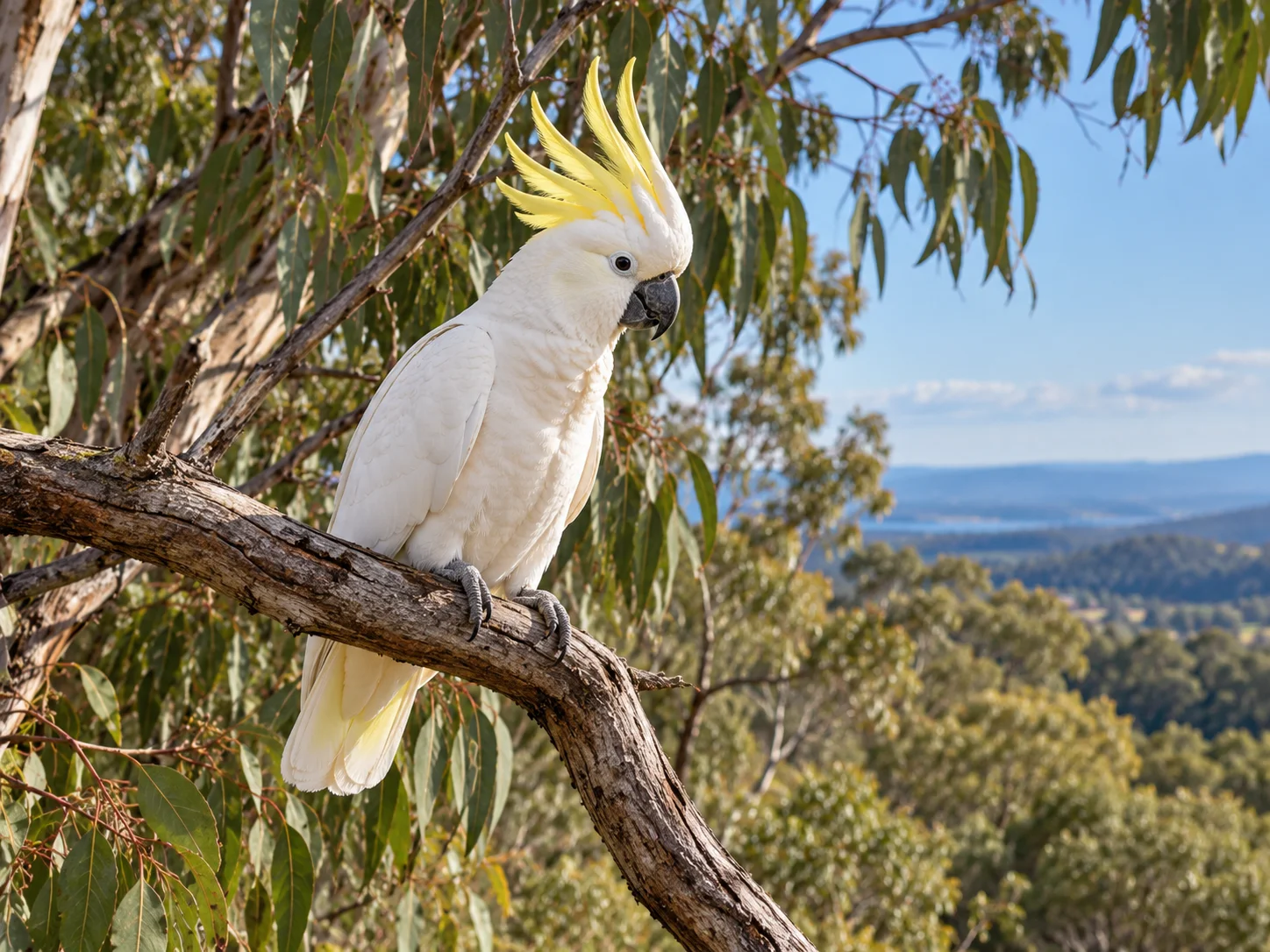
In 2018 a researcher in Sydney filmed a sulfur-crested cockatoo opening a wheelie bin: lifting the heavy lid with its beak, walking along the rim holding it up, and flipping it over to get at the food inside.
At the time, three suburbs had birds doing it. By 2019, after surveys of more than 1,300 residents, it was 44 suburbs, and the technique had spread outward from the original sites rather than appearing randomly. Birds were learning it by watching their neighbors.
Different areas developed slightly different methods, which is the detail that makes it genuinely significant: that is not just learning, it is local tradition.
Scientific Name and Classification
Cockatoos are the family Cacatuidae, with 21 species, so there is no single name. The sulfur-crested cockatoo is Cacatua galerita, and the palm cockatoo is Probosciger aterrimus.
- Kingdom: Animalia
- Phylum: Chordata
- Class: Aves
- Order: Psittaciformes
- Family: Cacatuidae
Cockatoos are parrots, but they sit in a family of their own, separate from all other parrots, and the differences are real:
- A movable crest, which no other parrot has.
- No blue or green. Cockatoos lack the structural feature that produces those colors in other parrots, which is why they are white, black, gray, pink and yellow and never green.
- A gall bladder, which other parrots do not have.
- Powder down. They produce a fine keratin dust that keeps their feathers waterproof, and it coats everything around them.
The cockatiel is the smallest cockatoo, which surprises people who think of it as a budgie-sized pet bird. The crest is the giveaway.
The Crest, and What a Cockatoo Is Telling You
The crest is not decoration. It is a signaling device that a cockatoo raises and lowers deliberately, and reading it is the single most useful thing to know about the bird.
- Raised fully, fanned forward. Alarm, threat or high excitement. In a pet bird this often precedes a bite.
- Raised with relaxed body. Interest and curiosity.
- Flat against the head. Calm, or in a different posture, fear.
- Raised and lowered repeatedly during display. Courtship, usually with bowing, strutting and tail fanning.
Palm cockatoos take it further and drum. Males break off a stick, shape it, hold it in one foot and beat it rhythmically against a hollow branch, and individual males have their own consistent rhythms. It is one of the very few documented cases of a non-human animal making a tool specifically to produce sound.
And then there is Snowball, a captive sulfur-crested cockatoo who moves in time to music. Analysis of his dancing identified fourteen distinct movements he produced spontaneously, and his ability to keep to a beat was the first solid evidence that spontaneous dancing to rhythm is not unique to humans.
Appearance and Anatomy
Cockatoos range from the cockatiel at 12 inches and 3 ounces to the Major Mitchell’s and palm cockatoos at around 2 feet and up to 2.6 pounds.
Most are white with yellow or pink in the crest, tail or underwing; some are black, some gray, and the galah is pink and gray.
The beak is heavy and curved, among the strongest in the bird world relative to size, and the palm cockatoo’s is large enough to crack extremely hard nuts.
Many species cannot be sexed by plumage, but in several, including the sulfur-crested, the eye color differs: females have a reddish-brown iris and males a near-black one, which is visible in good light.
Habitat and Range
Cockatoos live in Australia, New Guinea, Indonesia, the Philippines and nearby islands, and nowhere else naturally. Australia has the most species.
They occupy rainforest, eucalypt woodland, dry scrub, grassland, mangroves and increasingly cities, and a few have become extremely successful in suburbs, which is where the bin-opening came from.
Like macaws, they need tree hollows to nest in and cannot make them, so they depend on old eucalypts. A hollow large enough for a big cockatoo takes a century or more to form, and that is the constraint behind most cockatoo conservation problems.
Feral populations exist in New Zealand, Singapore, Hong Kong and Taiwan, mostly founded by escaped pets.
Diet and Feeding
Cockatoos are mainly seed eaters and effectively omnivorous, taking seeds, nuts, fruit, roots, bulbs, flowers, and insect larvae dug out of wood.
Many feed on the ground in flocks, digging for seeds and bulbs, which is unusual among parrots and is why galahs and corellas are so often seen walking about on grass.
Black cockatoos are specialists. Some chew into wood to extract grubs, and the Carnaby’s and Baudin’s black cockatoos depend heavily on particular banksia and marri seeds, which ties them tightly to specific vegetation.
They are also destructive foragers in a way that matters ecologically: a flock will strip and drop far more than it eats, which looks wasteful and in fact feeds a lot of animals on the ground below.
Behavior and Lifestyle
Cockatoos are intensely social, gathering in flocks of dozens to thousands, and pairs bond for life within the flock.
Flocks post sentinels. While most birds feed on the ground, a few sit in trees above and screech at the first sign of danger, which is why it is so hard to approach a feeding flock of corellas.
They are very loud, and the sulfur-crested cockatoo’s call is one of the harshest sounds any bird makes.
They are also clever in ways that have been tested properly. Goffin’s cockatoos in laboratory work have solved multi-step lock puzzles, made tools out of materials they had never seen, and in one study bent a wire into a hook to retrieve food, which few animals manage. In the wild, Goffin’s have been seen manufacturing sets of three different tools to get seeds out of a fruit.
That intelligence is the problem with keeping them. A cockatoo needs hours of occupation daily, forms an intense bond with one person, screams when left, and commonly self-mutilates when bored or lonely. They are among the most frequently surrendered pet birds for exactly this reason.
Reproduction and Life Cycle
Cockatoos nest in tree hollows, often lined with wood chips the pair chews from inside the cavity, and return to the same hollow for years.
Clutches are small, usually 1 to 3 eggs, and both parents incubate for 20 to 30 days, which is unusual and means both must survive for the brood to.
Chicks stay in the nest for 6 to 15 weeks depending on species and then remain with their parents for months, learning where food is and how to open it.
The palm cockatoo is an extreme case: it lays a single egg and may raise one surviving chick every two years, which is among the slowest reproduction of any parrot.
Cockatoos live 40 to 60 years in the wild and longer in captivity. A Major Mitchell’s cockatoo named Cookie lived at Brookfield Zoo in Chicago to 83.
Predators and Threats
Goshawks, falcons, owls, monitor lizards, snakes, quolls and introduced cats and foxes take cockatoos and raid hollows.
The main threats are land clearing, which removes the old hollow-bearing trees, trapping for the pet trade, which has hit Indonesian and Philippine species hardest, and in Australia culling and poisoning where flocks damage crops.
Psittacine beak and feather disease is a serious viral illness in wild and captive cockatoos, causing feather loss and beak deformity and usually killing.
There is also competition for hollows from feral honeybees and introduced birds, which matters more as hollows become scarce.
Conservation Status
The split is stark. The widespread Australian species are doing well, and the sulfur-crested cockatoo, galah and little corella are abundant enough to be treated as agricultural pests.
The island species are not. The Philippine red-vented cockatoo is Critically Endangered with a few hundred birds, having been trapped almost out of existence. The yellow-crested cockatoo is Critically Endangered in Indonesia, despite thriving as a feral population in Hong Kong, which is a strange situation: a species nearly gone at home and secure as an introduced bird in a city.
Carnaby’s black cockatoo in Western Australia is Endangered, hit by the clearing of its woodland.
One effort worth noting: on Rasa Island in the Philippines, former poachers were hired as wardens for the red-vented cockatoo, and the population there has risen from around 20 birds to several hundred.
Role in the Ecosystem
Cockatoos disperse seeds, pollinate flowers they feed at, and prune and drop vast amounts of vegetation, which feeds animals on the ground and recycles nutrients.
Black cockatoos digging grubs out of trunks open up dead wood, speeding decomposition and creating entry points other species use.
Their dependence on hollows makes them a flagship for old trees, which is a genuinely useful thing to be, because a landscape managed to keep veteran eucalypts standing supports possums, bats, owls and gliders at the same time.
And the bins matter beyond Sydney. A wild bird inventing a technique, neighbors copying it, the method spreading through a city and diverging into local variants is culture happening fast enough to be watched in real time. The usual objection to animal culture is that nobody can see it start. Here, people did.