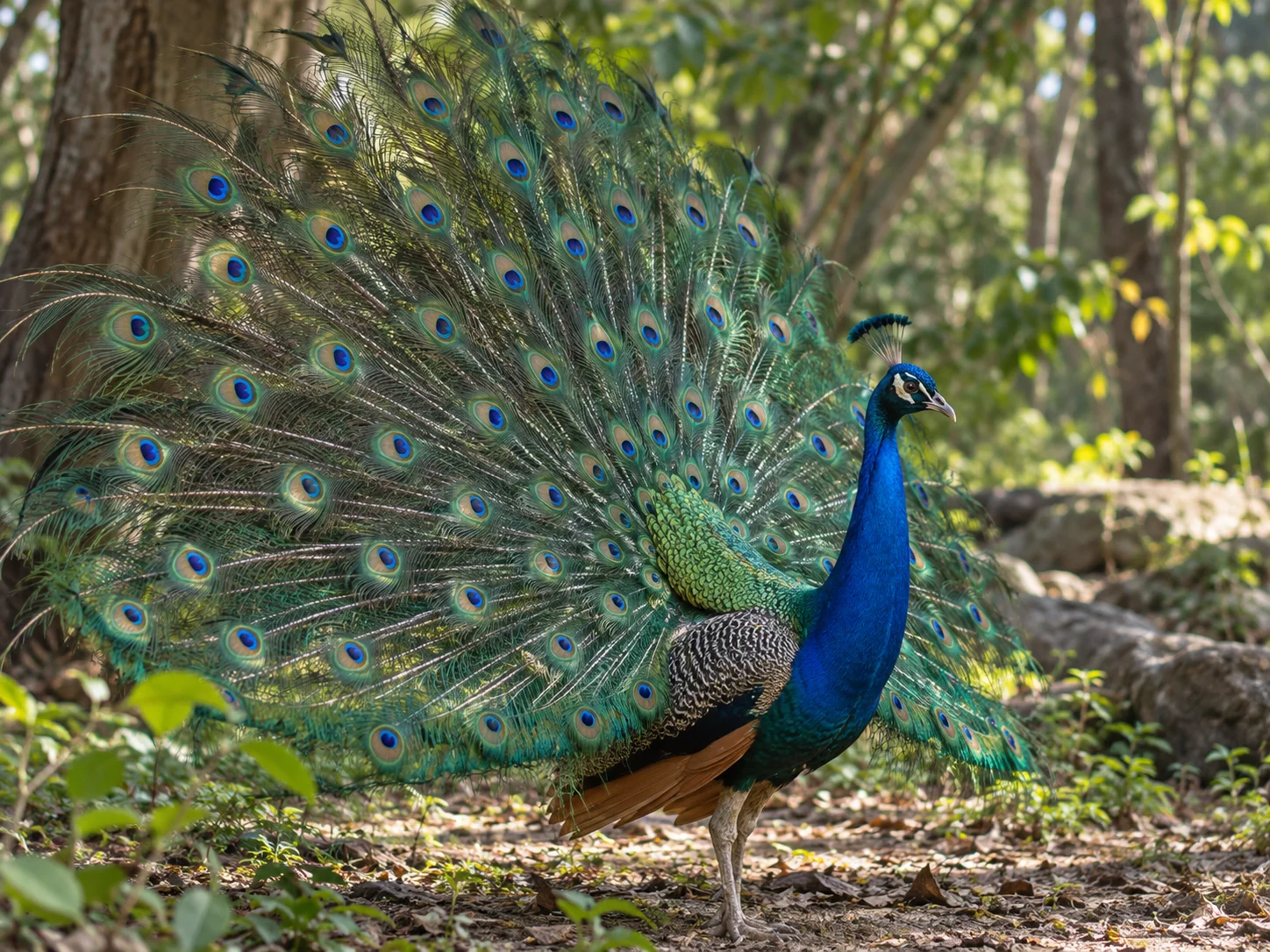
Meet the Peacock
In 1860 Charles Darwin wrote to a friend that the sight of a peacock’s tail made him sick. He meant it technically. Natural selection should strip away anything that makes an animal slower and more conspicuous, and here was a bird dragging five feet of advertising behind it.
Working out why the tail exists took him the rest of the decade, and the answer became his second great idea: sexual selection. If peahens prefer the most spectacular males, then spectacle gets inherited, even at a cost.
The peacock is the animal that forced the theory of evolution to grow a second half.
Scientific Name and Classification
There are three species of peafowl: the Indian peafowl Pavo cristatus, the green peafowl Pavo muticus of Southeast Asia, and the Congo peafowl Afropavo congensis, the only one from Africa and not described by science until 1936.
- Kingdom: Animalia
- Phylum: Chordata
- Class: Aves
- Order: Galliformes
- Family: Phasianidae
One point of vocabulary worth getting right: peacock means the male only. The female is a peahen, the chick is a peachick, and the species as a whole is peafowl.
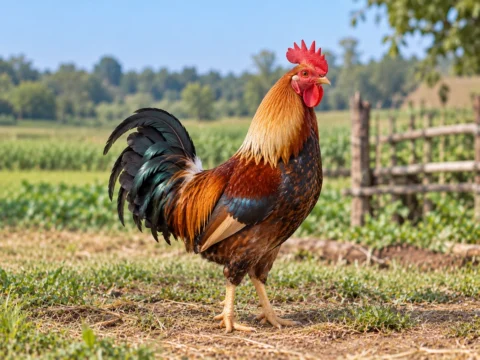
They belong to the pheasant family, which makes the peacock a close relative of the chicken.
The Tail That Is Not a Tail
The famous fan is not the bird’s tail. It is a train of about 150 greatly elongated feathers growing from the back, above the tail, and the real tail feathers are short brown ones hidden underneath, doing the work of propping the train up.
The colors are not pigment either, except for the brown. The blues and greens come from microscopic lattices of melanin rods in the feather barbules, spaced to reflect particular wavelengths. Grind a peacock feather up and the color vanishes, because there was never any blue in it.
Then there is the part nobody noticed until 2016. When a peacock fans out and shivers his train, which looks like a visual display, high-speed video and sound recording showed he is producing a low-frequency pulse below human hearing. Peahens respond to it, and a nearby female’s crest feathers vibrate in time with it.
So the display we have admired for 3,000 years turns out to have a soundtrack we cannot hear and a part of it the peahen feels through her head.
What the peahens are actually judging is still argued over. Eyespot number, train length and symmetry all correlate with success in some studies and not others, and eye-tracking work suggests peahens spend most of the display looking at the lower part of the train rather than the top.
Appearance and Anatomy
An Indian peafowl stands about 3 feet tall and weighs 9 to 13 pounds (4 to 6 kg). The body is around 3 feet long; add the train and a displaying male measures 7 to 8 feet from beak to feather tip.
The male is iridescent blue on the head, neck and breast, with a fan-shaped crest and the train behind. The peahen is mottled brown and green with a white face, and she needs to be: she incubates on the ground.
The train is molted and regrown every year, which is an enormous annual investment, and a young male does not grow a full one until he is three or four.
White peacocks are often assumed to be albino. They are not; they have a condition called leucism, which removes pigment from the feathers but leaves the eyes dark.
Habitat and Range
The Indian peafowl is native to the Indian subcontinent, in dry deciduous forest, farmland, scrub and village edges, and it has lived alongside people for thousands of years.
The green peafowl lives in Southeast Asia, from Myanmar to Java, and the Congo peafowl in lowland rainforest in the Democratic Republic of the Congo.
Indian peafowl have been introduced and gone feral in many places, including parts of the United States, Australia, New Zealand and South Africa, where their 4am screaming has made them locally unpopular.
They roost in trees at night, which is the one thing that keeps a bird this conspicuous alive.
Diet and Feeding
Peafowl are omnivores that forage on the ground, scratching about like the chickens they are related to.
They eat grain, seeds, shoots, berries and flower petals, along with insects, termites, millipedes, small lizards and frogs.
They will also kill and eat young snakes, which is partly why Indian farmers have tolerated them around settlements for so long, and part of the reason the bird acquired a reputation as a snake-killer in Indian tradition.
Their appetite for crops cuts the other way, and peafowl raiding fields is a genuine source of conflict in parts of India, complicated by the bird’s legal protection.
Behavior and Lifestyle
Peafowl live in small groups, usually one male with several females, called a party.
They are loud. The male’s call is a far-carrying may-awe scream, and in India it is widely treated as a sign of approaching rain, since peacocks do call more as the monsoon builds, which is less folklore than coincidence of timing.
Despite the train, they can fly, and surprisingly well for short distances. They flap up into trees to roost and can get clear of a dog without much difficulty.
Males display at a traditional spot, and several may display within earshot of each other, so a peahen can compare. Females then mostly ignore them, which is the normal pattern: a male may display dozens of times for every female who stops.
Reproduction and Life Cycle
Peafowl breed with the rains. The male takes no part in anything after mating; he does not help build, incubate or feed.
The peahen scrapes a shallow nest on the ground, often under cover, and lays 3 to 8 pale buff eggs. She incubates for 28 to 30 days alone.
The chicks can walk and feed themselves within hours, and can flutter up to a low branch at about a week old, which matters enormously for a ground-nesting bird.
Young males look like females for their first year, and the train develops over three to four years. Peafowl live 15 to 20 years in the wild and have reached 40 or more in captivity.
Predators and Threats
Leopards, tigers, jackals, wild dogs, mongooses and large birds of prey take peafowl, and eggs and chicks are lost to snakes, monitor lizards and feral dogs.
A displaying male is close to defenseless, and the train is slow to pack away, so the display is a real gamble rather than a metaphorical one.
Human threats fall unevenly across the three species. The Indian peafowl is doing well. The green peafowl is in serious trouble from hunting, egg collection and the clearance of lowland forest, and has disappeared from most of its old range. The Congo peafowl is threatened by logging and bushmeat hunting.
Peacocks are also still killed for their feathers in places, despite legal protection, and poisoning in retaliation for crop damage happens in India.
Conservation Status
The three species could hardly be more different in status, which is why the general figure for peafowl means little.
The Indian peafowl is Least Concern, common, and the national bird of India, protected under the Wildlife Protection Act of 1972. The green peafowl is Endangered. The Congo peafowl is Vulnerable.
The Indian bird’s success is instructive. It survives in a densely populated country largely because it has been regarded as sacred for millennia, associated with deities and temples, which has protected it far more effectively than any statute.
The green peafowl, almost identically spectacular but without that cultural shield, has lost most of its range in the same period.
Role in the Ecosystem
Peafowl eat large numbers of insects and some small snakes, and spread seeds in their droppings as they range across farmland and forest edge.
Their alarm calls are used by other animals. In Indian forests, a peacock screaming is a reliable signal that a tiger or leopard is moving, and guides and other wildlife both pay attention to it.
Their largest role, though, is in human thought. The peacock sits in Hindu and Buddhist iconography, in Greek myth as the bird of Hera, on Mughal thrones and in Art Nouveau wallpaper, and it is the reason we have a scientific account of beauty at all.
Darwin’s sick feeling was the right instinct. The tail genuinely did not fit the theory as it stood, and rather than ignore it he went and found the missing half.