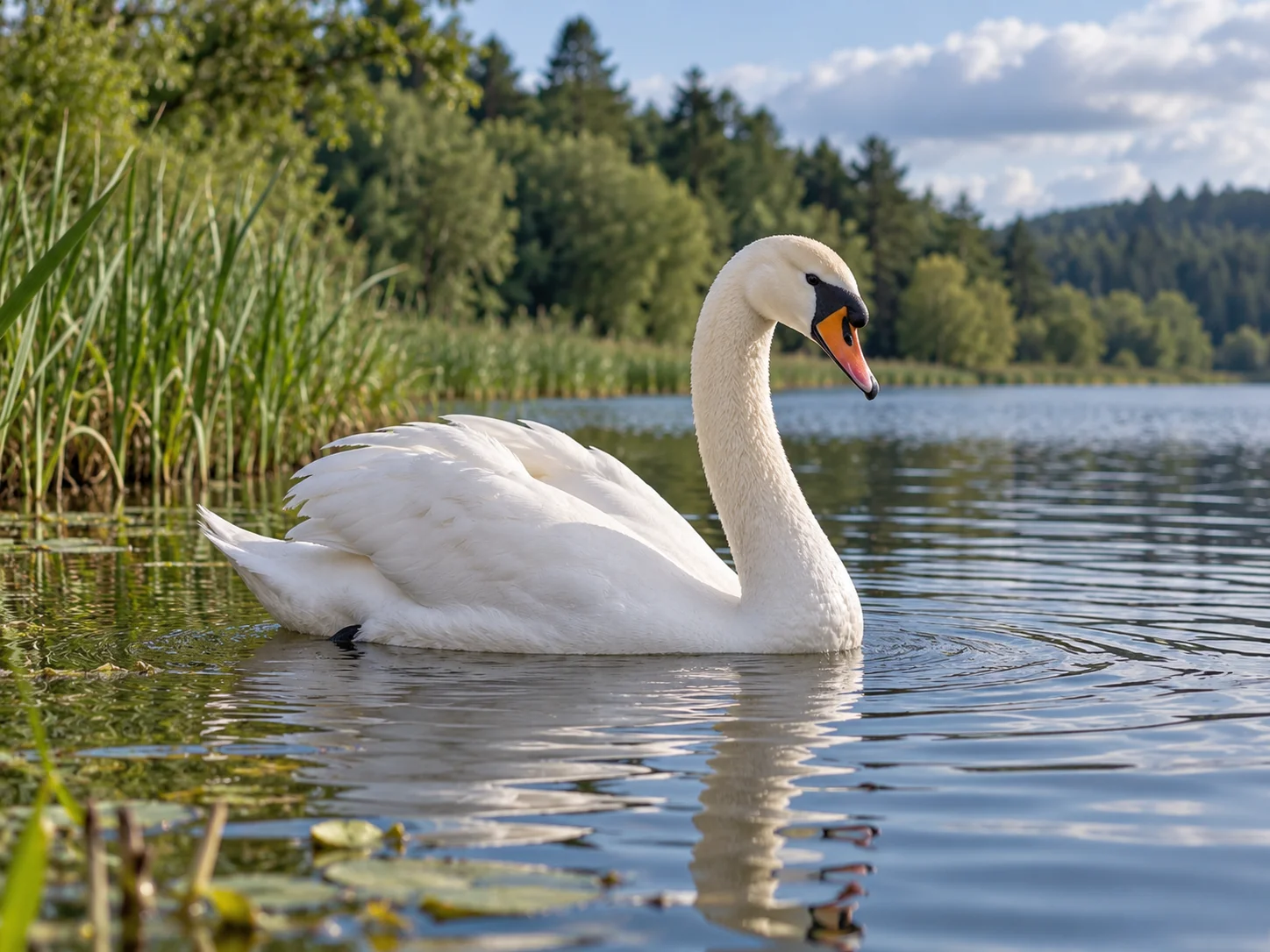
Meet the Swan
Until 1697, every swan any European had ever seen was white. The phrase black swan meant something that did not exist, and had done since Roman times.
Then a Dutch expedition sailed into a river in Western Australia and found swans that were black. The river is still called the Swan River.
That moment became one of the standard examples in philosophy of why no number of confirmations proves a general claim, and it is why a black swan event now means an unforeseen shock. An actual bird is the reason we have the phrase.
Scientific Name and Classification
Swans are the genus Cygnus, with six or seven species. The mute swan is Cygnus olor, the trumpeter swan is Cygnus buccinator, and the black swan is Cygnus atratus.
- Kingdom: Animalia
- Phylum: Chordata
- Class: Aves
- Order: Anseriformes
- Family: Anatidae
- Genus: Cygnus
Swans are waterfowl, so ducks and geese are their close relatives, and swans are essentially the largest members of that family.
The mute swan is the familiar European bird with the orange bill and the black knob at its base. It is also not mute: it hisses, snorts and grunts, and the name only means it is quieter than the trumpeter and whooper swans, which are extremely loud.
Can a Swan Break Your Arm?
Almost certainly not, and it is worth saying clearly because the claim is repeated constantly.
A swan is a big, strong, determined bird and a defending male can knock an adult over, bruise badly and give a painful bite. There is no documented case of a swan breaking a healthy adult’s arm, and the wing bones involved would likely break first.
The real danger is situational rather than mechanical. People have drowned after a swan drove them under or kept them from the bank, and a swan harassing a kayaker or swimmer in deep water is a genuine hazard, which is quite different from the arm-breaking story.
They defend hard because they have to. A swan nest is on the ground at the water’s edge, the pair will raise young there for months, and both parents fight anything that comes close, including dogs, foxes and people.
The display is mostly bluff: the busking posture with wings arched over the back and neck drawn in, followed by a hiss. If you are seeing it, you are too close to a nest.
Appearance and Anatomy
Swans are 4 to 5.5 feet long with a wingspan of 6.5 to 10 feet, and weigh 12 to 33 pounds (5.5 to 15 kg). The trumpeter swan is the heaviest native North American bird, and large mute swans are among the heaviest flying birds in the world.
- Neck vertebrae. 22 to 25, more than almost any other bird and more than twice a human’s seven, which is what lets a swan reach plants on the bottom without diving.
- Feathers. More than 25,000 on a mute swan, one of the highest counts of any bird.
- Bill. Serrated edges for gripping slippery vegetation, not teeth.
- Wings. Powerful enough to carry 25 pounds into the air, which needs a long running takeoff across water.
Cygnets are gray-brown and take a year or more to turn white, which is the actual basis of the ugly duckling story.
Black swans are not black all over: in flight they show startling white flight feathers, invisible when the bird is on the water.
Habitat and Range
Swans live on every continent except Antarctica and Africa, in lakes, rivers, marshes, estuaries, flooded fields and sheltered coasts.
What they need is shallow water with plants in reach of that long neck, which is why swans are birds of lake edges and slow rivers rather than open water.
Northern species migrate long distances. Whooper swans breed in Iceland and Siberia and winter in Britain, Ireland and around the North Sea, and the Bewick’s swan travels from Arctic Russia to western Europe. Whooper swans migrating from Iceland have been recorded at extraordinary altitude, and the Icelandic crossing is a non-stop sea flight of around 800 miles.
The mute swan is native to Europe and Asia and has been introduced to North America, Australia and New Zealand, where it is often treated as invasive.
Diet and Feeding
Swans are mostly herbivores, eating pondweed, algae, grass, grain and roots, with cygnets taking insects and small invertebrates for the protein.
An adult eats up to 8 pounds of vegetation a day, which is a very large quantity of low-energy food, and swans feed for much of the daylight.
They feed by dipping the head and neck, upending like a duck, and grazing on land, and they also tread the bottom with their feet to loosen plants.
On feeding bread: it is not the poison some signs claim, but it is close to junk food, and large amounts cause poor growth in cygnets and foul the water. Leafy greens, grain, oats and defrosted peas are far better, and uneaten bread rotting in a pond genuinely harms it.
Behavior and Lifestyle
Swans pair for years and often for life, and the bond is real rather than sentimental: established pairs raise more young, because they hold better territory and coordinate better.
They do separate, though. Studies of mute swans record divorce in a small percentage of pairs, usually after failed breeding, and a bird that loses a mate will often find another.
Outside the breeding season they are sociable and gather in large flocks, sometimes hundreds on one lake, and then become fiercely territorial again in spring.
They greet each other with head-dipping and a facing posture that brings their necks into a rough heart shape, which is the image on a great many greetings cards and is, in fact, a courtship display.
There is no truth to the swan song. Swans do not sing a beautiful final song as they die; the idea comes from ancient Greek writing, and whooper swans are simply loud all their lives.
Reproduction and Life Cycle
A pair of swans builds a large mound of reeds and vegetation at the water’s edge, often reusing the same site, and the male helps.
The female lays 4 to 8 eggs and incubates for 34 to 41 days while the male guards.
Cygnets can swim within a day or two, and both parents raise them, sometimes carrying small cygnets on their backs between the raised wings.
They stay with their parents for four to six months, sometimes through the first winter, and are then driven off before the next breeding season. Young swans join flocks of non-breeders for several years and do not breed until three or four.
Swans live 10 to 20 years in the wild, with ringed birds past 25 and captive birds past 30.
Predators and Threats
Foxes, mink, otters, large gulls, herons, snapping turtles, pike and eagles take eggs and cygnets, and most cygnets do not survive their first year. Healthy adults have few natural predators.
Human causes dominate adult deaths, and the list is mundane: flying into power lines, which is a major killer of a heavy bird with limited manoeuvrability, lead poisoning from swallowing fishing weights and old lead shot, entanglement in fishing line, oil spills, dog attacks, and vandalism, which is distressingly common.
Lead is the one worth knowing about. Swans pick up grit from the bottom and swallow lost fishing weights with it, and a few pellets will kill. Lead weight bans in Britain and elsewhere measurably reduced swan deaths, which is a clean example of a specific rule solving a specific problem.
Avian influenza has also killed large numbers in recent outbreaks.
Conservation Status
Most swans are listed as Least Concern, and the group includes one of conservation’s genuine triumphs.
The trumpeter swan was down to fewer than 100 known birds in the United States in the 1930s, hunted for feathers and skins. Protection, reintroduction and the later discovery of a previously unknown Alaskan population took it past 60,000, and it is no longer threatened.
Not everything is improving. The Bewick’s swan has declined substantially in northwest Europe, and the Coscoroba and black-necked swans of South America face habitat loss and pollution.
In Britain, mute swans have an unusual legal history: unmarked swans on open water are the property of the Crown, a rule dating from when swans were valuable food, and the annual swan upping on the Thames is still carried out to count and check them.
Role in the Ecosystem
Swans shape the plant life of shallow water. Grazing in quantity keeps vegetation open, which affects fish, insects and other waterbirds, and where introduced mute swans are abundant they can strip beds of aquatic plants entirely, which is the basis of their invasive classification in parts of North America.
Their feet and foraging stir sediment and release nutrients, and they move plant fragments and seeds between water bodies.
As indicators they are unusually useful, because they are large, visible, long-lived, and faithful to particular lakes, so a swan population tells you about one specific body of water over decades.
Culturally they are almost unmatched: Leda and the swan, the swan maidens, Tchaikovsky, the ugly duckling, the swan song, and the black swan. That last one is the most interesting, because it is the only case on this list where the bird did not supply a metaphor but destroyed one. For two thousand years a black swan was the standard example of the impossible, and then someone found a river full of them.