Meet the Cobra
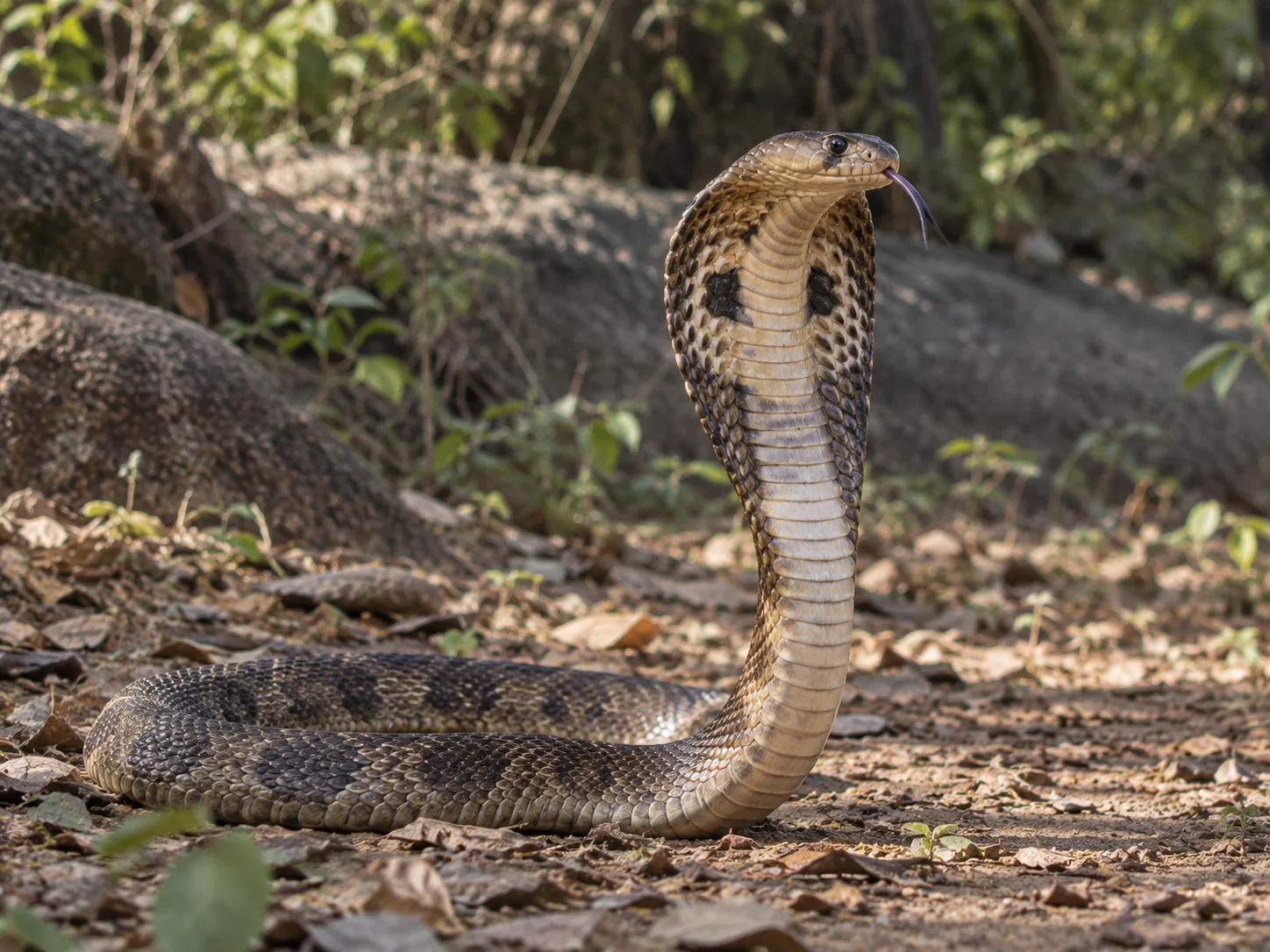
A snake charmer’s cobra is not dancing, and it is not listening to the flute. Snakes hear poorly and feel vibration far better than sound.
What the cobra is doing is tracking the pipe as a threat. It is reared up, hood out, following a moving object with its eyes and swaying to keep it in view, which is defensive behavior, not music appreciation.
The practice is now illegal in India under the Wildlife Protection Act, partly because the snakes were routinely defanged or had their mouths sewn shut and died of infection or starvation within months.
Scientific Name and Classification
The true cobras are the genus Naja, with around 30 species. The Indian or spectacled cobra is Naja naja, and the Egyptian cobra is Naja haje.
- Kingdom: Animalia
- Phylum: Chordata
- Class: Reptilia
- Order: Squamata
- Family: Elapidae
- Genus: Naja
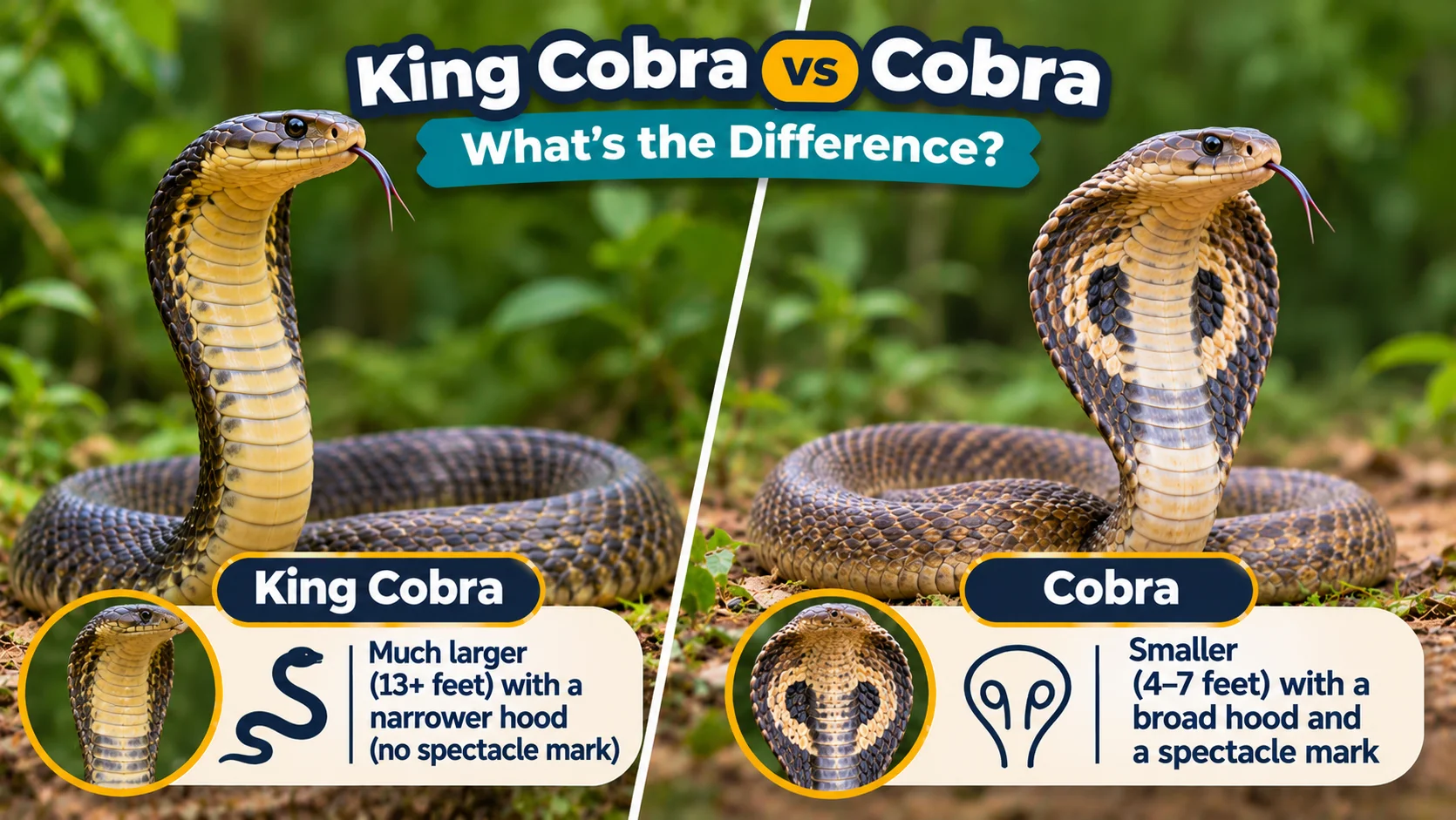
Several famous snakes called cobras are not in Naja at all. The king cobra is not a true cobra: it is Ophiophagus hannah, in a genus of its own, and it eats other snakes, including true cobras. That is where the name comes from — it is the cobra that kings over cobras.
The same applies to the rinkhals of southern Africa and the tree cobras. All of them belong to the family Elapidae, which also contains mambas, kraits, taipans and coral snakes.
The Hood, and Spitting Venom
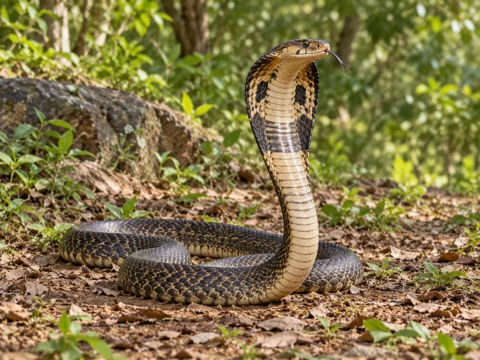
The hood is not a flap of loose skin. It is built from elongated ribs in the neck that the snake swings outward, stretching the skin between them, and it can be folded flat in an instant.
It is pure bluff, and it works. A reared cobra looks much larger than it is, and the eyespot markings on the back of an Indian cobra’s hood look like a face watching whatever is behind it.
Some cobras go further and spit. Around a dozen species are spitting cobras, and the mechanism is precise engineering:
- The fang is modified. The opening is at the front rather than the tip, turning the tooth into a nozzle.
- The venom is pressurized. Muscles squeeze the gland and fire a stream up to 8 feet.
- The aim is at the eyes. A spitting cobra aims for the face specifically, and hits it with striking reliability.
- The snake tracks movement. High-speed filming shows it shaking its head as it sprays, scattering the venom into a pattern that is hard to dodge.
Venom in the eyes is intensely painful and can cause lasting damage or blindness if it is not washed out at once. It is purely defensive; spitting cobras bite to kill their food like any other.
Research published in 2021 argued that spitting evolved as a defense specifically against primates, appearing in Africa and Asia around the time our own ancestors did.
Appearance and Anatomy
True cobras are 4 to 7 feet long and weigh 4 to 11 pounds (2 to 5 kg). The forest cobra is the largest at up to 10 feet; the king cobra, not a true cobra, reaches 18 feet and is the longest venomous snake in the world.
Their fangs are short and fixed in place at the front of the mouth, unlike a viper’s long hinged fangs. A cobra holds on and chews venom in rather than striking and releasing.
The venom is mainly neurotoxic, blocking the signals from nerves to muscles, and an untreated serious bite kills by paralyzing the muscles used for breathing. Some species add tissue-destroying components that cause severe local damage.
Like all snakes, they smell with a forked tongue that collects particles and delivers them to a sensory organ in the roof of the mouth, giving a sense of direction in scent. They have no external ears and no eyelids.
Habitat and Range
Cobras live across Africa, the Middle East, South Asia and Southeast Asia, in savanna, forest, farmland, scrub, wetland and city edges. There are no cobras in the Americas, Europe or Australia.
They do particularly well around people, which is the central problem. Farmland and villages offer rodents, and rodents are what cobras eat, so the snake and the farmer end up in the same place by design rather than accident.
They shelter in termite mounds, rodent burrows, rock piles, tree hollows, thatch and woodpiles, and often use water, with several species swimming well.
Diet and Feeding
Cobras are carnivores, and rodents are the staple, along with frogs, toads, lizards, birds, eggs and other snakes.
A cobra bites, holds, and waits for the venom to work, then swallows the prey whole and head first. Its jaws are joined by stretchy ligaments, so the two halves move independently and walk the meal down; the jaw does not unhinge, which is a persistent myth.
They eat rarely and digest slowly, and a large meal can sustain a cobra for weeks.
This is why cobras are genuinely valuable to farmers. A single cobra removes a great many rats, and in a country where rodents destroy a significant share of stored grain, that is a real service performed for free by an animal most people would rather kill.
Behavior and Lifestyle
Cobras are solitary, and mainly active at dusk and after dark, especially in hot weather.
They would much rather leave than fight. The hood display, the hiss, the rearing and often a mock strike with the mouth closed all come first, because venom is metabolically expensive to make and a fight risks injury. A great many bites happen when a snake is cornered, stepped on, or picked up.
They shed their skin several times a year, and are vulnerable and bad-tempered just before a shed, when the old skin clouds their eyes.
Cobras have to manage their own temperature by moving between sun and shade, which is why they turn up on warm roads and paths in the evening.
Reproduction and Life Cycle
Cobras lay eggs, usually 10 to 30, in a termite mound, burrow or pile of leaf litter.
Most species then leave. The king cobra does not, and it is the only snake in the world known to build a nest: the female gathers leaves into a mound with a coil of her body and guards it for two to three months, leaving shortly before the eggs hatch.
Eggs hatch in 50 to 70 days, and hatchlings are about 10 to 14 inches long and fully venomous from the first day, with no parental care at all.
Cobras mature at two to three years and live around 20 years in the wild, with some reaching 25 to 30 in captivity.
Predators and Threats
Mongooses, honey badgers, secretary birds, eagles, monitor lizards and king cobras all kill cobras. The mongoose is not immune to the venom, as the stories claim; it is simply fast, thick-coated and resistant enough to survive a dose that would kill an animal its size.
People are the main threat. Cobras are killed on sight, collected for skins and traditional medicine, taken for the pet trade, and losing habitat as forest becomes farmland.
Snakebite itself is a serious and badly neglected problem. The World Health Organization estimates roughly 80,000 to 140,000 deaths a year worldwide and three times as many survivors left with amputation or permanent disability, mostly among farmers in poor rural districts. Cobras are among the main species responsible in Asia and Africa.
The fix is unexciting and well understood: antivenom that is affordable and actually in stock at rural clinics, plus boots, torches and training.
Conservation Status
Most true cobras are listed as Least Concern, being adaptable and widespread. The Indian cobra is common, and protected in India under the Wildlife Protection Act of 1972.
Some are not doing well. The king cobra is Vulnerable, hit hard by deforestation and collection, and a few restricted species are threatened.
Cobras are also an unusual conservation case in that their best protection may be practical rather than legal. Where farmers come to see the local cobra as free rodent control, and where safe snake-removal services exist, far fewer get killed.
Role in the Ecosystem
Cobras are significant rodent predators across Africa and Asia, which matters for both crops and the diseases rodents carry.
They are also prey, feeding mongooses, raptors and other snakes, and they sit in the middle of the food web rather than on top of it.
Their venom has turned out to be medically useful. Cobra venom components have been studied for pain relief and are used as research tools for understanding how nerve signals work, since a molecule evolved to block a specific receptor is a precise instrument for studying that receptor.
And few animals carry more cultural weight. The cobra sits on the crown of the Egyptian pharaohs, coils around Shiva’s neck, shelters the Buddha from rain in Indian art, and appears on temple carvings across Asia. It is feared and venerated in the same breath, which is a fair response to an animal that kills rats for you and can kill you too.