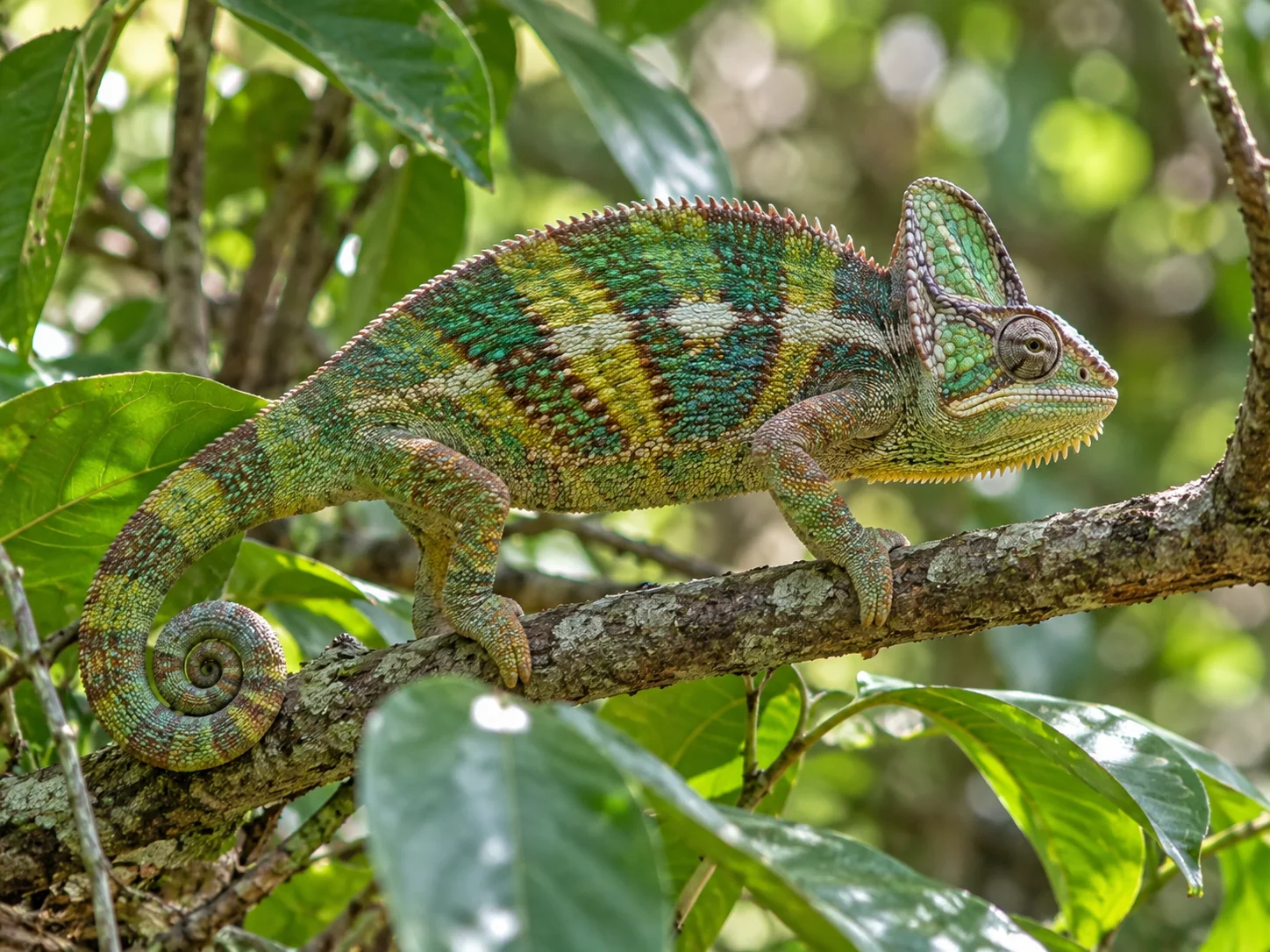
Meet the Chameleon
Chameleons do not change color to match their surroundings. Put one on a chessboard and it will not turn into a chessboard.
They change color mainly to control their temperature and to communicate: to signal aggression, to attract a mate, to show submission or stress. The color is a mood and a thermostat, not camouflage.
And how they do it was misunderstood until 2015, when researchers found the mechanism is not pigment at all.
Scientific Name and Classification
Chameleons form the family Chamaeleonidae, with around 200 species, so there is no single two-word name. The veiled chameleon is Chamaeleo calyptratus and the panther chameleon is Furcifer pardalis.
- Kingdom: Animalia
- Phylum: Chordata
- Class: Reptilia
- Order: Squamata
- Family: Chamaeleonidae
They are lizards, related to agamas and iguanas, though highly specialized ones.
Nearly half of all chameleon species live only on Madagascar, which is the world center of chameleon diversity.
Why Do Chameleons Change Color?
Three reasons, and blending in is the least of them.
- Temperature. A cold chameleon goes dark to absorb heat and a hot one goes pale to reflect it. Some will turn dark on one side only, the side facing the sun, which is about as clear a demonstration as you could ask for.
- Communication. This is the big one. A male signaling aggression flares into bright yellows, reds and whites. A male losing a contest goes dull brown and dark. A receptive female shows one pattern, a pregnant one another, often warning males off entirely.
- Camouflage. Real but limited. A chameleon’s resting colors already suit its habitat, and it can shift tone somewhat, but it is not copying whatever it is standing on.
The most striking color changes happen when two males meet, which is precisely when hiding would be useless.
How the Color Change Actually Works
For a long time the textbook explanation was that chameleons move pigment around inside their skin cells, concentrating or spreading it to darken or lighten.
That is part of the story, and it handles the browns and blacks. But it could not explain the bright blues, greens and yellows, because chameleons have no blue or green pigment at all.
Research from Geneva in 2015 found the answer. Beneath the pigment layer sits a layer of cells containing a lattice of tiny crystals, and the chameleon can change the spacing between them by relaxing or tightening the cell. Change the spacing and you change which wavelength of light the lattice reflects.
Packed close, the lattice reflects blue. Spread apart, it reflects yellow and red. Combined with yellow pigment above it, that produces the whole range, including green.
So a chameleon is not painting itself. It is retuning a microscopic mirror.
Appearance and Anatomy
Chameleons range from Brookesia nana, a Madagascan species under an inch long and among the smallest reptiles on Earth, to the Parson’s chameleon at around 27 inches.
- Eyes. The most remarkable in the reptile world. Each moves independently through almost 180 degrees, each focuses separately, and a chameleon can watch two different things at once with nearly 360-degree vision. When it spots prey, both eyes swing forward together to judge distance.
- Tongue. Fired out at extraordinary acceleration, reaching up to twice the animal’s body length, powered by stored elastic energy rather than muscle contraction. Smaller species accelerate their tongues harder than larger ones.
- Feet. Toes fused into two opposed bundles, forming a pincer that grips a branch like a hand.
- Tail. Prehensile and used as a fifth limb, coiled when not in use. Unlike many lizards, chameleons cannot regrow it.
- Casque. The helmet-like crest on the head, prominent in some species and used in display.
Many chameleons also glow. Bony bumps on the skull fluoresce blue under ultraviolet light, showing through the skin as a pattern of spots, and chameleons can see ultraviolet, so it appears to be a signal.
Habitat and Range
Chameleons live mainly in Africa and Madagascar, with some species in southern Asia, the Middle East, and one in southern Europe.
That European species, the common chameleon, lives in Spain, Portugal, Malta, Greece and nearby areas, and is the only chameleon in Europe.
Most are tree-dwellers in rainforest, dry forest, savanna and scrub, and their gripping feet and tail are built for life among branches.
A few are not. The small brown leaf chameleons of the genus Brookesia live in leaf litter on the forest floor and look exactly like dead leaves.
Many have tiny ranges. Some Madagascan species are known from a single mountain or forest patch and nowhere else.
Diet and Feeding
Chameleons are mainly insect eaters and count as insectivores, taking crickets, grasshoppers, locusts, flies, moths, beetles and spiders. Larger species also eat small birds, lizards and some fruit and leaves.
The hunt is all patience and one explosive movement. A chameleon creeps forward with a rocking motion that mimics a leaf in the breeze, locks both eyes on the target, and fires.
The tongue is a remarkable piece of machinery. Elastic tissue is wound up like a spring and released, so the tip leaves the mouth far faster than muscle alone could manage, and the tip forms a suction cup as well as being coated in thick sticky mucus. Prey heavier than you would expect can be hauled back.
The whole strike takes a fraction of a second, which from an animal that otherwise moves with absurd slowness is startling to watch.
Behavior and Lifestyle
Chameleons are solitary and territorial, and most will not tolerate another chameleon nearby outside breeding. Two males meeting leads to a color display, flattened bodies turned side-on to look larger, gaping, and sometimes a fight.
They move with a deliberate swaying walk, pausing constantly, which makes them hard to pick out among moving leaves.
They are active by day and sleep at night clinging to a branch, when their colors fade to pale, which is one reason chameleons are easier to find after dark.
They are also, frankly, highly strung. Chameleons are easily stressed by handling and by other chameleons, and chronic stress shows directly in their color.
Reproduction and Life Cycle
Most chameleons lay eggs, with the female climbing down to the ground to dig a hole and bury a clutch of anything from 2 to 100 eggs, then leaving. Some species give birth to live young instead.
Incubation can be very long, from four months to over a year depending on species and temperature.
Hatchlings are independent at once, with working tongues and gripping feet from the first day.
One species does something extraordinary. Furcifer labordi of Madagascar spends most of its life as an egg, hatches, grows, breeds and dies within four to five months, giving it the shortest adult lifespan of any four-limbed animal known. For most of each year the entire species exists only as buried eggs.
Most chameleons live 2 to 7 years, with larger species reaching 10.
Predators and Threats
Snakes, birds, monkeys and larger lizards eat chameleons, and their defenses are stillness, color and that side-on flattening display.
Habitat loss is the main human threat, and it is severe. Madagascar has lost a large share of its forest, and species confined to single patches disappear with them.
The pet trade takes large numbers. Wild-caught chameleons travel badly and die at high rates, and the species that do best in captivity are the ones now bred domestically, which is the only version worth buying.
They are also killed out of superstition in parts of their range, where they are considered unlucky.
Conservation Status
There is no single status across around 200 species, and a large proportion are threatened.
Madagascar is the crisis point. Nearly half the world’s chameleons live there, many in tiny ranges, and the island’s forests have been heavily cleared. Several species are Critically Endangered and a few are known from a single remaining forest fragment.
New species are still being described regularly, including Brookesia nana in 2021, which means some are almost certainly being lost before anyone has named them.
Most chameleons are listed under CITES, which regulates international trade.
Role in the Ecosystem
Chameleons are significant insect predators in the canopy and understory, and because they sit still and wait they catch prey that more active hunters miss.
They are prey in turn for snakes and birds, moving energy from insects up the food chain.
Because so many species are confined to tiny areas, they are extremely useful indicators of habitat condition. A forest fragment with its original chameleon species still present is a fragment that has not been degraded.
Scientifically they have been unusually productive. Their crystal-based color mechanism is studied by materials scientists designing surfaces that change color without pigment, and the elastic power of their tongue is of interest to engineers building fast-acting mechanisms. An animal famous for a trick it does not actually do turned out to be doing something more interesting instead.