
What “Endangered” Actually Means: Reading The Red List
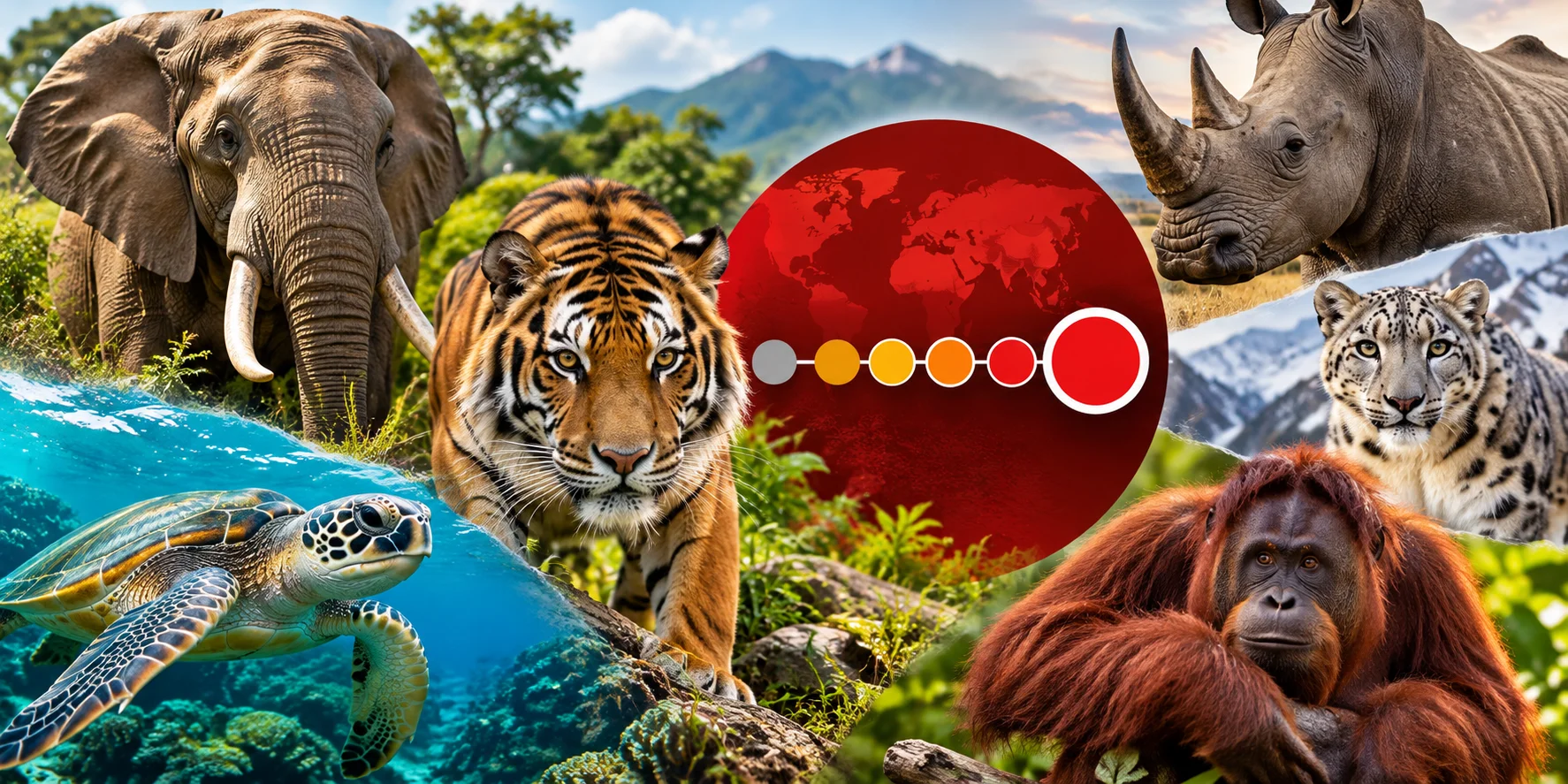
When someone says an animal is endangered, that is not a general description of how worried people feel about it. It is a specific category, with criteria, assigned by a specific organization.
Knowing how the system works makes a lot of wildlife news easier to read, and it explains some things that look contradictory, like why an animal with 20,000 individuals left can be in more trouble than one with 600.
The Nine Categories
The list is kept by the International Union for Conservation of Nature, and it is called the IUCN Red List. Every assessment puts a species into one of these:
- Extinct (EX) — no reasonable doubt the last individual has died.
- Extinct in the Wild (EW) — survives only in captivity or as a reintroduced population outside its former range.
- Critically Endangered (CR) — facing an extremely high risk of extinction in the wild.
- Endangered (EN) — a very high risk.
- Vulnerable (VU) — a high risk.
- Near Threatened (NT) — likely to qualify as threatened soon.
- Least Concern (LC) — widespread and abundant.
- Data Deficient (DD) — not enough information to judge.
- Not Evaluated (NE) — nobody has assessed it.
The word threatened is an umbrella covering the three middle categories: Critically Endangered, Endangered and Vulnerable. So “threatened” and “endangered” are not the same thing, and a report saying a species is threatened is making a weaker claim than one saying it is endangered.
It Is Not Just About How Many Are Left
This is the part most people find surprising. Population size is only one of five criteria, and a species can be listed on any of them:
- How fast it is declining. A rapid drop counts even if the remaining number is large.
- How small its range is. A species confined to one island or one valley can be listed even if it is common there, because a single fire or disease could take all of it.
- How few mature individuals remain.
- How tiny and restricted the population is overall.
- What a quantitative model predicts about its chance of extinction.
Which is why the lion, at 20,000 to 25,000 animals, is Vulnerable, while the tuatara, at 60,000 to 100,000, is Least Concern. The lion is falling fast across most of its range; the tuatara is stable and protected. Direction matters as much as quantity.
It is also why a species can be reassessed without anything changing in the wild. Sometimes the new information is simply better.
The Global Figure Hides The Local One
A Red List category is global. That can be badly misleading at a national level, and plenty of wildlife reporting falls into the gap.
The house sparrow is listed as Least Concern worldwide, because it is one of the most numerous birds on earth. Britain has lost most of its house sparrows since the 1970s and red-lists them nationally. Both statements are correct.
The same applies to the nightingale, Least Concern globally and in steep decline in England, and to the dugong, Vulnerable overall but Critically Endangered in East Africa.
So when you see a status on a species page, including on this site, it is worth asking which scale it refers to. Most countries keep their own national red lists, and those are the relevant ones for local conservation.
Why Species Become Endangered
The causes are consistent enough that conservationists have a shorthand for them, and habitat loss leads by a wide margin.
Habitat loss and fragmentation. Land converted to farming, settlement and infrastructure. Fragmentation does damage of its own: several small isolated populations are far more fragile than one large connected one, because they inbreed and cannot recolonise after a local loss.
Overexploitation. Hunting, fishing and collection. The Atlantic cod is the clearest case, fished from apparent inexhaustibility to around one percent of its spawning population in a few decades.
Invasive species. Particularly devastating on islands, where animals evolved with no mammalian predators. Rats, cats and mongooses introduced to islands have caused a long list of extinctions.
Pollution, including pesticides that accumulate up food chains, plastic, and noise.
Climate change, which shifts where species can live and breaks the timing between animals and their food. It also catches reptiles in a particular trap, because in many of them nest temperature decides the sex of the hatchlings.
Disease, which is often moved around by us. Chytrid fungus, spread largely through the trade in amphibians, has devastated frog populations worldwide and driven numerous species to extinction.
What Actually Reverses It
Conservation works more often than the general tone of the news suggests, and the successes share a pattern: a specific problem, identified correctly, and then addressed with money and persistence.
- The Eurasian otter was nearly gone from England. The pesticides poisoning it were banned, rivers were cleaned, and otters are back in every English county.
- The northern elephant seal was down to perhaps a few dozen animals. Protection took it past 200,000.
- The Espanola tortoise was down to 14 animals. A breeding program returned over 2,000 to the island and was wound up in 2020 because they were breeding unaided.
- India’s tigers roughly doubled from their 2006 low after honest counting, prey protection and funded patrols.
What those have in common is not public awareness. It is a diagnosis followed by a specific intervention: ban this chemical, fund these patrols, fence this nesting beach, put an excluder in this crab trap.
What One Person Can Do
Honest answer: individual choices matter far less than policy, and the most useful thing most people can do is vote and donate accordingly.
That said, a few things genuinely help, and they are the small habitat ones rather than the symbolic ones. Leave part of a garden untidy and unsprayed, because that is where insects breed and insects are what most small animals eat. Turn off outdoor lights at night, which moths and fireflies need. Keep cats in at night. Support local habitat restoration, which is unglamorous and effective.
And learn the categories, which is why this post exists. People who know what Vulnerable means read wildlife news better, and are harder to mislead in either direction, by the alarming headline and by the reassuring one.
Keep Reading
More from the blog
-
 Conservation An A To Z Of Endangered Animals, And What Is Actually Killing Them
An A to Z of endangered animals, each with the specific thing threatening it. What comes out is a list where famous species are…
-
 Guides Best Pet Fish For Beginners (And Three To Avoid)
The honest answer is that the fish matters less than the tank. But given a cycled 20-gallon setup, these seven are hardy, small…
- Guides Carnivore, Herbivore, Omnivore: What Diet Does To An Animal’s Body No vertebrate can digest cellulose, not cows, not horses, not us. Every plant eater rents gut space to bacteria instead. That one…