Meet the Nightingale
A male nightingale can sing more than 180 different song types. Some birds hold over 250. He strings them together without obvious repetition, which is why the song sounds improvised rather than recited.
It is also very loud for a small brown bird. A nightingale singing in a quiet wood can be heard a mile away, and birds in noisy cities have been measured singing louder still, pushing past 90 decibels at close range.
And here is the part worth knowing: the birds singing at night are unmated males. Once a female accepts him, he mostly stops. A wood full of nightingales at 2am is a wood full of bachelors.
Scientific Name and Classification
The common nightingale is Luscinia megarhynchos. The thrush nightingale, Luscinia luscinia, is a separate species further east.
- Kingdom: Animalia
- Phylum: Chordata
- Class: Aves
- Order: Passeriformes
- Family: Muscicapidae
- Species: Luscinia megarhynchos
For a long time nightingales were classed with the thrushes. They are now placed with the Old World flycatchers and chats, which makes the European robin a closer relative than the blackbird.
Several birds carry the name without being nightingales. The Japanese nightingale is a bush warbler, and the Virginia nightingale is the northern cardinal, both named by people who recognized a good singer and reached for the most famous one.
What Makes the Song So Remarkable?
Nightingales have been recorded and analyzed more thoroughly than almost any other songbird, and the findings are genuinely strange.
- The repertoire is enormous. 180 to 260 distinct song types per male, each a different arrangement of whistles, trills, clicks and gurgles.
- He sings in a deliberate order. Males do not shuffle randomly. They work through their repertoire in patterns, and a male who has just sung one particular type is more likely to follow it with certain others.
- The whistles are the hard part. Long pure whistle sequences are physically demanding, and females pay particular attention to them. The males who manage the most difficult whistles are the ones who do best.
- They answer each other. Rival males match song types, replying with the same type the neighbor just used, which is a direct way of addressing a specific bird.
- The syrinx is the engine. Like all birds, a nightingale sings with a syrinx at the base of the windpipe, which has two independently controlled sides. It can effectively sing two notes at once and switch between them faster than any human could articulate.
Learning the repertoire takes work. Young males listen to adults, practice through a stage that sounds like a quiet muddle, and build their final repertoire from what they heard. A nightingale raised without adult song never develops a proper one.
It is also worth saying what the song is not. It is not expressing joy or sorrow, whatever the poets decided. It is a male advertising his quality to females and warning other males off, and the fact that it is beautiful is a by-product of how demanding it is to produce.
Appearance and Anatomy
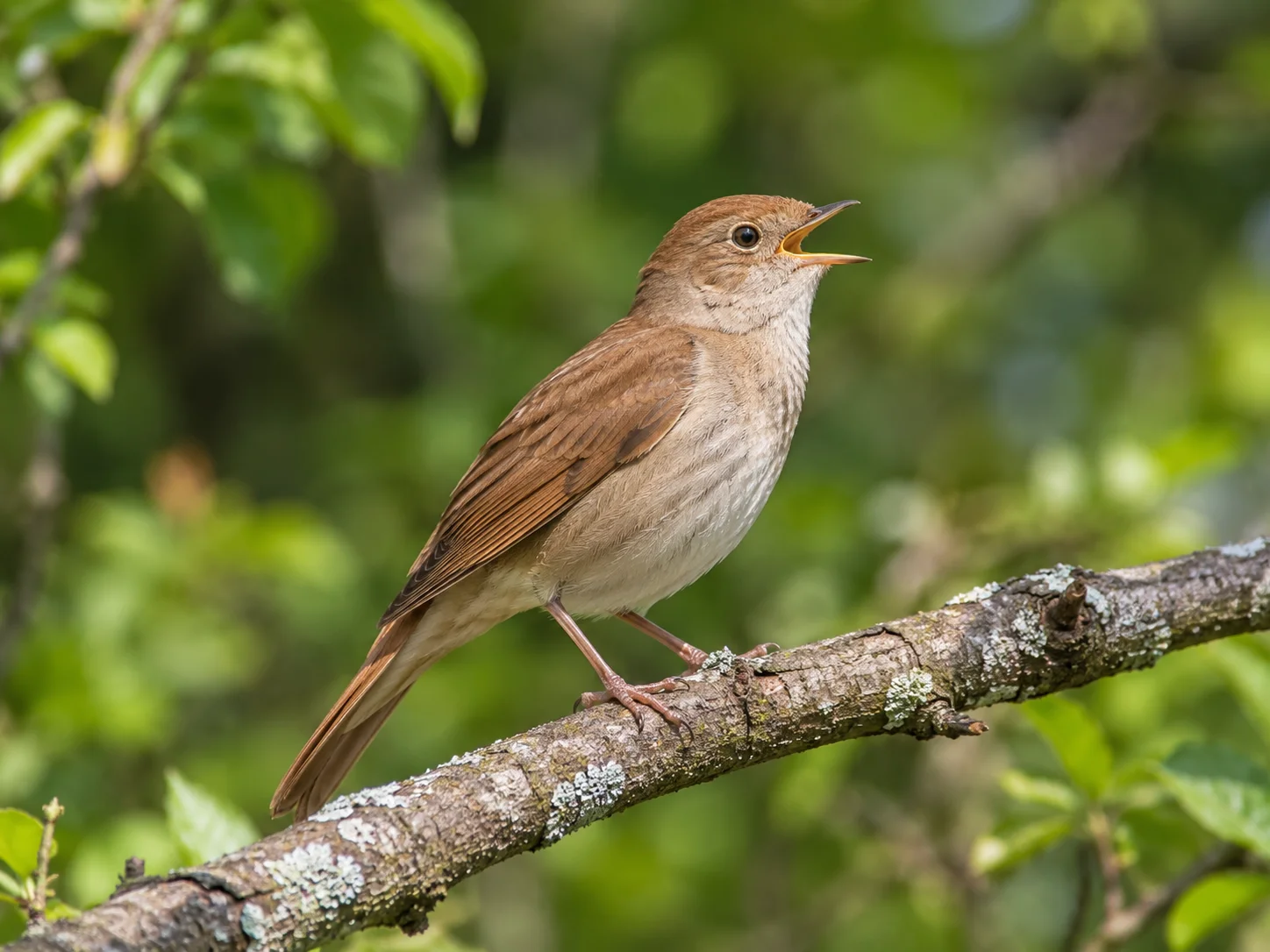
The nightingale is 6 to 6.5 inches long with a 9 to 10 inch wingspan, and weighs 0.6 to 0.9 ounces (17 to 24 g). It is slightly larger than a robin.
It is plain. Warm brown above, paler buff below, with a faintly rufous tail and large dark eyes. Males and females look identical, and there is no crest, no bright patch, nothing to photograph.
That plainness is probably not an accident. A bird that advertises itself by sound from inside a thicket gains nothing from bright plumage, and gains a good deal from being hard to see while doing it.
The one unusual feature is internal: the muscles controlling the syrinx are unusually well developed, which is what the whole animal is built around.
Habitat and Range
Nightingales breed across southern and central Europe, North Africa and western Asia, and winter in sub-Saharan Africa.
They are fussy about habitat in a very specific way. What a nightingale wants is dense low scrub with bare ground underneath: thickets of blackthorn or hawthorn, coppiced woodland a few years after cutting, overgrown hedges and damp scrubby thickets. It needs cover to sing from and open litter to feed on.
Mature woodland is no use to them, and neither is cleared ground. This is why nightingales have declined as coppicing stopped and as deer have eaten out the understory of English woods, which is one of the clearest cases anywhere of a bird lost because a habitat stopped being managed.
In Britain they are now largely confined to the southeast, and the northern edge of the range has been retreating southward for decades.
Diet and Feeding
Nightingales feed mainly on invertebrates, which makes them omnivorous overall, since they take berries in late summer and fall.
They forage on the ground in leaf litter, hopping and flicking leaves aside to find beetles, ants, spiders, earwigs, caterpillars and worms.
The fall switch to fruit matters more than it sounds. A nightingale about to cross the Sahara needs to put on fat fast, and berries do that in a way insects cannot, so the elderberries and blackberries in a thicket are migration fuel.
The need for bare ground under cover comes straight from this feeding style: a bird that hunts by turning over leaf litter cannot do it through thick grass.
Behavior and Lifestyle
Nightingales are secretive and territorial, and far more often heard than seen. Many experienced birdwatchers have heard hundreds and seen very few.
The night singing has a practical explanation. Sound carries better in cool still night air, there is less competition from other species, and a female migrating overhead in darkness can hear an unmated male below. Males sing by day too, but the daytime song is mostly aimed at rivals and the night song at attracting a mate.
Their migration is remarkable for a bird weighing less than an ounce. Nightingales fly from Europe to central and west Africa, crossing the Mediterranean and the Sahara, mostly at night and often in a few long flights, roughly 3,000 miles each way.
They are on the breeding grounds for a short season, arriving in April and gone again by August.
Reproduction and Life Cycle
Males arrive first and start singing to claim territory. Females arrive days later and choose, and the evidence suggests they choose largely on song, with repertoire size and the quality of the difficult whistles both mattering.
The nest is built by the female, low down or on the ground in dense cover, from leaves and grass.
She lays 4 to 5 olive-brown eggs and incubates them for about 13 days, with both parents then feeding the chicks, which fledge in 11 to 13 days.
One brood a year is typical, which is few, and it leaves little margin: a nest lost to a predator often means no young at all that season.
Nightingales live 1 to 3 years on average, with ringing records of birds over 8. Most of the mortality is on migration.
Predators and Threats
Cats, snakes, weasels, jays, magpies and sparrowhawks take nightingales, eggs and chicks, and a ground nest in low scrub is reachable by a great deal.
The declines come from elsewhere. Loss of scrub and coppice habitat is the main one, and in England deer browsing has removed the dense understory nightingales need across large areas of woodland. Hedgerow removal and tidy management take out more.
Then there is everything along a 3,000-mile route: drought and habitat loss in the Sahel, and illegal trapping of songbirds around the Mediterranean, which kills very large numbers of migrating birds every year.
They were also caught and caged for their song for centuries, a trade that persisted in Europe into the twentieth century and continues illegally in some places.
Conservation Status
The common nightingale is listed as Least Concern globally, because it remains widespread and numerous across southern Europe and western Asia.
The regional picture is poor. Britain has lost the great majority of its nightingales since the 1960s and they are now red-listed there, with the breeding range contracting into the southeast.
What works is known and specific: restore coppicing on a rotation so there is always young scrub somewhere, fence or reduce deer so the understory grows back, and leave hedges thick rather than trimmed flat. Where this has been done, nightingales have returned.
That makes the nightingale an unusually hopeful case. The bird is not rare globally and it is not fussy about anything we cannot provide. It needs scrubby thickets, and scrubby thickets are easy to grow if anyone decides to.
Role in the Ecosystem
Nightingales eat large quantities of ground invertebrates and disperse the seeds of the berries they eat in the fall.
They are a good indicator species. Because their requirements are so precise, a wood with nightingales in it is a wood with a working scrub layer, and their absence is a reliable sign the understory has gone.
Their largest effect, though, is on people. The nightingale is probably the most written-about bird in the world: Homer, Ovid, Chaucer, Shakespeare, Keats, Coleridge, Hans Christian Andersen, Oscar Wilde and Persian poetry, where the nightingale and the rose is one of the central images. In 1924 the BBC broadcast a live nightingale singing in a Surrey garden, and it became one of the most popular radio programs in Britain, repeated annually for years. It was the first outdoor wildlife broadcast anywhere.
Which leaves a slightly uncomfortable thought. We have spent three thousand years writing about this bird’s song, and in the places where most of that writing was done, there is now far less of it to hear.