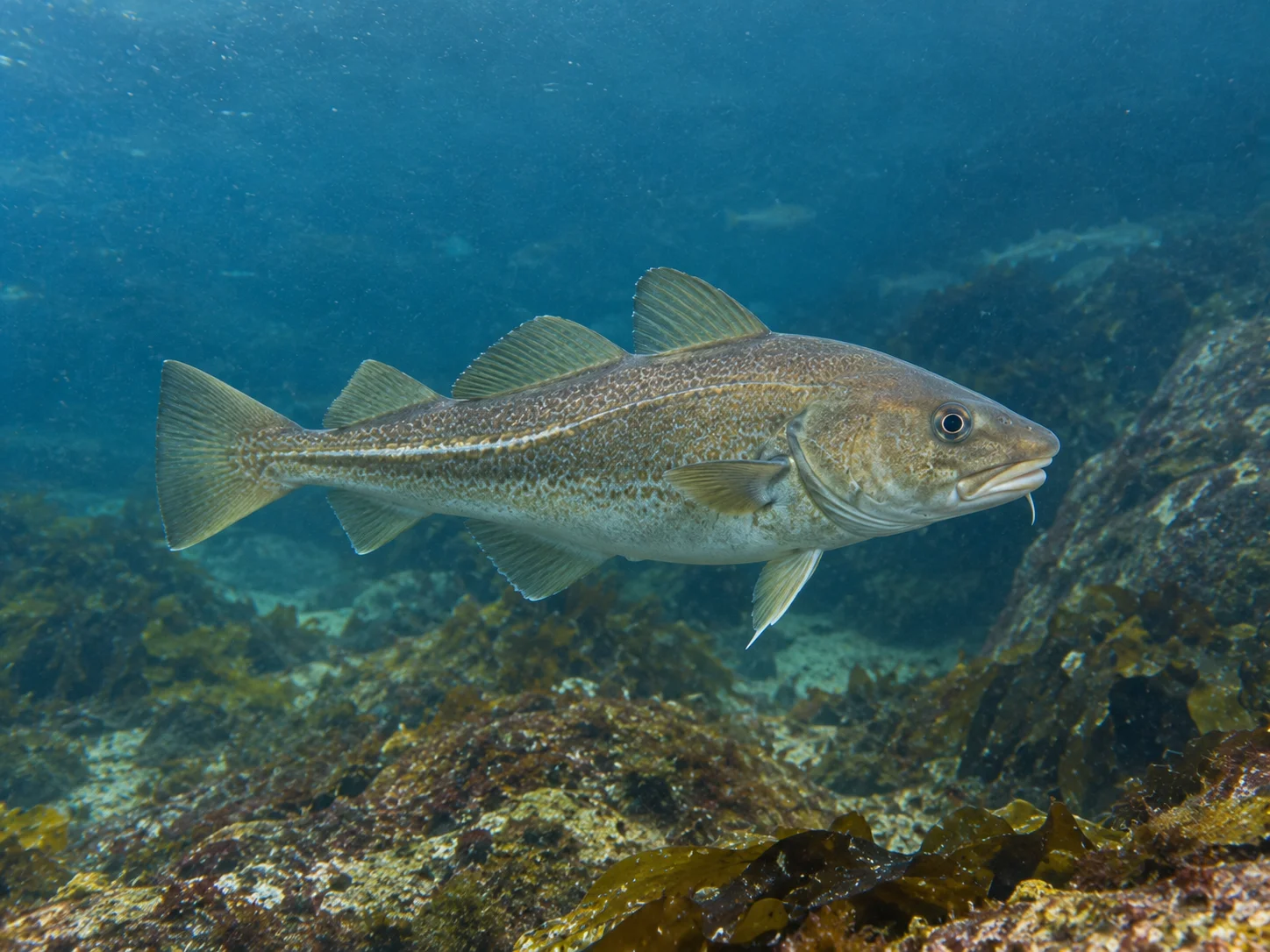
Meet the Codfish
When John Cabot reached the Grand Banks off Newfoundland in 1497, his crew reported that cod could be caught by lowering a basket into the water. For the next four centuries the fishery was treated as inexhaustible, and for practical purposes it behaved that way. The codfish, or Atlantic cod (Gadus morhua), is a cold-water fish of the North Atlantic and one of the most heavily fished animals in history.
On 2 July 1992, Canada closed it. The cod were gone: the spawning population had fallen by something like 99 percent, and around 35,000 people lost their jobs in a single announcement, the largest industrial layoff in Canadian history.
More than thirty years later the Grand Banks cod have still not properly recovered. That is the part worth sitting with. The fishing stopped, and the fish did not simply come back.
Scientific Name and Classification
The Atlantic cod is Gadus morhua. The Pacific cod, Gadus macrocephalus, and the Greenland cod are separate species in the same genus.
- Kingdom: Animalia
- Phylum: Chordata
- Class: Actinopterygii
- Order: Gadiformes
- Family: Gadidae
- Species: Gadus morhua
Haddock, pollock, whiting and hake are relatives in the same order, which is why they turn up interchangeably in fish and chip shops.
A great many fish are sold as cod without being cod. Rock cod, reef cod, Murray cod and various others belong to entirely different families, and the name traveled because cod was the fish people wanted to buy.
The Fish That Built Nations
Cod has shaped more history than almost any other animal, for one unglamorous reason: salted and dried, it keeps for years without refrigeration.
That made it the protein that let people cross oceans. Basque fishermen were working cod grounds in the North Atlantic before Columbus sailed and kept the location to themselves. Dried cod fed the Vikings on their voyages west. The medieval Catholic calendar, with its many days of abstinence from meat, created enormous demand for preserved fish, and cod met it.
It then became entangled in the slave trade, with the lowest grade of salt cod shipped to Caribbean plantations as cheap food for enslaved people, while merchants in New England grew rich on the trade. Massachusetts hung a carved wooden cod in its State House, where it still hangs, and called the fishery the source of the colony’s wealth, which it was.
Britain and Iceland fought three Cod Wars between the 1950s and 1976 over fishing limits, with ships ramming each other and nets being cut. Iceland won, and the 200-mile exclusive economic zone that is now standard in international law came substantially out of that dispute.
Appearance and Anatomy
Atlantic cod commonly reach 2 to 4 feet and 10 to 60 pounds, though the record is around 6 feet and 211 pounds. Fish that size no longer exist in most of the range, which is itself a consequence of fishing.
- Three dorsal fins and two anal fins, which distinguishes cod from most similar-looking fish.
- A barbel under the chin, used to feel for food on the bottom.
- A pale lateral line curving along the flank, clearly visible against the mottled brown or greenish body.
- A swim bladder used for buoyancy, and in cod it also amplifies sound, so they can hear well and the males drum with muscles against it.
Cod from Arctic waters carry antifreeze proteins in the blood, which bind to ice crystals and stop them growing, letting the fish live in water below the normal freezing point of its own body fluids. The same class of protein has been studied for use in preserving transplant organs and in ice cream.
Habitat and Range
Atlantic cod live in the cold North Atlantic, from Greenland and the Barents Sea down to the Gulf of Maine and the Bay of Biscay, mostly over continental shelves at 30 to 650 feet.
They are shelf fish rather than deep-ocean fish, which is exactly why they were so catchable. The Grand Banks are shallow, nutrient-rich plateaus where cold and warm currents meet, and the cod gathered there in numbers that are hard to credit now.
They form distinct stocks that stay separate and spawn in particular places at particular times, and this matters for management: losing one stock is losing a population with its own timing and behavior, not just a share of a global total.
Some populations migrate long distances to spawn, and the Barents Sea cod travel to the Norwegian coast every year in a run that has supported fishing villages for a thousand years.
Diet and Feeding
Cod are carnivores and fairly indiscriminate ones, eating capelin, herring, sand eels, young cod, crabs, shrimp, squid, worms and mollusks.
They feed by engulfing prey with a large mouth rather than chasing it down, and they hunt near the bottom using the chin barbel and good low-light vision.
They are cannibalistic, and large cod eat small cod routinely. This turns out to matter: in a healthy population, big cod suppress the numbers of other predators and competitors, and when the big fish are removed the system does not simply revert.
Their stomachs have produced some remarkable finds over the centuries, including a book, which is the sort of thing that happens when a fish swallows anything that fits.
Behavior and Lifestyle
Cod live in schools, often large ones, and move between deeper water and the shelf with the seasons.
They are noisier than most people expect. Males drum using muscles against the swim bladder, producing a low grunt used in courtship, and research has found that cod populations have different drumming patterns, which raises the possibility that a stock has something like a local dialect. If so, mixing stocks may not work as well as managers hoped.
They are also long-lived and slow to mature, and that combination is the heart of their vulnerability. A cod needs years to reach breeding size, and a big old female produces vastly more eggs than a small young one.
Heavy fishing selects against size and late maturity, and Atlantic cod now mature younger and smaller than they did a century ago. That is evolution driven by fishing gear, and it is measurable.
Reproduction and Life Cycle
The numbers behind cod reproduction are extraordinary and slightly misleading. A large female cod releases 3 to 9 million eggs in a spawning season, and exceptional fish have produced more.
The eggs are fertilized in open water and drift with the current, and almost none survive. Of millions, a handful reach adulthood, and that is normal rather than a sign of anything wrong.
This is why fecundity is not safety. A fish that lays millions of eggs still depends on a large population of mature adults, because the survival rate is so close to zero that only enormous numbers of eggs produce enough recruits. Remove the big females and the arithmetic fails.
Larvae hatch in two to three weeks, feed on plankton, and settle to the bottom at a few months old. Cod mature at two to eight years depending on the stock and live 12 to 25 years, with records past 30.
Predators and Threats
Seals, sharks, larger cod and seabirds eat cod, and eggs and larvae are eaten by almost everything in the plankton.
The threat is fishing, and the Grand Banks collapse is worth understanding mechanically rather than as a morality tale:
- Technology outran the fish. Factory trawlers arriving in the late 1950s could take in an hour what a schooner took in a season, and bottom trawling destroyed the seafloor habitat as it went.
- The science was overruled. Scientists warned repeatedly through the 1980s. Quotas were set above their advice for economic and political reasons.
- The data was wrong in a dangerous way. Catch rates stayed high while the population crashed, because the boats were getting better at finding the remaining concentrations. The fishery looked healthy right up until it was empty.
- The ecosystem reorganised. With cod gone, crab, shrimp and forage fish increased, and those species eat cod eggs and larvae. The new state resists the old one returning.
Warming water adds to it, pushing cod north and reducing recruitment in the Gulf of Maine in particular.
Conservation Status
The Atlantic cod is listed as Vulnerable, and the status by stock varies enormously, which is the only useful way to read it.
Newfoundland’s northern cod remain at a small fraction of historical levels after three decades of closure, with a limited fishery reopened in 2024 to considerable argument. The Gulf of Maine stock is badly depleted. The North Sea stock has partly rebuilt after severe cuts.
The Barents Sea stock is the counter-example and deserves credit. Jointly managed by Norway and Russia with quotas that follow scientific advice, it has remained one of the largest and healthiest cod stocks in the world. Cod can be fished sustainably; it is a question of whether anyone is willing to.
For anyone buying cod, the stock matters more than the species. Barents Sea and Icelandic cod are generally well managed, and certification schemes exist precisely because the label alone tells you nothing.
Role in the Ecosystem
Cod were a dominant predator across the North Atlantic shelf, controlling capelin, herring, crab and shrimp, and their removal changed those systems in ways that are still visible.
The Grand Banks is now a crab and shrimp fishery rather than a cod fishery, which is sometimes described as a replacement and is better understood as a different ecosystem occupying the same water. Newfoundland’s economy adapted to the animals that moved in.
Their collapse also changed science. The Grand Banks is the case study in almost every fisheries course in the world, and the ideas that came out of it, that catch rates can hide a collapse, that an ecosystem can lock into a new state, and that political quota-setting overrides biology, now underpin how fisheries are managed everywhere.
And there is the simplest lesson on the site. A fish that lays nine million eggs, that fed Europe for five hundred years, and that was described as inexhaustible by everyone who saw it, was fished to one percent of its numbers in about thirty years. Abundance was never the same thing as safety.