Meet the Zonkey
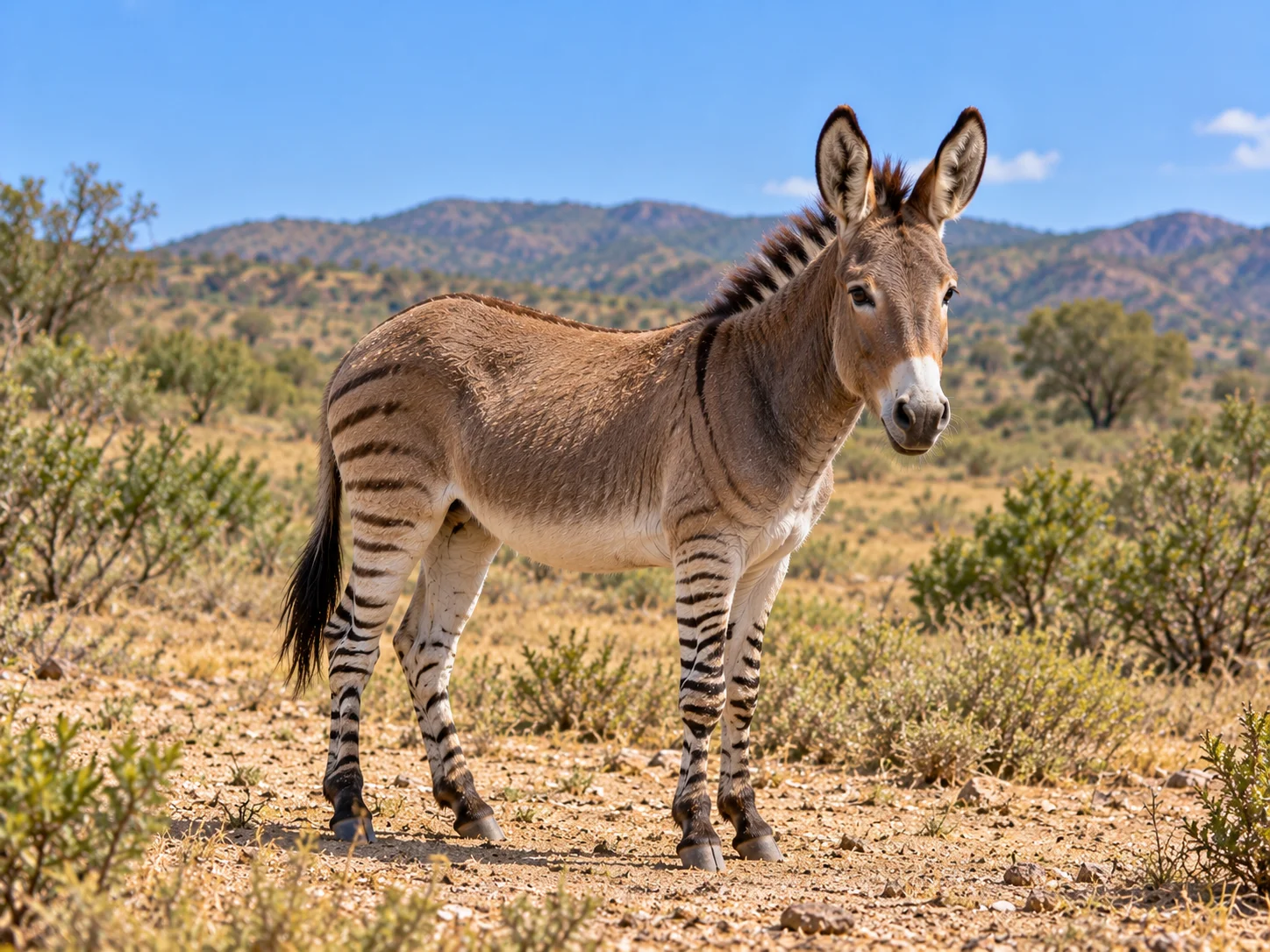
A zonkey is the foal of a zebra and a donkey. It usually looks like a donkey wearing striped socks.
It is not a species, and it is not an animal you will find a wild population of. A zonkey is a one-off, almost always born in captivity, and almost always unable to have young of its own.
What makes it worth a page is what it shows about where one species ends and the next begins. Zebras and donkeys are close enough to produce a living, healthy foal together, and far enough apart that the foal is a dead end.
What a Zonkey Is Called
The umbrella word for any zebra hybrid is zebroid. Within that, the names are usually built by jamming the two parent animals together, and the convention puts the father first.
- Zonkey: a zebra crossed with a donkey. Also called a zedonk, zenkey or zebrass
- Donkra: the reverse cross, a donkey father and a zebra mother
- Zorse: a zebra stallion with a horse mare
- Hebra, or zebrinny: a horse stallion with a zebra mare
- Zony: a zebra stallion with a pony mare
So zonkey and donkra are the same pair of animals in opposite order, and which way around it happened changes what the foal is called.
Classification
- Kingdom: Animalia
- Phylum: Chordata
- Class: Mammalia
- Order: Perissodactyla
- Family: Equidae
- Parentage: a zebra, usually Equus quagga, crossed with the domestic donkey, Equus asinus
There is no scientific name for a zonkey, and there should not be. Scientific names belong to species, and a sterile hybrid is not one.
Why a Zonkey Cannot Have Foals
This is the heart of the thing, and it comes down to counting.
Horses, donkeys and zebras all have different numbers of chromosomes. Across the family the count runs from 32, in the mountain zebra, up to 66, in Przewalski’s horse. A donkey has 62. A hybrid foal inherits half of each parent’s set, so it ends up with a number roughly halfway between them, and it ends up odd.
Making eggs or sperm requires chromosomes to pair up and divide evenly, which an odd number cannot do. The cell division fails, and the animal is sterile. It is the same reason a mule cannot breed.
There is a slight asymmetry, which biologists call Haldane’s rule. Female hybrids are poorly fertile rather than completely infertile, so very rare exceptions turn up among the females. Males are generally sterile with no exceptions worth counting on.
Appearance
A zonkey takes its body color from its donkey parent, so it is usually tan, brown or gray, with lighter underparts. The stripes come through only where the coat is pale, which is why they show up on the legs and belly and often nowhere else.
In size and build it sits between the two parents, and since a donkey and a zebra are not far apart to begin with, that means something broadly donkey-shaped with a stiffer mane and a striped lower half.
Health is a real concern with zebra crosses. Dwarfism is common in them, and temperament is the other recurring problem: zebroids tend to be more difficult than purebred horses, and a zebra is a strong, genuinely aggressive animal that does not domesticate the way a horse does.
Do Zonkeys Happen Naturally?
Very rarely, and only where the two animals end up living alongside each other, which in practice means near people.
Cases are reported from South Africa, where zebras and domestic donkeys share ground, and a natural mating was documented in Borana, in Ethiopia. Both situations involve a wild zebra and a farm animal, not two wild populations meeting.
Why People Bred Zebra Hybrids
The history here is older and odder than you would expect, and the motives were mostly practical.
- In 1815 Lord Morton crossed a quagga stallion, from a zebra now extinct, with a chestnut Arabian mare
- Cossar Ewart crossed zebras with ponies to test telegony, the old belief that a mare’s earlier mate could influence later foals by another sire
- During the South African War the Boers crossed Chapman’s zebras with ponies to pull guns
- Zoos bred zedonks in the 1970s, partly in the hope of producing a disease-resistant riding and draft animal
That last reason is the most interesting one. Zebras resist sleeping sickness, which kills horses and ponies, so a hybrid with a zebra’s resistance and a donkey’s workable temper would have been genuinely valuable across tropical Africa.
It did not work out, largely because the temperament did not come through as hoped, and because every animal has to be bred from scratch. A sterile hybrid cannot found a line. You cannot build a working breed out of animals that cannot reproduce, which is why the zonkey has stayed a curiosity instead of becoming a farm animal.
Famous Zonkeys
Because each one is a news story, individual zebroids get names and dates.
- Alex, a zonkey born in Barbados in 2005, reported as the first there
- Eclyse, a hebra born in Germany in 2007 to a zebra mare and a horse stallion
- Ippo, a zonkey born in Florence, Italy, in 2013
- Khumba, a zonkey born in Reynosa, Mexico, in 2014
- Zippy, a zonkey born in Somerset, England, in 2018
- Shadow, a zedonk at Colchester Zoo, which died in 2009
Today zebroids are kept mainly as curiosities in circuses and smaller zoos, and occasionally as riding or draft animals.
Conservation Status
A zonkey has no conservation status, because the IUCN assesses species and a hybrid is not one. There is nothing to count and nothing to protect.
Its parents are a different matter. Domestic donkeys are not assessed either, being farm animals, but zebras are, and their listings range from Near Threatened to Endangered depending on the species.
What the Zonkey Teaches
Species are usually explained to children as groups that cannot interbreed, and the zonkey shows that the real line is blurrier than that.
A zebra and a donkey can interbreed. They produce a healthy foal that grows up, eats, runs and lives a normal lifespan. What they cannot produce is a third generation, and that is the actual boundary: not whether two animals can have young, but whether those young can carry the line forward.
A zonkey is what a species boundary looks like from the inside. It works once, and then it stops.