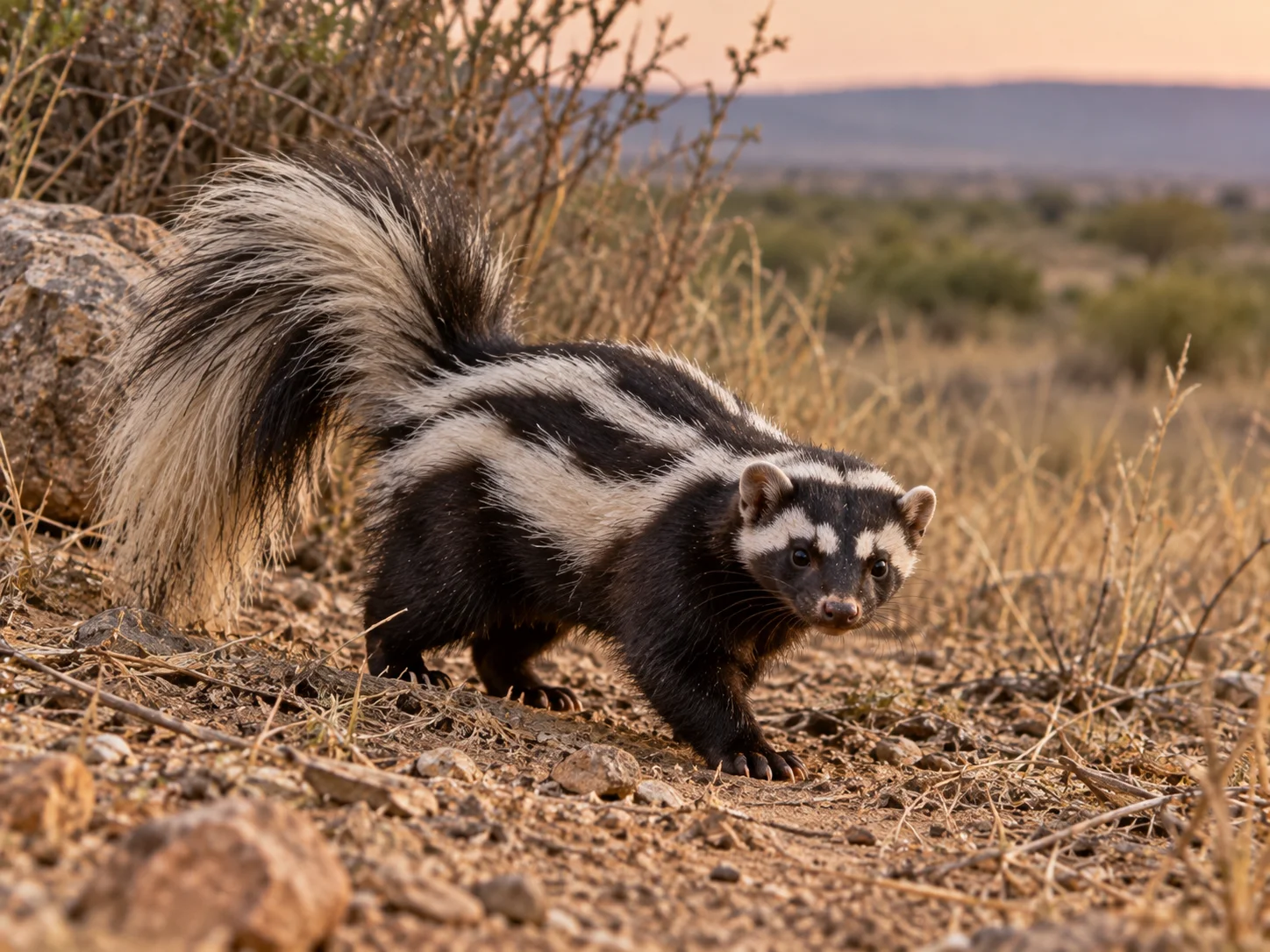
Meet the Zorilla
The zorilla looks like a skunk, walks like a skunk, and sprays like a skunk. It is not a skunk.
It is a small African mustelid, a relative of weasels, badgers and otters, and its resemblance to an animal on another continent is one of the cleaner examples of convergent evolution you can find in a mammal. Two unrelated lineages arrived at the same answer: be black and white, be slow and obvious about it, and smell appalling.
The name comes from the Spanish zorrillo, meaning skunk, so even the word is a case of mistaken identity.
Scientific Name and Classification
The zorilla is Ictonyx striatus, described by Perry in 1810, and known more properly as the striped polecat.
- Kingdom: Animalia
- Phylum: Chordata
- Class: Mammalia
- Order: Carnivora
- Family: Mustelidae
- Species: Ictonyx striatus
That family line is the important one. Skunks are Mephitidae, a family of their own. The zorilla is Mustelidae, which makes it a closer relative of a weasel than of the animal it is named after, and it is why the alternative name African skunk is considered inaccurate.
It goes by a long list of names: striped polecat, zorilla, zorille, African polecat, Cape polecat, African muishond and striped muishond.
Appearance and Size
A zorilla has a body 12 to 15 inches (30 to 38 cm) long, with a tail adding another 9 to 12 inches (22 to 30 cm), and weighs 1.5 to 3.1 pounds (0.7 to 1.4 kg). Males are the larger sex by a wide margin, running about 50 percent heavier than females.
- Mostly black, with four white stripes down the back
- Those stripes start from a white band across the back of the head
- White patches on the cheeks and a white spot on the forehead
- White in the tail, which is long and bushy
- The exact pattern varies between individuals
The whole design is a warning label. Black and white in a small mammal, worn conspicuously by an animal that does not run, almost always means it has something unpleasant in reserve.
Habitat and Range
The zorilla ranges across most of sub-Saharan Africa, from Mauritania east to southeastern Egypt and all the way south to South Africa. It is missing from the dense rainforests of West Africa and from the Congo Basin.
Within that enormous range it is not fussy. Grassland, forest, rocky ground and desert all suit it, and it has been recorded from sea level up to 13,700 feet (4,180 m). What it prefers is open country.
The Spray
Glands near the anus release a fluid described as nauseating and badly irritating to the eyes. It is the zorilla’s whole defensive strategy, and it works on most mammalian predators.
What is interesting is that the animal would rather not use it. First comes a warning: the zorilla arches its back and lifts its tail, making itself as visible as possible and giving whatever is approaching a clear chance to reconsider. Spraying is the second step, not the first.
If that fails, it has a third option, which is to play dead.
Birds are the gap in the system. They tolerate the smell far better than mammals do, so a bird of prey is much less impressed by a zorilla’s display than a jackal would be.
You will often see the zorilla called the smelliest animal in the world. It is a fun claim and it may well be true, but it is worth noticing that it is not something anyone has actually measured. Skunks, striped polecats and a few others all produce foul sulfur compounds from anal glands, and ranking them is harder than it sounds.
Diet and Hunting
Insects are the zorilla’s most important food, followed by mice and rats of the murid family, then reptiles. It also takes birds, eggs, amphibians and other invertebrates.
There is one recorded exception, and it is a sensible one. Zorillas generally avoid bufonid toads, the family that includes the true toads with poison glands behind the eyes. An animal that eats almost anything still knows what not to eat, which is the same judgment a mongoose shows around prey it cannot safely handle.
Behavior
Zorillas forage at night and spend the day in a burrow or a rock crevice, which is a large part of why an animal with this range is so rarely seen.
They are solitary. The exception is a mother with her young, who form a small family group for a while. Adult males are openly hostile to one another.
Breeding and Life Cycle
Gestation is short, about 36 days, and a female usually raises one litter of two or three young a year.
Newborns arrive blind, deaf and almost hairless, and are weaned by about eight weeks. In the wild a zorilla typically lives four or five years. In captivity, with no predators and reliable food, one has passed thirteen, which is nearly three times the usual wild figure.
Conservation Status
The IUCN lists the zorilla as Least Concern, and has done so consistently, in 1996, 2008 and 2015.
The reasons are straightforward. It occupies most of a continent, it lives in nearly every habitat that continent offers, it eats whatever is available, and very little wants to eat it.
Role in the Ecosystem
A small nocturnal predator that lives mainly on insects and rodents is doing quiet, useful work across a very large area, and farmers with a rat problem have a friend in the zorilla whether they know it or not.
Its better lesson, though, is the one it teaches by accident. If you put a zorilla and a skunk side by side, you are not looking at two relatives. You are looking at two separate families of carnivore, on two continents, that independently worked out the same defense and the same advertising to go with it. That is what convergent evolution looks like, and it is rarely this easy to see.