Meet the Airedale Terrier
In the First World War, an Airedale terrier called Jack ran a message four miles across open ground under shellfire. He arrived with a shattered jaw, a splintered leg and the message still attached, delivered it, and died minutes later. The battalion he was carrying it for was saved.
Airedales did that work in large numbers. They were the standard British messenger dog of that war, chosen because they were big enough to cover ground, calm enough to work under fire, and clever enough to find their way back.
They are the largest of all terriers, which earned them the nickname King of Terriers.
Scientific Name and Classification
The Airedale terrier is a breed of domestic dog, Canis familiaris. Every dog breed shares the same scientific name.
- Kingdom: Animalia
- Phylum: Chordata
- Class: Mammalia
- Order: Carnivora
- Family: Canidae
- Species: Canis familiaris
Kennel clubs place it in the terrier group, where it is comfortably the biggest member. A typical terrier weighs 15 to 25 pounds; an Airedale weighs 50 to 70.
It has contributed to other breeds too, and stands behind the development of several larger working terriers.
Why Is It Called the King of Terriers?
Because of size and the range of jobs it has done.
Most terriers were bred small on purpose, to follow rats and foxes into holes. The Airedale was bred for a different problem: hunting otters and large rats along the rivers of Yorkshire, which meant swimming, working in cold water, and tackling something that fought back.
So it was built larger, with a terrier’s nerve in a body the size of a retriever’s.
The name is literal. The breed comes from the valley of the River Aire in West Yorkshire, where working men crossed local black-and-tan terriers with otterhound-type dogs in the mid-1800s. It was first shown as the Waterside Terrier and the Bingley Terrier before the name Airedale stuck.
That size then made it unusually versatile. Airedales have worked as police dogs, army messengers, search dogs, guard dogs, ratters, bird dogs and big-game hunting dogs, which is a wider range of employment than almost any other breed can claim.
Origin and History
The Airedale was created in Yorkshire around the 1850s by mill workers and miners who wanted a dog that could hunt, swim, kill vermin and guard the house.
It then went to work in a remarkable number of places. Airedales were among the first dogs used by British police forces. They served as Red Cross casualty dogs, finding wounded men on battlefields, and as messengers in the First World War, where Lieutenant Colonel Edwin Richardson trained them at the British War Dog School.
They were also fashionable. President Warren Harding’s Airedale, Laddie Boy, was famous enough in 1920s America to have a seat at cabinet meetings and his own newspaper coverage, and Theodore Roosevelt kept one too.
Then German Shepherds largely replaced them in police and military work, and the Airedale became uncommon. It is now a relatively rare breed, which is an odd fate for a dog that was once everywhere.
Appearance and Anatomy
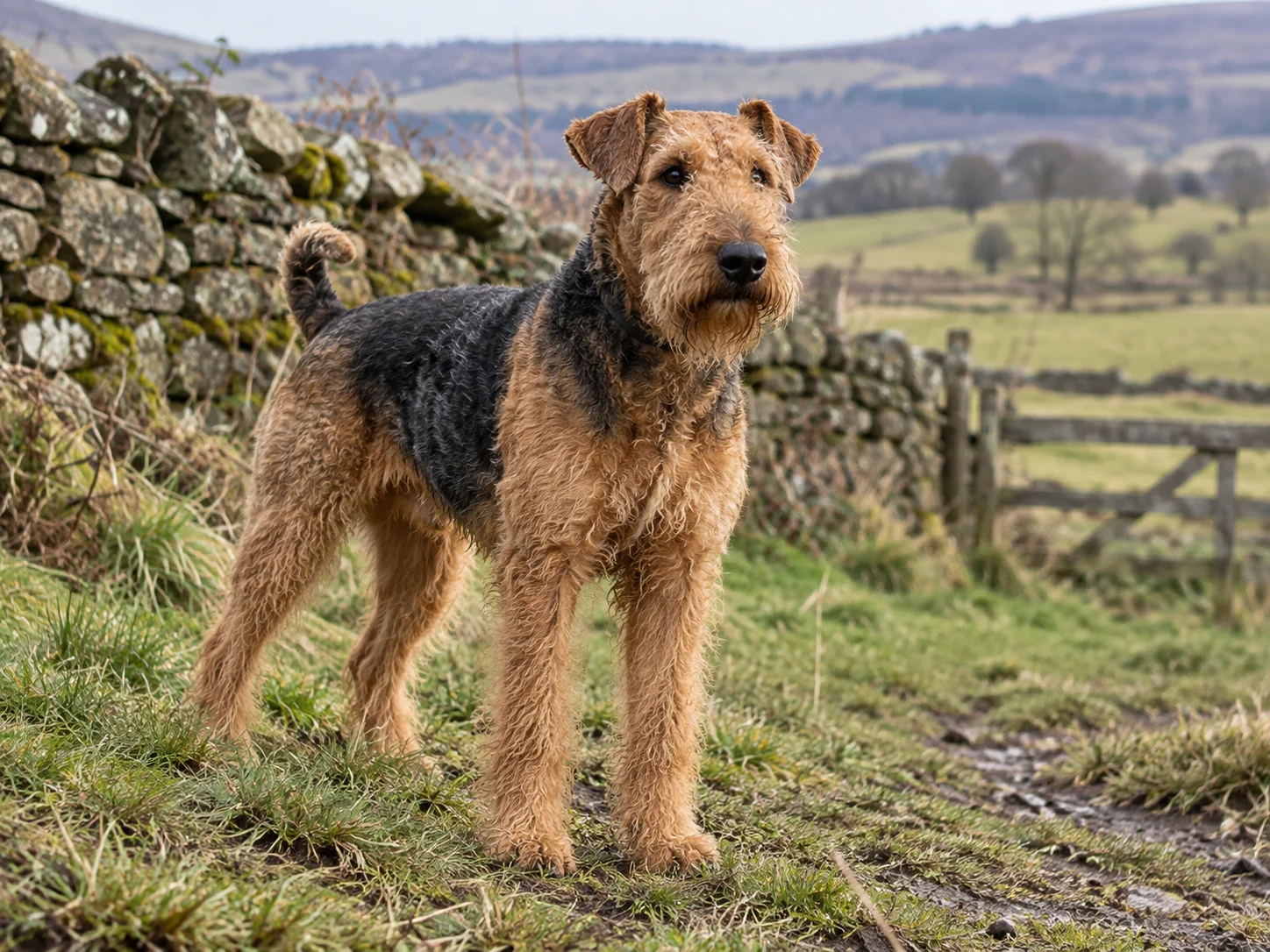
Airedales stand 21 to 24 inches at the shoulder and weigh 50 to 70 pounds, with a square, upstanding outline.
- Coat. Hard, dense and wiry over a softer undercoat, always tan with a black or dark grizzle saddle over the back and sides.
- Head. Long and flat, with a beard and mustache that give the breed its distinctive square-jawed look.
- Ears. Small, V-shaped and folded forward.
- Legs. Long and straight, built for covering ground and for swimming.
- Coat care. The wiry texture is traditionally maintained by hand-stripping rather than clipping, because clipping softens it permanently.
They shed very little, which people like, but low shedding is not the same as low maintenance.
Temperament and Behavior
Confident, intelligent, playful and strong-willed, with a terrier’s independence in a large dog’s body.
- Clever. Airedales learn quickly and get bored quickly, and a bored one will invent a job for itself, usually a destructive one.
- Independent. Terriers were bred to work out of sight of their handler and make their own decisions, so an Airedale will consider an instruction rather than simply obey it.
- Protective. Naturally watchful and a genuine deterrent, without being a nervous barker.
- Playful for life. They stay boisterous well into adulthood, which is charming in a garden and awkward in a small flat.
- Dog-selective. Many Airedales do not suffer other dogs gladly, particularly same-sex dogs, and early socialisation matters.
- Strong prey drive. They were bred to kill vermin, so cats and small pets are usually a poor match.
They need real exercise, an hour or more a day, and mental work alongside it. Training works best with variety and reward rather than repetition, because an Airedale asked to do the same thing twenty times will simply stop cooperating.
Diet and Feeding
Airedales are omnivores, like all dogs, and eat a normal complete dog food suited to a medium-to-large active breed.
They are prone to putting on weight if exercise drops, and an overweight Airedale puts avoidable strain on its hips.
The beard needs wiping after meals, since a wiry muzzle holds food and water.
The usual warnings apply: chocolate, grapes and raisins, onions and garlic, and the sweetener xylitol are all toxic to dogs.
Health and Life Span
Airedales live 11 to 14 years, which is good for a dog of this size.
The conditions to know about are hip dysplasia, hypothyroidism, eye problems including progressive retinal atrophy, skin allergies, and bloat, where the stomach fills with gas and can twist. Bloat is an emergency and owners of deep-chested breeds should know the signs.
Cancer rates are somewhat higher than average in the breed, particularly in older dogs.
Litters run to 7 to 9 puppies. A responsible breeder screens for hip and eye problems and thyroid function, and asking to see those results is the most useful thing a buyer can do.
Is an Airedale Terrier Right for Your Family?
It suits active households with space, people who enjoy training a dog that argues back, families with older children, and anyone wanting a watchful dog that is not a nuisance barker. They are affectionate and genuinely funny to live with.
It suits badly first-time owners, homes with cats or small pets, people out all day, small flats, and anyone who wants an obedient dog. An under-exercised, under-stimulated Airedale is a serious handful.
They are good with children they have grown up with, though a boisterous 65-pound dog needs supervising around toddlers.
The Airedale Terrier’s Place Among Dogs
The Airedale is a good illustration of how breeds are shaped by local problems. A specific valley in Yorkshire needed a dog that could swim a river, kill a rat, face an otter and guard a house, and within a few decades working men had built one.
Its war record is also a reminder of something easy to forget: dogs were used as communication technology. Before reliable field radio, a dog that could carry a message across ground no runner could survive was a military asset, and Airedales did that job at considerable cost.
And its decline says something about fashion rather than quality. The Airedale was replaced in police and military work and drifted into rarity, while the qualities it was bred for have not changed at all.