Meet the Xerus
A xerus is a ground squirrel from the dry country of East Africa, and it is named for what it does not have.
Africa’s other ground squirrels wear a neat white stripe along each side. This one does not, which is why its common name is the unstriped ground squirrel, a plain sandy animal in a family full of markings.
It breaks a bigger rule than that. Ground squirrels are famous for living in crowds, standing guard for one another and calling out warnings. A xerus mostly lives alone, keeps its own burrow, and sorts out its own problems.
Scientific Name and Classification
The xerus is Xerus rutilus, and it is now the only species left in the genus Xerus. Its old relatives have been moved into genera of their own as scientists have sorted out how African ground squirrels are related.
- Kingdom: Animalia
- Phylum: Chordata
- Class: Mammalia
- Order: Rodentia
- Family: Sciuridae
- Genus: Xerus
- Species: Xerus rutilus
Sciuridae is the squirrel family, so a xerus is a close cousin of every tree squirrel, chipmunk and marmot. The genus name comes from a Greek word meaning dry, which is a fair summary of where it lives.
Appearance and Anatomy
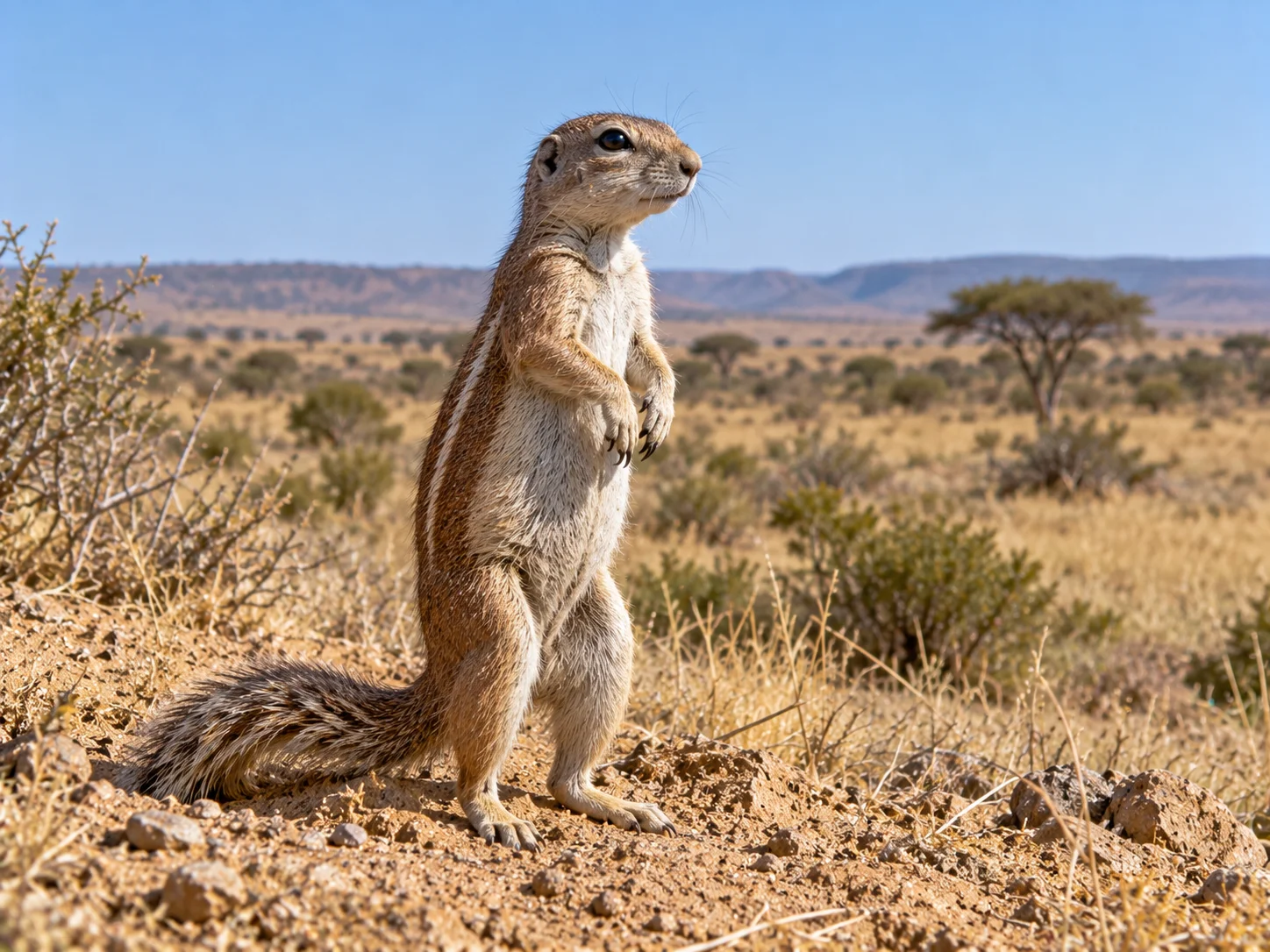
A xerus measures about 8 to 10 inches (20 to 26 cm) in the body, with a tail of 5 to 9 inches (12 to 23 cm) behind it, and weighs roughly 9 to 15 ounces (260 to 420 g), about as much as a can of soup.
- Sandy to cinnamon fur with no side stripes
- Broad, flattened tail carried over the back
- Short front limbs with heavy digging claws
- Eyes set high for watching the sky
- Males and females the same size
The tail is the part worth watching. It is wide and flat rather than bushy, and a xerus holds it arched over its back as a sunshade, moving it to keep its own shadow over its body as the sun shifts.
Habitat and Range
Xerus live across the dry east of Africa: Ethiopia, Eritrea, Djibouti, Somalia, Sudan, Kenya, Uganda and Tanzania, from sea level up to around 6,500 feet (2,000 m).
They want open, arid bush and scrubby savanna with soil soft enough to dig. Burrows go in at the base of a stunted acacia, under a thicket, or into the side of a termite mound, which gives the tunnel a solid roof.
Each animal usually has its own burrow system, occupied alone or shared with a single other adult. Home ranges overlap freely, and a male covers far more ground than a female: around 17 acres against roughly 3.
Diet and Feeding
More than half of what a xerus eats is dry seeds and leaves. The rest is roots, stems, pods, fruit (baobab is a favorite) and a share of insects, which makes it an omnivore rather than a strict vegetarian.
It is an unusually capable feeder. A xerus copes with plant chemicals that put other animals off, including the bitter tannins in acacia and commiphora seeds, and it handles foods containing oxalates that many mammals avoid. In practice that means a wider menu in country where there is not much menu to choose from.
Surplus food gets buried. A xerus scatter-hoards, pushing single seeds into the soil in dozens of separate places rather than filling one larder, so no single discovery costs it everything.
Behavior and Lifestyle
A xerus is awake by day and spends almost all of it above ground, using the burrow mainly for sleeping and for emergencies.
The morning starts with sunbathing. A xerus will sit out for as long as half an hour soaking up heat before it goes to work, which saves the energy a small mammal would otherwise burn warming itself up.
Shedding that heat later takes a trick worth knowing. After foraging in the open, a xerus will find shade and press its belly flat against the cooler ground, dumping heat out of the thinly furred underside like a hand on cold metal. In the worst of the afternoon it goes below entirely.
It is not territorial, and it is strikingly relaxed about property. A frightened xerus will dive into the nearest hole whether or not the hole is its own, and it puts up with visiting squirrels in its own burrow, including squirrels of other species. For an animal that lives alone, it is a surprisingly poor gatekeeper.
Reproduction and Life Cycle
Litters are small: one or two young, born in a burrow chamber, blind and helpless. Breeding has been recorded mainly around March and April, though animals in some areas appear to breed whenever conditions allow.
How long a xerus lives in the wild is not really known, because small rodents are hard to follow for years at a time. The best recorded figure comes from captivity, where a male collected on the Blue Nile in 1913 lived just over six years.
Predators and Threats
A small animal feeding in the open by day is a target from above all day long. Tawny eagles, martial eagles and bateleurs hunt xerus, as do the leopard, the black-backed jackal, and snakes that come down the burrows after them.
That is the reason for the high-set eyes, the constant pauses to sit up and scan, and the willingness to use any burrow in reach. Living alone means no sentry on duty, so every xerus is its own lookout.
The species itself is not in trouble. The IUCN lists it as Least Concern: its range is large, it copes with dry and disturbed country, and it is not hunted in any significant way.
Role in the Ecosystem
Scatter-hoarding makes a xerus a gardener by accident. Every seed it buries and never comes back for is a seed planted at the right depth in bare ground, and acacias and commiphoras spread partly on the strength of squirrel forgetfulness.
Its burrows outlast it too, becoming shelter for insects, lizards, snakes and smaller mammals in a landscape that offers very little cover. And it feeds a long list of hunters, which makes it one of the links that carries energy from dry seeds up to eagles.
For all that, the xerus gets noticed mostly for its name. It is one of the handful of animals that gives the letter X anything at all, and unlike some of them, it is a real, common, everyday creature going quietly about its business in the African scrub.