Meet the X-Ray Fish
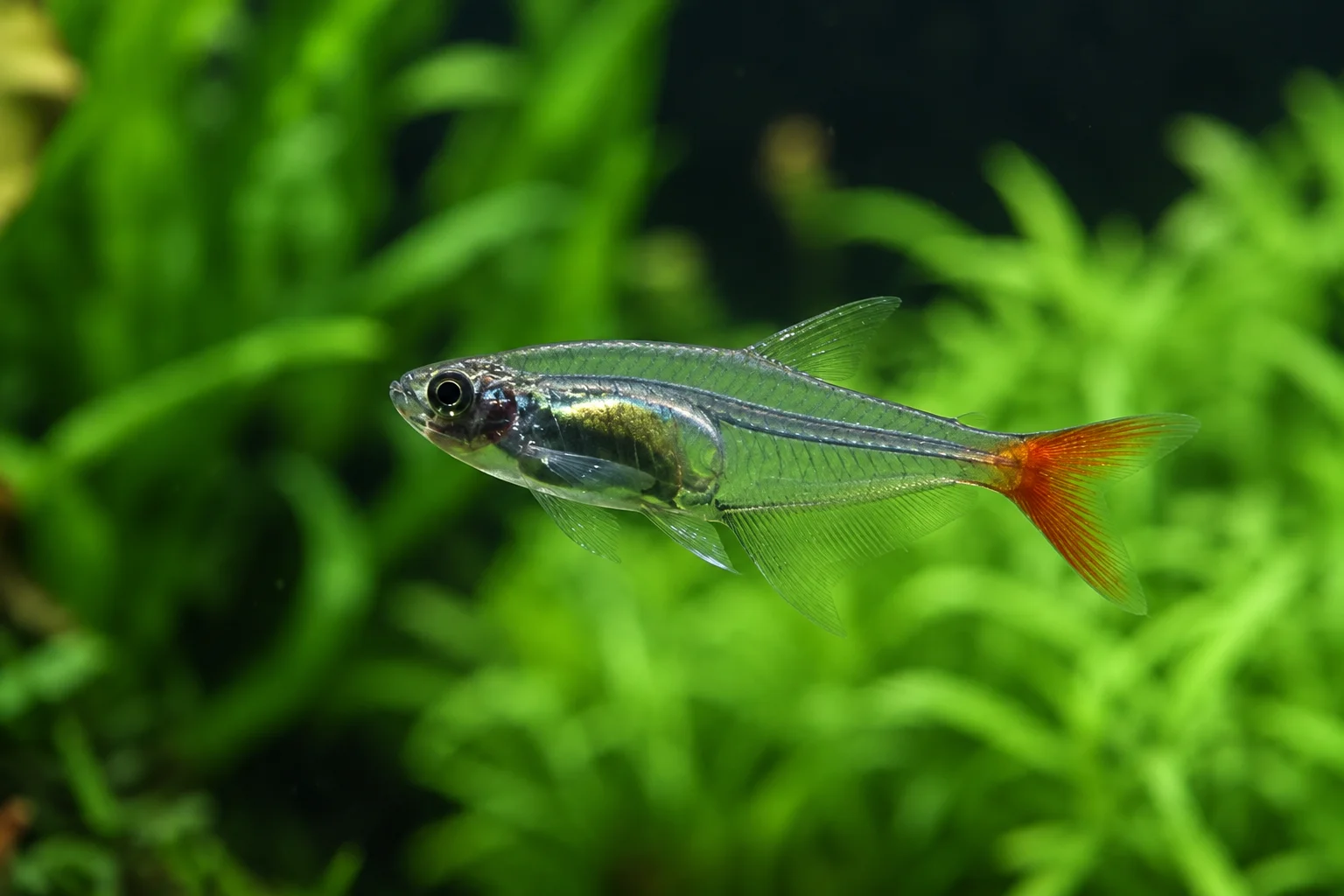
Hold an x-ray fish up to the light and you can see its spine. Not through a scan or a trick of photography, just by looking: the backbone, the swim bladder and the outline of its organs are visible through the side of the living animal.
That is where the name comes from, and it is the reason this little South American tetra has been a favorite in home aquariums for a century.
Being see-through is not a novelty. In open water, it is the best camouflage there is.
Scientific Name and Classification
The x-ray fish’s scientific name is Pristella maxillaris. It is also called the x-ray tetra, pristella tetra, water goldfinch or signal tetra.
- Kingdom: Animalia
- Phylum: Chordata
- Class: Actinopterygii (ray-finned fish)
- Order: Characiformes
- Family: Characidae
- Species: Pristella maxillaris
It is a characin, the same family as the neon tetra and, more distantly, the piranha. It is the only species in its genus.
Despite the name it has nothing to do with x-rays, and it is not related to the various other transparent fish sold as glass fish.
Why Can You See Through It?
Because almost nothing in its body blocks light.
Two things make an animal opaque: pigment, and tissues that scatter light as it passes between layers of different density. The x-ray fish has very little pigment in its flesh, and its muscle and connective tissue are arranged so that light passes through with little scattering.
What remains visible is what cannot be made transparent. The backbone shows as a clear line. The swim bladder shows as a silvery pocket, because it is full of gas and gas bends light very differently from flesh. The eyes stay dark, because an eye that let light straight through could not see.
And the point of all this is to disappear. In open sunlit water there is nowhere to hide, so a small fish’s best option is to let the light through and show predators almost nothing. Transparency has evolved again and again in open-water animals for exactly this reason, from jellyfish to squid larvae to shrimp.
Appearance and Anatomy
X-ray fish reach about 1.5 to 2 inches long and weigh well under a gram. They are small enough that a dozen fit comfortably in a modest tank.
- Body. Translucent yellowish-green, diamond-shaped, with the spine clearly visible along the middle.
- Fins. The dorsal and anal fins carry bold black, white and yellow bands, which give the fish its other name of signal tetra.
- Swim bladder. Visible as a bright silvery sac behind the head.
- Tail. Forked and often faintly red.
- Weberian apparatus. A set of modified vertebrae connecting the swim bladder to the inner ear, which lets the fish hear unusually well. You can see the parts involved through its skin.
Females are a little larger and rounder than males, which is the easiest way to tell them apart.
Habitat and Range
X-ray fish live in the Amazon and Orinoco basins of South America, in Brazil, Venezuela, Guyana and surrounding countries.
They are unusual among tetras in tolerating a wide range of water. Most Amazon tetras need soft acidic blackwater, while the x-ray fish lives happily in clear water, blackwater and even brackish coastal streams.
That tolerance is exactly why it is such a good beginner aquarium fish: it forgives the water-chemistry mistakes that kill fussier species.
In the wild they occupy flooded savanna and coastal swamps, moving into temporary pools in the rainy season.
Diet and Feeding
X-ray fish are omnivores, eating small insects, insect larvae, worms, tiny crustaceans and plant matter.
They feed mainly in open water in the middle of the stream, taking anything small that drifts past.
In an aquarium they will take flake, small pellets and frozen or live food, and they are not remotely fussy.
Mosquito larvae are a natural part of the diet, which makes them useful in their home range.
Behavior and Lifestyle
X-ray fish are schooling fish and should never be kept alone. A single one becomes stressed, hides and fades; a group of six or more is confident and active.
Schooling is a defense. A tight group of near-invisible fish is extremely hard for a predator to pick a target out of, and the transparency and the schooling work together.
They are peaceful, and get on with other small community fish.
That unusually good hearing matters to how they behave. The swim bladder acts as a sounding chamber linked to the inner ear, so the school responds quickly to vibration and noise, which is part of how it reacts as one.
Reproduction and Life Cycle
X-ray fish are egg scatterers. A female releases several hundred eggs among fine-leaved plants, and the parents take no further interest at all.
They will eat their own eggs, so in an aquarium breeders separate the adults immediately after spawning.
Eggs hatch in about a day, and the fry are so small they are nearly invisible for the first week, living on microscopic food.
They are mature at a few months old and live 3 to 5 years, a little longer in a well-kept tank.
Predators and Threats
Larger fish, kingfishers, herons, water snakes and predatory insects all eat them. Their defenses are transparency, schooling and speed, and nothing else.
Human pressures on the wild population are habitat change, deforestation and pollution in the Amazon and Orinoco basins.
Collection for the aquarium trade has much less impact than it used to, because the species breeds readily in captivity and most fish sold are now farmed rather than caught.
Conservation Status
The x-ray fish is widespread and common across a very large area of northern South America, and is not considered at risk.
Its tolerance of different water conditions helps considerably. A species that can live in clear water, blackwater and brackish swamp has far more options than a specialist when conditions change.
The broader concern is the health of the river systems themselves, since deforestation, mining and pollution affect every fish in them.
Role in the Ecosystem
Small schooling fish like this are the middle of the river food web. They convert insects, larvae and plankton into food for everything larger, and there are enormous numbers of them.
They eat mosquito larvae, which matters in flooded savanna where mosquitoes breed in huge quantities.
They are also a useful teaching animal, and not trivially so. A living fish whose spine you can see through its skin shows a child what a vertebrate actually is, without a diagram or a dissection.
For anyone keeping fish for the first time, the x-ray tetra is one of the easiest and most forgiving choices there is, which is why it has stayed popular for a hundred years.