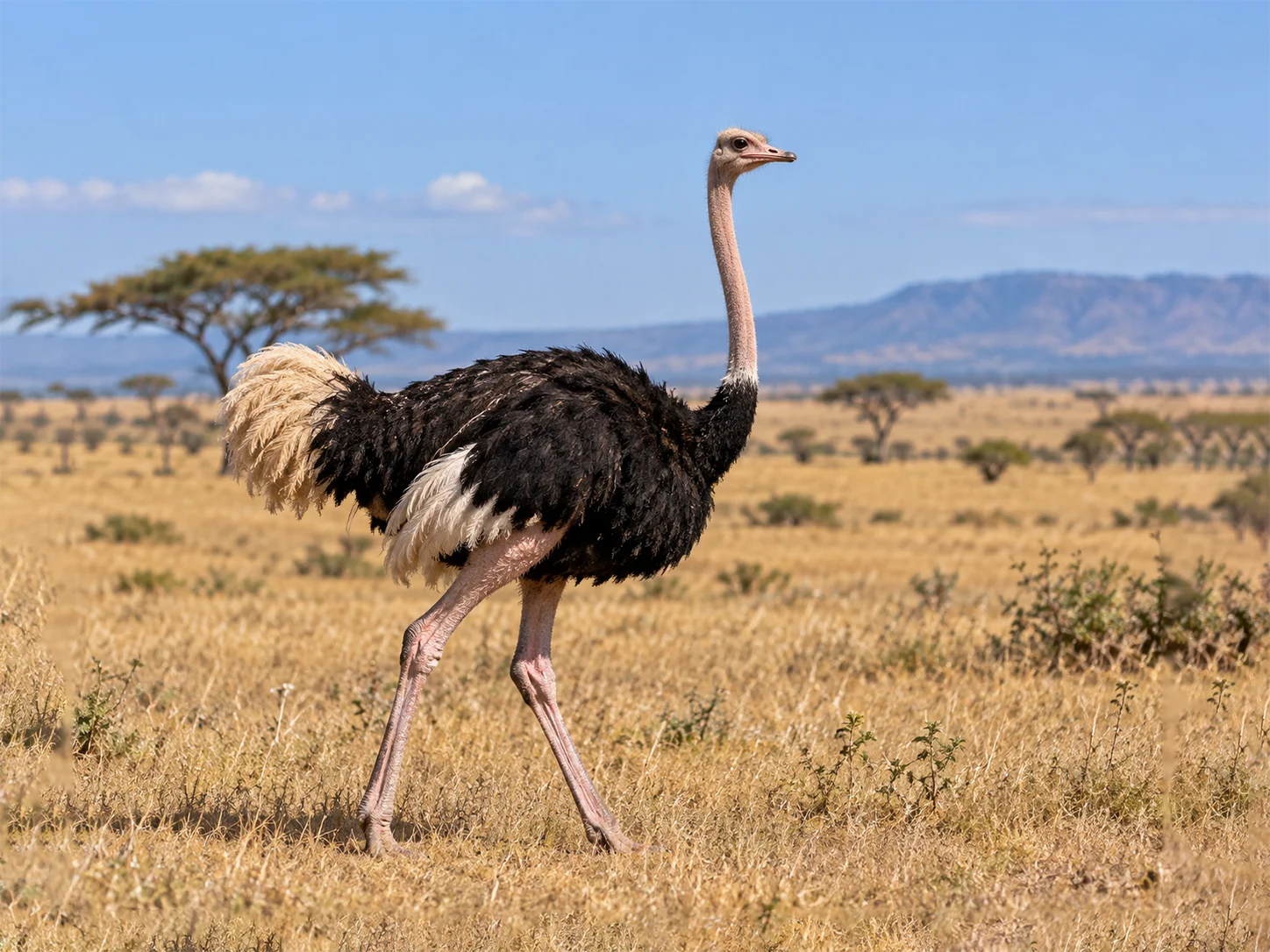
Meet the Ostrich
An ostrich does not bury its head in the sand. It never has, and it would suffocate if it tried.
What it actually does is lie flat with its neck stretched along the ground, which from a distance makes the head and neck almost disappear into the heat shimmer. It also turns the eggs in a nest scraped into the soil, and from far away a bird with its head down in a hole looks exactly like the story.
The real bird is more impressive than the myth. It is the largest bird alive, the fastest animal on two legs, lays the biggest egg of any living creature, and has eyes bigger than its own brain.
Scientific Name and Classification
The common ostrich’s scientific name is Struthio camelus. The second part means camel, after the long neck, the two-toed feet and a shared tolerance for dry country.
- Kingdom: Animalia
- Phylum: Chordata
- Class: Aves
- Order: Struthioniformes
- Family: Struthionidae
- Species: Struthio camelus
There is a second species, the Somali ostrich, Struthio molybdophanes, recognized separately since 2014 and distinguished by its blue-gray neck and legs.
Ostriches are ratites, the flightless birds that also include the emu, cassowary, rhea and kiwi.
Do Ostriches Bury Their Heads in the Sand?
No. It is one of the oldest and most persistent animal myths there is, and it appears to be about 2,000 years old: the Roman writer Pliny the Elder recorded it, and it has been repeated ever since.
Three real behaviors probably combined to create it.
- Lying flat. A threatened ostrich, especially one on a nest, drops to the ground and lays its neck out straight. The body looks like a mound of earth and the thin neck and small head vanish against the ground, particularly in heat haze.
- Tending the eggs. Ostriches nest in a shallow scrape in the soil and turn the eggs several times a day with their beaks, which means putting their heads right down into the hole.
- Feeding. They swallow sand and grit deliberately to help grind food, so a feeding ostrich spends time with its head at ground level.
What an ostrich actually does when threatened is run, and if cornered, kick. It has no reason to hide its head, because it can outrun almost anything on the savanna.
Appearance and Anatomy
Ostriches stand 7 to 9 feet tall and weigh 200 to 320 pounds, with males larger and black and white while females are gray-brown.
- Eyes. About 2 inches across, the largest of any land animal, and genuinely bigger than the bird’s brain. Ostriches can see a predator over a mile away.
- Legs. Immensely powerful, with a kick that can kill a lion. They kick forward, which is unusual, and the claw on the main toe acts as a weapon.
- Two toes. Ostriches are the only birds with just two toes on each foot. The large inner toe takes nearly all the weight, which works like a hoof and is part of why they run so well.
- Wings. Useless for flight but not useless. They span about 6 feet and are used for balance and steering at speed, for shading chicks, and in display.
- Neck. Long and nearly bare, which helps shed heat.
They are the fastest animal on two legs, reaching about 43 miles an hour and holding 30 for half an hour, with a stride up to 16 feet.
Habitat and Range
Ostriches live in Africa, in savanna, open grassland, scrub and semi-desert across the east and south of the continent and the Sahel.
They need open ground, because their defense is seeing danger early and running from it. Dense bush is no use to an animal that relies on a clear view and a long stride.
They handle heat and drought extremely well, getting most of their water from plants and tolerating a body temperature that swings through the day rather than spending energy holding it steady.
The Arabian ostrich, which lived across the Middle East, was hunted to extinction by the mid-twentieth century.
Diet and Feeding
Ostriches are omnivores, eating mainly seeds, grass, leaves, roots and flowers, plus insects, lizards and small rodents.
They have no teeth, so they swallow pebbles and grit, sometimes several pounds of it, which sit in the gizzard and grind food up.
They also have no crop, so food travels down the long neck in visible lumps.
Their digestive tract is extremely long for a bird, letting them extract nutrition from tough dry plants that would not sustain most birds at all. They can go days without drinking.
Behavior and Lifestyle
Ostriches live in loose groups of around 5 to 50, often alongside grazing zebras and antelope. The arrangement suits everyone: the ostrich sees further than they do, and they hear and smell better than it does.
Males boom. The call is a deep resonant sound made by inflating the neck, and at a distance it is often mistaken for a lion.
Courtship display is spectacular: the male drops to his knees and waves his wings alternately while rocking his head from side to side.
They are genuinely dangerous when provoked, and ostriches have killed people. A cornered ostrich kicks forward with a clawed foot and considerable force, and farm workers treat breeding males with real caution.
Reproduction and Life Cycle
Ostrich eggs are the largest of any living animal, about 6 inches long and weighing around 3 pounds, equivalent to about two dozen chicken eggs. Relative to the size of the bird, though, they are among the smallest eggs going.
The nesting arrangement is unusual. A dominant female lays in a communal nest scraped in the ground, and several other females add their eggs to it. The nest can hold 20 to 60 eggs in total.
The dominant female can recognize her own eggs among the others, and she arranges them in the middle of the nest where they are safest, pushing the rest to the edges where predators take them first.
She incubates by day, being camouflaged, and the black male takes the night shift. Eggs hatch after about 42 days.
Chicks are the size of a chicken at hatching and grow about a foot a month. Ostriches live 30 to 40 years in the wild and over 40 in captivity.
Predators and Threats
Lions, leopards, cheetahs and hyenas take adult ostriches, and eggs and chicks are eaten by jackals, mongooses, vultures and Egyptian vultures, which crack the thick shells by dropping stones on them.
Most chicks do not survive their first year.
Human pressures are habitat loss as grassland is converted to farming, hunting for meat, feathers, skin and eggs, and fences that block their movement.
The feather trade once drove enormous demand. In the late 1800s ostrich plumes for hats were among South Africa’s most valuable exports, worth more by weight than almost anything else being shipped, and fashion then changed and the trade collapsed.
Conservation Status
The common ostrich is listed as Least Concern, helped considerably by being farmed worldwide for meat, leather and feathers.
Wild numbers have fallen a long way, though, and ostriches have disappeared from large parts of their former range in North and West Africa.
The Somali ostrich is Vulnerable, pressured by hunting and egg collection in a region where conservation work is difficult.
The Arabian ostrich is a reminder of how this can end. It was hunted out of existence by around the 1940s, and reintroduction projects in the Middle East now use African ostriches as substitutes.
Role in the Ecosystem
Ostriches are major seed dispersers, and the distances involved make them unusual. They eat large quantities of seed, walk a long way, and pass the seeds in dung, moving plants across the savanna in a way smaller animals cannot.
Some seeds germinate better after passing through an ostrich, with the gut scouring the tough outer coat.
They are also the plain’s lookout. Because ostriches see further than any mammal around them, grazing herds watch them, and an alarmed ostrich sets off a reaction across the whole mixed herd.
Their eggs matter too. A 3-pound egg is a substantial meal for a jackal or a vulture, and ostrich eggshell has been used by people for tens of thousands of years as water containers and beads, making it some of the oldest surviving human craftwork found anywhere.