Meet the Vaquita
There are probably fewer than ten vaquitas alive. Not ten thousand, not ten hundred — ten animals, and surveys in 2024 and 2025 identified somewhere between six and eleven individuals.
The vaquita is the smallest porpoise in the world and the most endangered marine mammal on Earth. It lives in one small patch of sea at the top of the Gulf of California in Mexico, and nowhere else.
Almost nobody has ever seen one. It was not even described by science until 1958, it avoids boats, and it has gone from thousands to single figures within a single human lifetime, without ever being hunted for itself.
Scientific Name and Classification
The vaquita is Phocoena sinus. The name means porpoise of the gulf, and vaquita is Spanish for little cow.
- Kingdom: Animalia
- Phylum: Chordata
- Class: Mammalia
- Order: Artiodactyla (infraorder Cetacea)
- Family: Phocoenidae
- Genus: Phocoena
- Species: Phocoena sinus
Phocoenidae is the porpoise family, which is not the same as the dolphin family. Porpoises are generally smaller and blunter in the face than a dolphin, with spade-shaped teeth instead of cone-shaped ones, and no beak at all.
Appearance and Anatomy
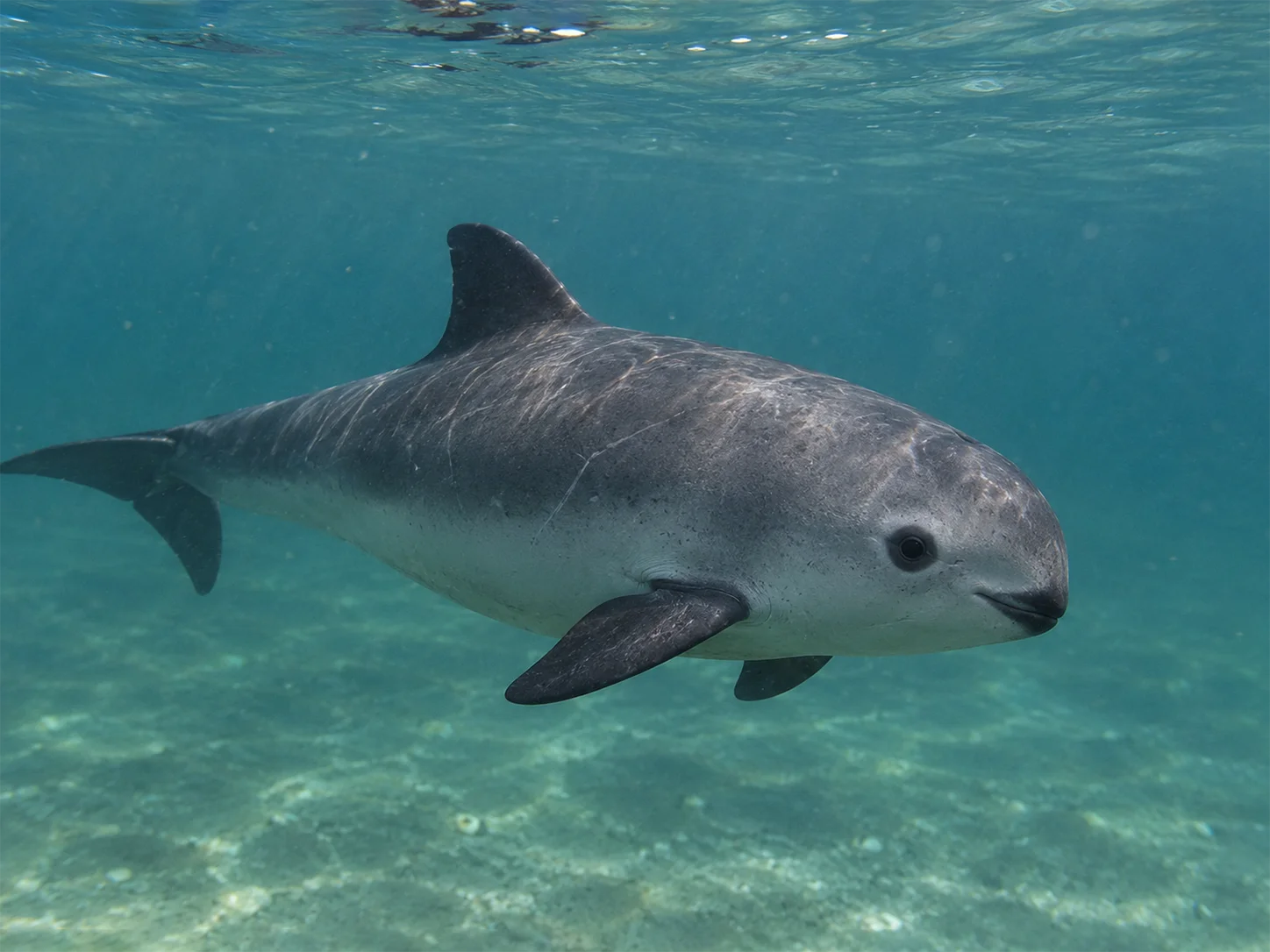
Females reach about 4.9 feet (150 cm) and males about 4.6 feet (140 cm), and they weigh between 60 and 150 pounds (27 and 68 kg). No other whale, dolphin or porpoise is smaller.
- Gray above, paler on the sides, white underneath
- Black patches ringing the eyes and the lips
- Rounded head with no beak
- An unusually tall triangular dorsal fin
- Small, stocky body
The face is what people remember. Dark rings around the eyes and dark lines around the mouth give the vaquita a markedly expressive look, which is part of why the few photographs that exist have done so much work in campaigns to save it.
The large dorsal fin is thought to help with heat. This is a small-bodied warm-blooded animal in unusually warm, shallow water, and a tall fin gives it extra surface through which to shed heat.
Habitat and Range
The vaquita has the smallest range of any cetacean: the northern end of the Gulf of California, the arm of sea between the Baja California peninsula and mainland Mexico.
It stays in shallow, cloudy water less than 490 feet (150 m) deep. Murky water suits it, because it hunts by sound rather than sight, and the richness of that water is what supported the species in the first place.
A range this small is a vulnerability all by itself. There is no second population somewhere else to fall back on, and no part of the range that is out of reach of a fishing boat.
Diet and Feeding
Vaquitas are generalists. They take small fish living on or near the bottom (grunts and croakers make up much of the diet) along with crustaceans and squid.
Like all porpoises they find food by echolocation, sending out clicks and reading the echoes. In water this cloudy that is not a supplement to eyesight but a replacement for it.
Reproduction and Life Cycle
A vaquita becomes mature somewhere between three and six years old. Pregnancy lasts 10 to 11 months, and a single calf is usually born between February and April.
Calves nurse for six to eight months, and a female normally produces one every other year, though recent sightings suggest some may calve annually. A vaquita lives around 20 years.
That slow rate is central to the whole problem. A species that raises roughly one calf every other year cannot replace animals killed faster than that, no matter how good conditions are otherwise.
Why the Vaquita Is Disappearing
Nobody wants to catch a vaquita. It is dying as bycatch, caught by accident in nets set for something else, and the something else is a fish called the totoaba.
Totoaba swim bladders sell on the black market, mostly into China for use in traditional medicine, for 20,000 to upwards of 80,000 dollars. They have been nicknamed the cocaine of the sea, and that comparison is about the economics rather than the biology: the money is large enough to make illegal fishing worth the risk.
The nets used are large-mesh gillnets, walls of near-invisible mesh hung in the water. A vaquita that swims into one cannot back out, and because it has to surface to breathe, it drowns. Illegal totoaba fishing increased sharply after 2011, and vaquita numbers collapsed alongside it.
At such tiny numbers a further trap opens up. With so few animals left, individuals may simply struggle to find each other to breed at all, a problem that gets worse the smaller the population becomes.
Efforts to Save the Vaquita
A great deal has been tried, and the record is honest about how hard this is.
- 2008: a program offering fishers gear swaps and payments to give up their permits
- 2015: a partial gillnet ban, made a permanent exclusion zone in 2017
- 2017: an attempt to catch vaquitas and keep them in sea pens, which was abandoned after captured animals died of shock
- 2019: UNESCO listed the habitat as a World Heritage Site in Danger
- 2020: the United States banned seafood imports from vaquita habitat
- 2022: the Mexican navy began dropping concrete blocks fitted with hooks to snag and destroy illegal nets
The 2017 capture attempt deserves a moment. The idea was to hold animals safely until the nets were gone, but vaquitas turned out not to tolerate capture: one died shortly after being caught, another had to be released, and a female died later in the effort. It closed off what had looked like the emergency option.
There is one piece of genuine good news. The animals still out there are breeding, and monitoring in 2025 recorded new calves. The handful that remain are not simply old survivors waiting to die.
Conservation Status
The IUCN has listed the vaquita as Critically Endangered since 1996, and describes it as the most endangered marine mammal in the world.
Critically Endangered is the last category before Extinct in the Wild, and in this case the numbers behind it are not estimates in the thousands but counts of named individuals, recognized by the marks on their bodies.
Role in the Ecosystem
As a small predator of bottom-dwelling fish and squid, the vaquita occupies a place in the upper Gulf of California that no other animal fills in quite the same way, and like any whale or porpoise, it is a sign of whether the water beneath it still works.
Its real importance now is as a warning. The vaquita is not disappearing because anybody hated it, hunted it, or wanted anything from it. It is disappearing because it shares a small sea with a profitable crime, and because nets do not distinguish between what they are set for and what swims into them.
That is the hardest kind of extinction to prevent, and the most ordinary. No villain is required, only a few years of everybody looking the other way.