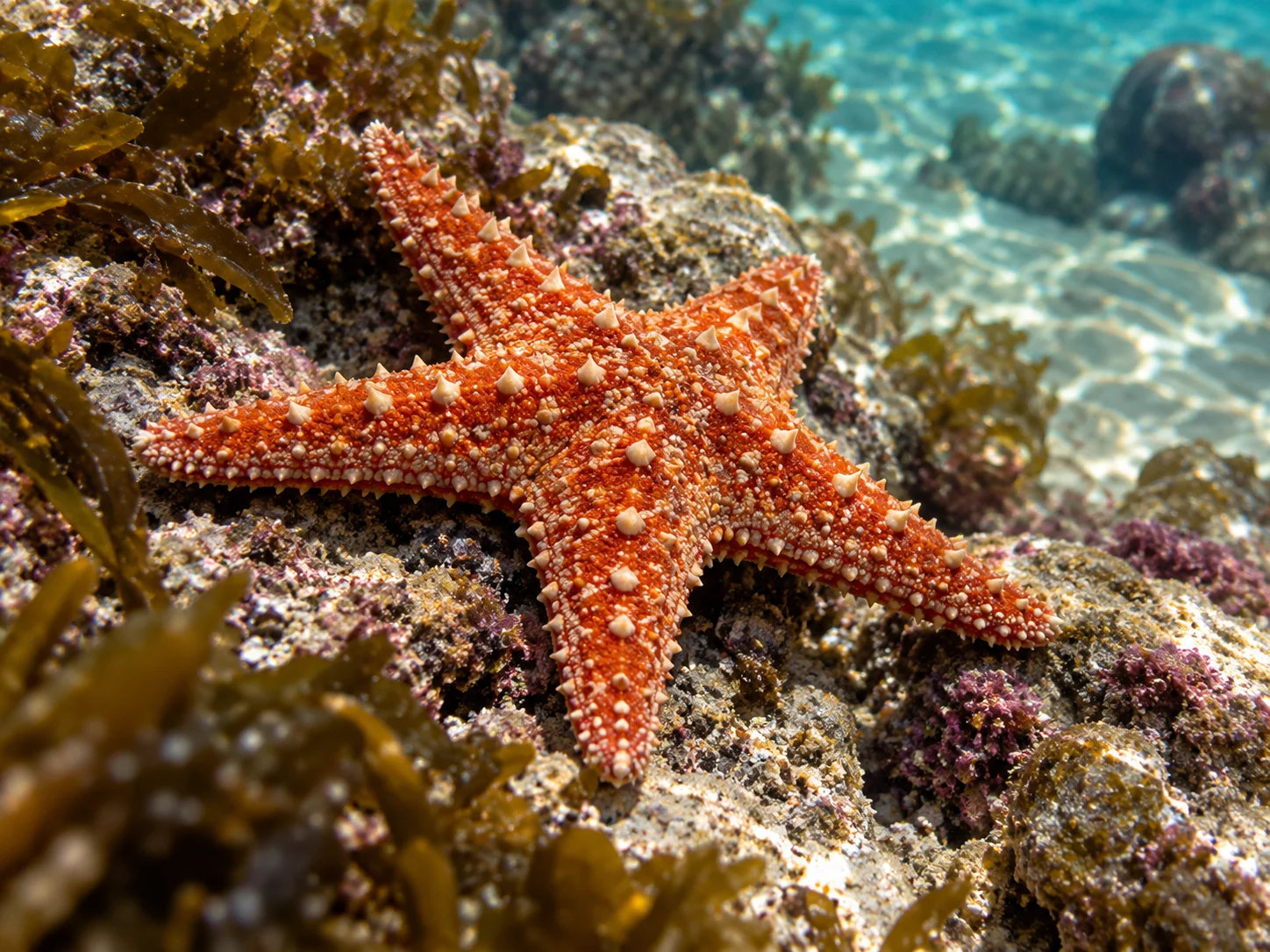
Meet the Starfish
To eat a mussel, a starfish pulls the shell slightly open, then pushes its own stomach out through its mouth, into the gap, and digests the animal inside its own shell. Starfish are armed, slow-moving sea animals of the class Asteroidea, with around 2,000 species on sea floors worldwide.
When it has finished it pulls the stomach back in and moves on.
A starfish has no brain and no blood. It runs on seawater, pumped through a system of canals, and it has eyes on the tips of its arms. It is also, despite the name, not a fish at all.
Scientific Name and Classification
Starfish form the class Asteroidea, with around 2,000 species, so there is no single two-word name.
- Kingdom: Animalia
- Phylum: Echinodermata
- Class: Asteroidea
A starfish is not a fish. It has no backbone, no gills, no fins and no scales, and it is not even a vertebrate. Marine biologists increasingly call them sea stars for exactly that reason.
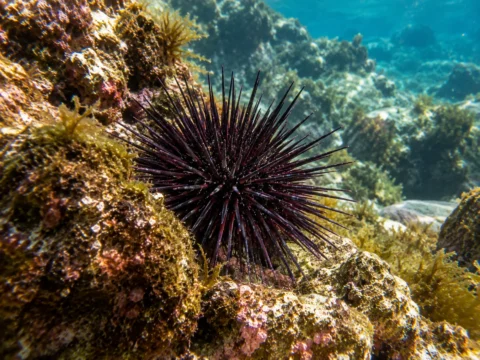
Their phylum, the echinoderms, also contains sea urchins, sea cucumbers and sand dollars. The name means “spiny skin”.
Oddly, echinoderms are more closely related to us than to most invertebrates. They sit on the same broad branch of the animal tree as vertebrates, which is why a starfish larva is bilaterally symmetrical like a fish before it reorganises itself into a star.
How Does a Starfish Eat?
By turning its stomach inside out.
A starfish has a mouth on its underside, at the center, and most species have two stomachs. One of them, the cardiac stomach, can be pushed out through the mouth and used outside the body.
Faced with a mussel or clam, the starfish grips both halves of the shell with its tube feet and pulls steadily. It does not need to open the shell wide. A gap of a fraction of a millimeter is enough, because the everted stomach can squeeze into it and begin digesting the animal inside its own home.
A mussel can clamp shut hard, but it tires. The starfish does not, because its tube feet work on water pressure rather than muscle, and it can keep pulling for hours.
Once the meal is partly digested, the stomach is drawn back inside and digestion finishes internally.
Appearance and Anatomy
Starfish range from under half an inch to the sunflower star at over 3 feet across, and most are a few inches wide.
- No brain. There is a nerve ring around the mouth and a nerve running down each arm, with no central brain and no single place where decisions happen.
- No blood. Instead a water vascular system: seawater is drawn in through a sieve plate on top and pumped through canals, carrying oxygen and nutrients and powering movement.
- Tube feet. Hundreds or thousands of small water-filled tubes on the underside, each extending and gripping by water pressure. They are how a starfish walks and how it prises shells open.
- Eyes. One simple eye at the tip of each arm, able to form a rough image. A five-armed starfish has five eyes, pointing in five directions.
- Arms. Usually five, but some species have 10, 20 or over 40.
Their skin contains hard calcium plates, which is what makes a starfish stiff and rough, and some can change its firmness from rigid to pliable in seconds.
Can a Starfish Regrow an Arm?
Yes, and some can do considerably more than that.
A starfish that loses an arm to a predator regrows it over months, and many will deliberately shed an arm to escape, in the same way a lizard sheds its tail.
In several species a single severed arm can regrow an entire new starfish, provided it carries a piece of the central disc. One animal becomes two.
This created a famous problem. When oyster and mussel fishermen caught starfish eating their beds, they chopped them up and threw the pieces back. The pieces grew into more starfish, and the fishermen made the problem worse.
A few species reproduce this way on purpose, splitting themselves in two across the disc and regrowing the missing half.
Habitat and Range
Starfish live in every ocean on Earth, from tropical reefs to polar seas and from rock pools down to the deep ocean floor over 20,000 feet below the surface.
There are none in fresh water at all. Starfish need the salt, because their water vascular system is open to the sea and cannot regulate salinity.
Most live on the seabed, on rock, sand, mud, coral and kelp.
They cannot survive long out of water, which is the practical reason not to lift one out of a rock pool for a photograph.
Diet and Feeding
Starfish are carnivores, eating mussels, clams, oysters, barnacles, snails, worms, sponges, coral and other starfish, plus carrion.
They move slowly, so they specialize in prey that cannot run: anything fixed in place or slower than they are.
Some are filter feeders instead, catching plankton on their arms and passing it to the mouth along grooves lined with tiny beating hairs.
One species is notorious. The crown-of-thorns starfish eats living coral, digesting the tissue off the skeleton, and a single outbreak can strip large areas of reef. Outbreaks are made worse by nutrient runoff feeding their larvae and by the loss of the fish and snails that prey on them.
Behavior and Lifestyle
With no brain, a starfish has no central decision-maker, and how it manages to act as one animal is genuinely interesting.
Each arm can sense and move on its own, and movement happens by agreement rather than command. When a starfish starts walking, one arm effectively takes the lead and the others follow, and which arm leads can change.
They are slow, usually a few inches a minute, though the sunflower star can manage a brisk crawl by starfish standards.
A starfish turned upside down can right itself by twisting two arms underneath and levering over, which takes several minutes.
Their eyes are better than expected. Research has shown some starfish use the images from their arm-tip eyes to navigate back toward a reef, which means the eyes are for finding home rather than just detecting light.
Reproduction and Life Cycle
Most starfish release eggs and sperm into the water, in enormous numbers. A single female may release millions of eggs in a season.
The larva that hatches looks nothing like a starfish. It is a tiny, bilaterally symmetrical swimmer that drifts as plankton for weeks, and then settles on the seabed and rebuilds itself into a five-sided animal.
That transformation is one of the strangest in the animal kingdom: an animal with a left and a right side becoming an animal with neither.
Some brood their young instead, holding them under the body or in pouches, and some reproduce by splitting in two.
Starfish live around 5 to 10 years commonly, and some larger species over 30.
Predators and Threats
Sharks, rays, large fish, crabs, sea otters, gulls and other starfish all eat them. Shedding an arm to escape is a routine part of a starfish’s life.
The most serious threat is disease. Sea star wasting disease, which causes animals to develop lesions, lose arms and disintegrate within days, swept the Pacific coast of North America from 2013 and killed billions of starfish across more than twenty species.
The sunflower star was hit hardest and is now Critically Endangered, having almost vanished from much of its range in a few years.
Warming seas, ocean acidification and coastal pollution all add pressure, and acidification is a particular problem for animals that build their bodies from calcium.
Conservation Status
There is no single status across around 2,000 species, and most have never been assessed.
The sunflower star is the clearest casualty, Critically Endangered after the wasting disease epidemic, with captive breeding programs now trying to rebuild it.
The crown-of-thorns needs controlling rather than protecting on damaged reefs, and divers now cull them by injection on parts of the Great Barrier Reef.
What happened on the Pacific coast after the die-off is the clearest argument for why starfish matter, and it is worth setting out properly.
Role in the Ecosystem
The starfish is the animal that gave science the idea of a keystone species.
In the 1960s the ecologist Robert Paine removed every ochre starfish from a stretch of rocky shore and watched what happened. Mussels, freed from their main predator, took over completely and crowded out almost everything else. Species richness collapsed from around fifteen to barely a handful.
That experiment showed that some species hold a whole community together out of proportion to their numbers, and the word keystone comes directly from it.
The wasting disease outbreak then ran the same experiment across thousands of miles of coast by accident. Where sunflower stars disappeared, sea urchins multiplied unchecked and grazed down kelp forests, turning them into bare urchin barrens and taking the fish and otters that depended on the kelp with them.
So a brainless, bloodless animal that moves a few inches a minute turns out to hold up kelp forests. That is worth remembering the next time something looks unimportant.