Meet the Sperm Whale
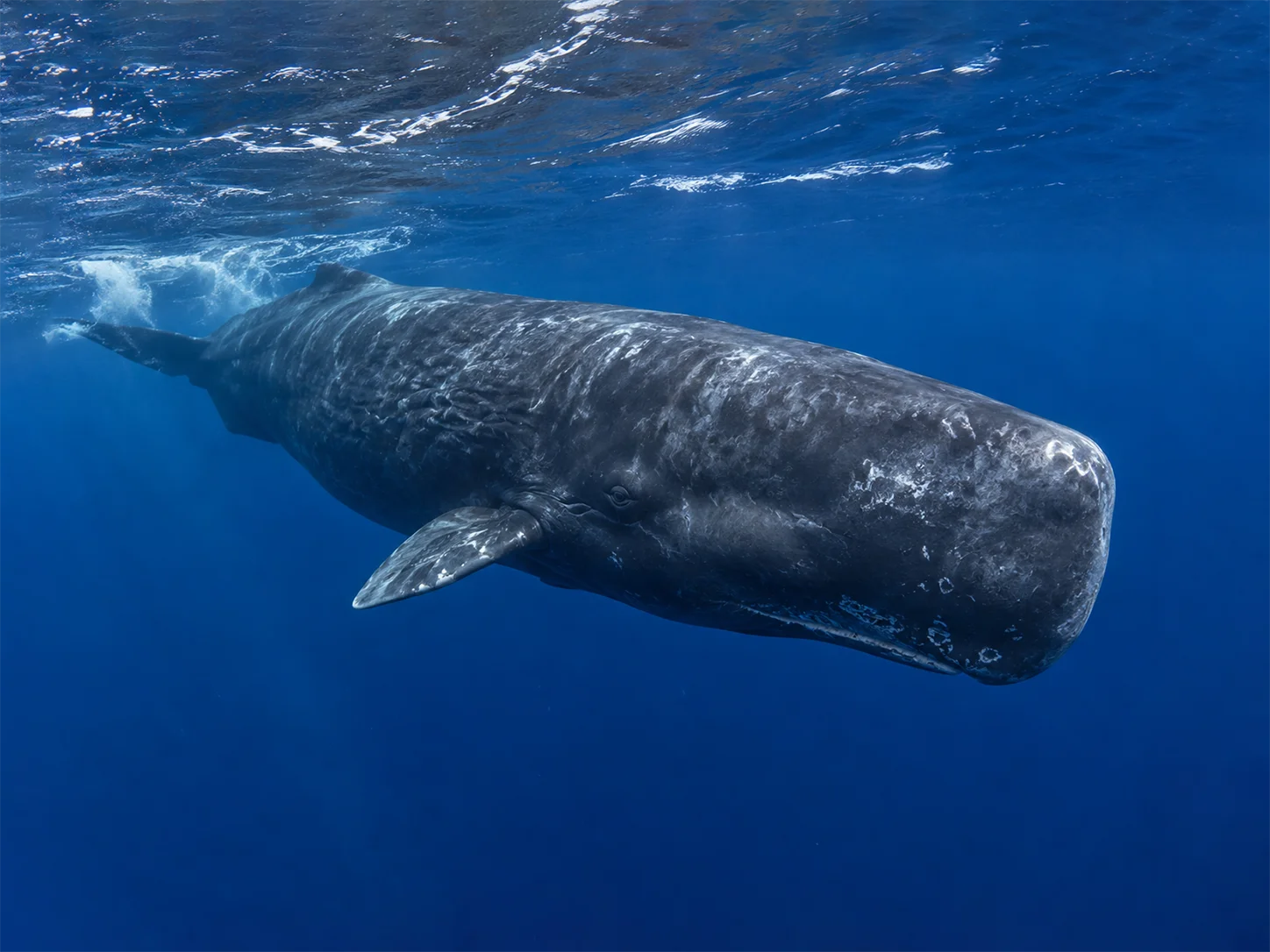
The sperm whale has the largest brain of any animal that has ever lived, about 17 pounds, roughly five times the size of ours. The sperm whale (Physeter macrocephalus) is the largest toothed predator on Earth, hunting squid in deep water in every ocean.
It also makes the loudest sound produced by any animal. Its clicks have been measured at 230 decibels, which is loud enough that at close range the pressure wave alone could injure a person.
And it uses those clicks to talk. Sperm whales produce patterned bursts called codas, and groups in different parts of an ocean use different coda repertoires, which function something like accents. Whales that share a dialect associate with each other and generally ignore whales that do not.
Scientific Name and Classification
The sperm whale is Physeter macrocephalus, which means blower with a big head, and it is the only living member of its genus.
- Kingdom: Animalia
- Phylum: Chordata
- Class: Mammalia
- Order: Artiodactyla
- Family: Physeteridae
- Species: Physeter macrocephalus
That order will look wrong, and it is one of the more startling results in modern biology. Artiodactyla is the even-toed hoofed mammals, which means whales sit in the same group as deer, pigs and camels, and the hippopotamus is their closest living relative.
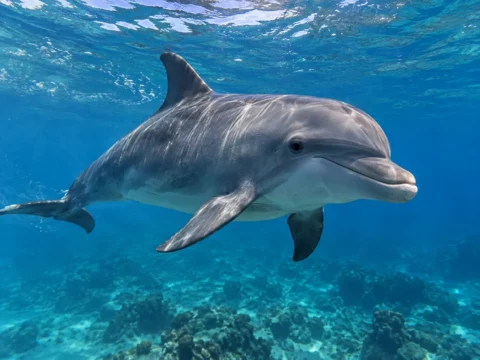
It is a toothed whale, like the dolphin, rather than a baleen whale like the blue whale. That makes it the largest toothed predator on earth.
The name comes from spermaceti, the waxy oil in its head, which eighteenth-century whalers mistook for something else entirely.
What Is Inside That Enormous Head?
A third of the sperm whale’s body is head, and most of that head is not brain. It is a sound machine.
The spermaceti organ holds up to 500 gallons of waxy oil. Behind it sits a second mass called the junk, and the two work together as a biological sound cannon:
- The click is made at the front. Air forced through a valve near the blowhole produces the initial pulse.
- It travels backwards through the spermaceti organ to a mirror-like air sac at the back of the skull.
- It reflects forward through the junk, which focuses it into a narrow beam, and leaves the front of the head.
- The result is a click of enormous power and extraordinary precision, which the whale uses to find squid in total darkness a mile down.
The spermaceti may have a second job. The whale can cool it by circulating water through its nasal passages, which solidifies the wax and makes it denser, and warm it again to make it lighter. Whether this is genuinely a buoyancy control system is still debated, but the physics works.
That oil is also why the species was nearly destroyed. Spermaceti burned cleanly and brightly, and it lubricated machinery better than anything else available, so sperm whales lit the lamps and oiled the factories of the industrial revolution.
Appearance and Anatomy
Males reach 52 to 60 feet and 80,000 to 100,000 pounds. Females are much smaller, at 36 to 40 feet and around 30,000 pounds, which is one of the largest size differences between sexes of any mammal.
- Teeth. Up to 26 pairs in the lower jaw only, each up to 8 inches long. The upper jaw has sockets they fit into. Oddly, the whale does not seem to need them: individuals with badly deformed jaws have been found well fed.
- Blowhole. Single, set to the left of center, so a sperm whale’s spout goes out sideways at an angle. It is identifiable from a distance.
- Skin. Wrinkled like a prune behind the head, unusual among whales.
- Brain. About 17 pounds, the largest ever measured in any animal.
They are usually covered in circular scars from the hooks and suckers of giant squid, which is most of the evidence we have for battles nobody has ever watched.
Habitat and Range
Sperm whales live in every ocean, from the tropics to the edge of the polar ice, which makes them one of the most widely distributed mammals on earth.
They need deep water, preferring 3,000 feet or more, and gather near submarine canyons and continental shelf edges where squid are plentiful.
The sexes live apart. Females and young stay in warm and temperate water year-round, rarely going above about 40 degrees of latitude. Mature males leave those groups in their teens and head for cold, high-latitude water, returning to the tropics only to breed. A large male may spend most of his life alone near the ice.
Diet and Feeding
Sperm whales are carnivores and squid specialists, eating around 3 percent of their body weight a day, which for a large male is well over a ton.
Most of it is medium-sized squid, taken in enormous numbers. They also eat octopus, fish, rays and small sharks, and off Alaska some have learned to strip fish off longlines.
Their diving is the deepest of any mammal. Typical foraging dives go to 2,000 feet for 45 minutes; recorded dives have passed 7,000 feet and nearly two hours. There is almost no light at that depth, considerable cold and crushing pressure, and the whale does it on one breath, several times a day, for 70 years.
They manage it by collapsing the lungs deliberately, storing oxygen in muscle rather than air, slowing the heart, and shutting blood flow to everything not immediately needed.
Giant squid are a small part of the diet but a real one, and most of what science knows about giant and colossal squid came out of sperm whale stomachs long before anyone filmed one alive.
Behavior and Lifestyle
Female sperm whales live in units of about ten related animals, and those units stay together for decades. The society is built around females, like an elephant herd.
They babysit. A calf cannot follow its mother to the bottom of a dive, so it is left at the surface, and other members of the unit take turns staying with it. The group dives in rotation so that someone is always there.
The dialect findings are the most interesting part of all of this. Units that share a coda repertoire form larger groupings called clans, which can contain thousands of whales spread over an ocean. Clans that overlap in range use the same waters but keep socially apart, and calves appear to learn their clan’s codas rather than inherit them. That is cultural identity in an animal, and it is hard to describe any other way.
They sleep vertically, hanging nose-up or nose-down near the surface in groups, completely still, which was not photographed until 2008.
Reproduction and Life Cycle
Females mature at around nine years. Males mature later and do not breed successfully until their late twenties, by which time they are vastly bigger than the females.
Gestation lasts 14 to 16 months, and a single calf is born at about 13 feet and 2,000 pounds.
Calves nurse for two years at minimum and sometimes far longer, with suckling recorded in whales over ten years old, and they can be nursed by females other than their mother.
A female produces a calf only every four to six years, which is a very slow rate of replacement and the main reason recovery from whaling has taken so long. Sperm whales live 60 to 70 years and probably longer.
Predators and Threats
Only orcas threaten sperm whales, and only by attacking calves in groups. The females’ response is a formation called the marguerite, heads together and tails outward like the petals of a flower, with the calf in the middle.
The real history is whaling. Commercial hunting ran from the early 1700s to the late twentieth century and killed somewhere around a million sperm whales, and the twentieth-century phase was worse than the age of sail, because factory ships were far more efficient than open boats.
Current threats are quieter. Ship strikes, entanglement in fishing gear, swallowed plastic, which has killed whales found with bellies full of sheeting and rope, chemical pollution concentrating in blubber, and noise from shipping and seismic surveys interfering with the sense they live by.
Conservation Status
The sperm whale is listed as Vulnerable, with a global population estimated at a few hundred thousand, which is thought to be under half the number before whaling.
They have been protected since the international moratorium on commercial whaling took effect in 1986, and recovery is slow but real.
One finding deserves to be better known. Whaling did not only remove animals; it removed knowledge. Sperm whale groups learned to evade whaleboats within a few years of first encountering them in the Pacific, and that information spread between groups that had never met the same ships. When older females were killed, their units lost whatever those individuals knew. A long-lived, culture-carrying animal can be damaged in ways a population count does not show.
It is worth being clear about the uncertainty: sperm whales spend most of their lives deep and far offshore, so population figures are estimates with wide margins.
Role in the Ecosystem
Sperm whales are the main predator of deep-ocean squid, and they move nutrients in a way almost nothing else does.
They feed in the deep and defecate at the surface, carrying iron and nitrogen upward into the sunlit layer where plankton can use it. This is called the whale pump, and in the Southern Ocean sperm whale droppings fertilize enough plankton growth to absorb more carbon than the whales’ own breathing releases. The population there is a net carbon sink.
Their bodies keep working after death. A sunken whale carcass feeds a specialized community for decades, including species found nowhere else.
Culturally, this is the whale of Moby-Dick, and the novel was based on real events: the whaleship Essex was rammed and sunk by a sperm whale in 1820. It is also the animal that has done most to change what scientists will say about animal minds, because a creature with the largest brain on earth, lifelong family groups and inherited dialects is difficult to think of as merely an animal that happens to be big.