Meet the Sparrow
In 1958 China began the Four Pests campaign, and one of the four pests was the sparrow, because sparrows ate grain. People across the country were mobilized to kill them: nests destroyed, eggs broken, and crowds banging pots and drums to keep the birds flying until they dropped dead from exhaustion.
Hundreds of millions of sparrows were killed. Then the locusts arrived.
Sparrows eat grain, but they feed insects to their chicks, and with the birds gone, locust and other insect populations exploded across farmland. Crop losses were severe, and the campaign contributed to a famine in which tens of millions died. China eventually imported sparrows from the Soviet Union.
Scientific Name and Classification
The house sparrow is Passer domesticus, and the Old World sparrows are the family Passeridae, with around 40 species.
- Kingdom: Animalia
- Phylum: Chordata
- Class: Aves
- Order: Passeriformes
- Family: Passeridae
- Species: Passer domesticus
Here is a naming trap worth knowing. The American birds called sparrows, the song sparrow, white-throated sparrow and the rest, are not in this family at all. They belong to Passerellidae, the New World sparrows, and are more closely related to buntings. Early colonists saw small brown birds and used a familiar name.
The hedge sparrow, or dunnock, is not a sparrow either. It is an accentor.
The Bird That Followed Us Everywhere
The house sparrow is one of the most widely distributed wild birds on earth, and almost all of that distribution is our doing.
It originated in the Middle East and spread with agriculture itself, moving through Europe and Asia alongside grain farming. Genetic work suggests the sparrows living with humans diverged from their wild relatives thousands of years ago, and that they carry an adaptation for digesting starch, which is the same kind of change seen in dogs. It is a bird partly domesticated by proximity, without anyone intending it.
Then came deliberate introductions. Eight pairs released in Brooklyn in 1851, and further releases after that, put house sparrows across North America within fifty years. They were also introduced to South America, Africa, Australia and New Zealand.
They now live on every continent except Antarctica, and are found almost exclusively around people. Walk far enough from human settlement and the house sparrows stop.
The irony is that this spectacularly successful bird is now declining sharply in the places it has lived with us longest.
Appearance and Anatomy
The house sparrow is 6 to 6.7 inches long with a wingspan of 7.5 to 10 inches, and weighs about an ounce (24 to 40 g).
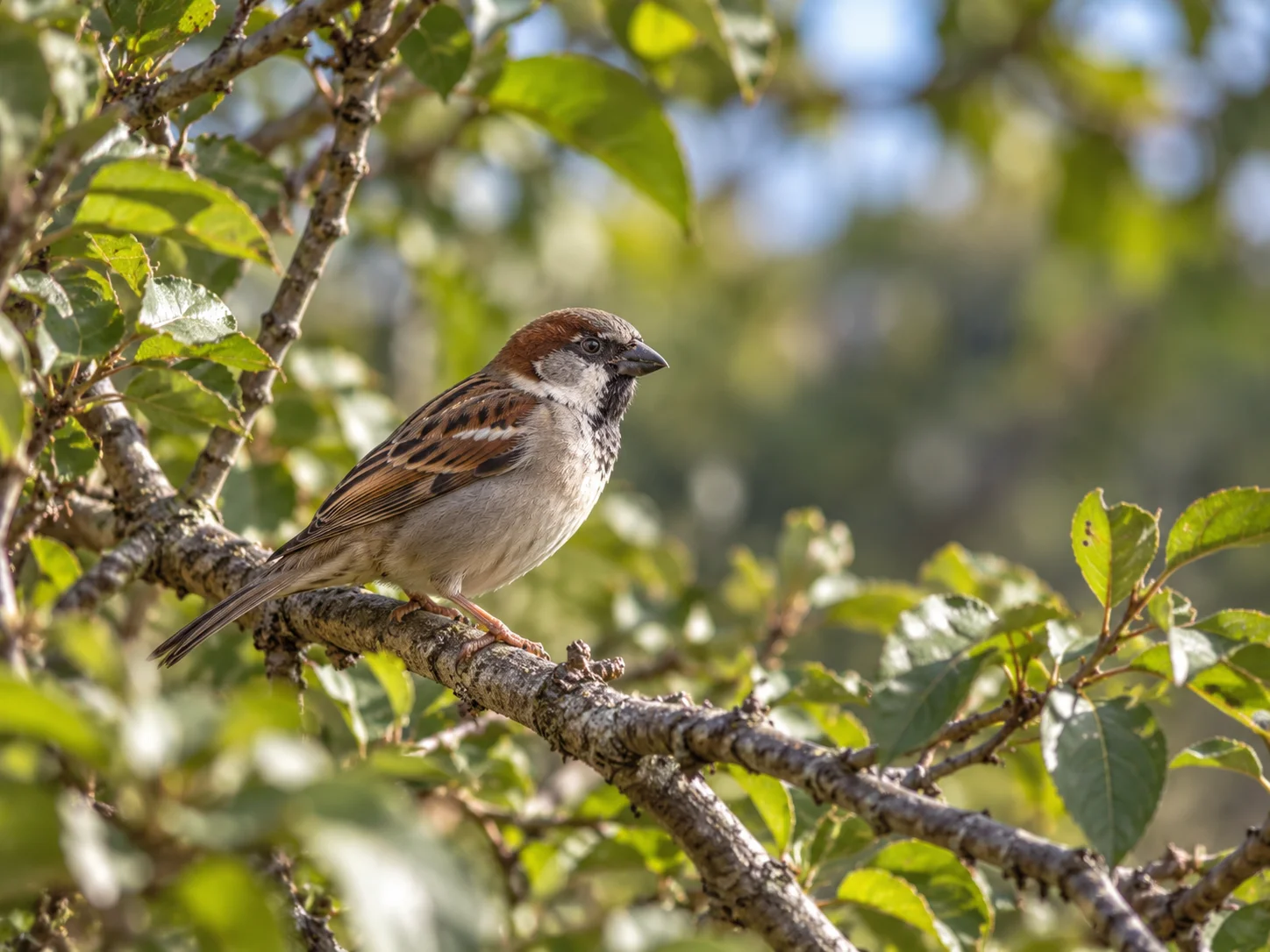
Males have a gray crown, chestnut nape, white cheeks and a black bib. Females are plainer, streaked brown and buff with a pale stripe behind the eye.
The male’s bib is a status signal. Larger, blacker bibs correlate with dominance, and the bib grows through the winter as the pale feather tips wear away, so a male’s badge sharpens as the breeding season approaches without him growing a single new feather.
The bill is thick and conical, built for cracking seeds, and sparrows have strong jaw muscles for their size. They also have an unusual extra bone in the tongue that helps with seed handling.
Habitat and Range
House sparrows live in cities, towns, villages and farmland across six continents, and essentially nowhere without human activity.
They nest in cavities: holes in walls, under roof tiles, in gutters, behind signs, in street lights, and in the structures of buildings. They will also build a bulky domed nest in a tree or creeper when no hole is available.
They are sedentary, and most house sparrows live and die within a mile or two of where they hatched, which is unusual for a small bird and important for understanding their decline: a local population that disappears is not easily replaced from elsewhere.
Other sparrows in the family are less tied to us, and some, like the Spanish sparrow and the desert sparrow, live in open country and arid scrub.
Diet and Feeding
Sparrows are omnivores, and the split by age is the crucial thing. Adults eat mainly seeds, grain, buds and scraps; chicks are fed almost entirely on insects, which they need for protein.
That is the detail China’s campaign missed, and it is also central to why sparrows are vanishing from modern cities. A city can be full of food for adult sparrows and have almost no insects for their young, and chicks fed on crumbs starve.
They feed in flocks on the ground, hopping rather than walking, and they are opportunistic to a degree that is almost comic: sparrows have learned to trigger automatic doors to get into supermarkets and bus stations, and then do it again to leave.
They also drink nectar, eat flower buds and take food directly from outdoor tables with very little fear.
Behavior and Lifestyle
Sparrows are intensely social, feeding, roosting, bathing and dust-bathing in groups, and the constant chirping of a hedge full of sparrows is the sound of a colony keeping contact.
They roost communally in dense cover or building cavities, sometimes in large numbers, and in winter they huddle.
They are also tough and quarrelsome. House sparrows will take over the nest sites of other birds, including bluebirds and swallows in North America, sometimes destroying eggs to do it, which is a large part of why they are unpopular there despite being loved in Europe.
Their adaptability has made them one of the most studied wild birds in the world, and a great deal of what is known about how birds adjust to cities, cope with pollution and respond to new environments comes from research on house sparrows.
Reproduction and Life Cycle
Sparrows breed from spring into late summer and raise two to four broods a year, which is how a short-lived bird keeps up.
The pair builds an untidy nest of grass, feathers and whatever else is available in a cavity, and both maintain it.
The female lays 3 to 6 eggs and both parents incubate for 11 to 14 days, then feed the chicks on insects for another two weeks.
Pairs are typically monogamous for a season and often for life, though genetic testing shows a notable share of chicks are fathered by a neighboring male, so the social pair and the biological parents are not always the same.
Most sparrows die in their first year. Those that survive live 3 to 5 years, with ringed birds recorded past 13.
Predators and Threats
Cats are the single largest predator of house sparrows in urban areas, along with sparrowhawks, kestrels, owls, magpies, rats and squirrels.
The decline in western Europe has been dramatic, and Britain has lost a large majority of its house sparrows since the 1970s, with central London losing almost all of them. No single cause explains it, which is part of what makes it interesting, but the leading candidates are:
- No insects for the chicks. Tidy paving, pesticides and the loss of weedy corners mean not enough invertebrates to raise a brood, and studies in London found chicks starving.
- No nest holes. Modern building, renovation and sealed eaves remove the cavities sparrows need, and a renovated street can lose its colony permanently.
- Loss of scrub. Sparrows need dense cover near food, and manicured gardens provide none.
- Agricultural change. Fall-sown crops and clean, efficient harvesting leave almost no spilt grain through winter.
Meanwhile, in much of Asia, Africa and the Americas, house sparrows remain abundant, so this is a regional collapse rather than a global one.
Conservation Status
The house sparrow is listed as Least Concern globally, because it is still one of the most numerous birds in the world.
Nationally the story differs. It is red-listed in Britain, has declined in the Netherlands, India and parts of Europe, and is an unwanted invasive species in North America and Australia. Few animals manage to be protected in one country and culled in another.
What helps is small and local, which makes the sparrow a good conservation story for anyone with a garden: leave a patch untidy, plant dense shrubs, skip the pesticide, put up a terrace of nest boxes, since sparrows prefer to nest in groups.
India now marks World Sparrow Day on 20 March, which began as a response to the bird’s disappearance from Indian cities.
Role in the Ecosystem
Sparrows eat enormous quantities of insects during the breeding season and large quantities of weed seeds the rest of the year, and they are prey for every urban predator from cats to sparrowhawks.
They are a useful indicator precisely because they live where we do. A city losing its sparrows is a city losing its insects and its untidy corners, and the bird is simply the visible part of that.
Their scientific contribution is substantial and underrated, since the house sparrow has been the test subject for much of what is known about urban adaptation in animals.
And the Four Pests campaign remains the clearest lesson in the whole encyclopedia. The sparrows really were eating the grain. The mistake was not about the facts but about the system, and it cost more than any amount of grain the birds could have taken. Anyone deciding an animal is a pest is making a claim about an entire food web, usually without having checked it.