Meet the Red Panda
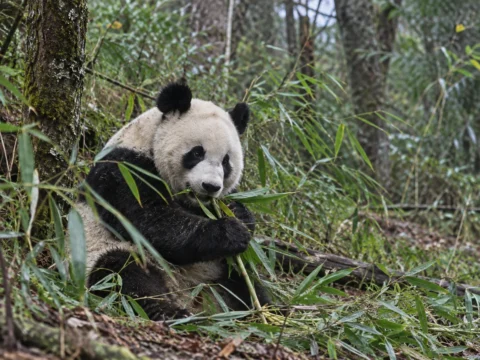
The red panda was called a panda first. It was described in 1825, about 45 years before anyone in the West had heard of the giant panda, and the black and white one was named after it.
They are not closely related. The giant panda is a bear; the red panda is in a family of its own, with no close living relatives anywhere.
What they share is bamboo, and the strange consequences of a carnivore trying to live on grass.
Scientific Name and Classification
The red panda’s scientific name is Ailurus fulgens, meaning roughly “shining cat”.
- Kingdom: Animalia
- Phylum: Chordata
- Class: Mammalia
- Order: Carnivora
- Family: Ailuridae
- Genus: Ailurus
It is the only living member of the family Ailuridae. Classifiers spent a century moving it between the bears and the raccoons before genetics settled the matter: it belongs to neither and sits alone on its own branch, nearest to weasels, skunks and raccoons but distant from all of them.
That isolation matters. If the red panda disappears, an entire family of mammals goes with it, not just a species.
Research in 2020 suggested there may be two species, the Himalayan and the Chinese red panda, separated for millions of years.
Appearance and Anatomy
Red pandas measure 20 to 25 inches in the body with a tail of 11 to 20 inches, and weigh 7 to 14 pounds, about the size of a large house cat.
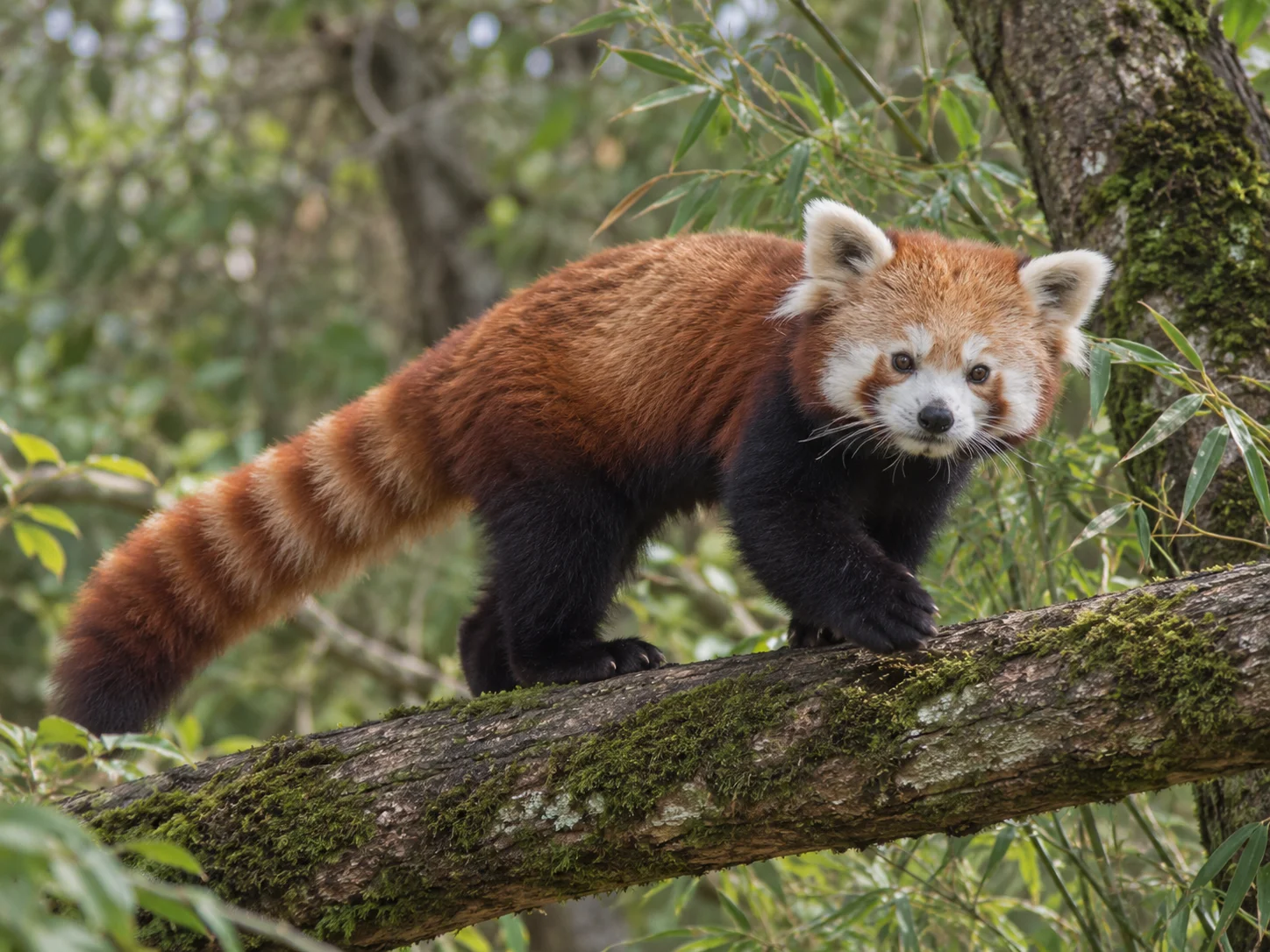
- Coat. Deep chestnut red on top, black underneath. Upside down from most mammals, and it works: seen from below against dark branches, the black belly disappears, while the red back blends with the reddish moss and lichen covering fir trees in their forests.
- Tail. Long, bushy and ringed, used for balance in trees and wrapped around the body as a blanket in cold weather.
- False thumb. An extended wrist bone for gripping bamboo.
- Feet. Furry soles for grip on wet branches and insulation on snow, and ankles that rotate so it can climb down head-first.
- Face. White markings unique to each animal, and each subspecies pattern differs.
When threatened a red panda rears up on its hind legs and raises its front paws, making itself look bigger. It is genuinely a threat display, however it looks.
Habitat and Range
Red pandas live in the eastern Himalayas and southwestern China: Nepal, Bhutan, northern India, Myanmar and China’s Yunnan and Sichuan provinces.
They need a narrow and specific habitat: temperate mountain forest between about 7,000 and 13,000 feet, with a bamboo understory beneath tall trees, and water nearby.
That combination exists only in a thin band along mountainsides, and it is already fragmented into isolated patches.
They are well insulated for cold and handle snow comfortably, but suffer in heat above about 25 degrees Celsius.
Diet and Feeding
Red pandas are classed as omnivores and eat some fruit, eggs, insects and small animals, but around 95 percent of the diet is bamboo.
And here is their central problem. A red panda has the digestive system of a carnivore: a short, simple gut with none of the chambers or long fermentation a grazing animal uses. It cannot digest cellulose properly.
So it extracts only about a quarter of what it eats, and compensates by eating enormous amounts. A red panda may consume up to 20,000 bamboo leaves a day, spending 13 hours feeding.
It is also selective, taking only the youngest, most nutritious leaves and shoots, which is why it needs a lot of bamboo rather than just some.
The whole animal is organized around that shortfall: it moves slowly, sleeps a great deal, and lowers its metabolic rate in winter to save energy.
Behavior and Lifestyle
Red pandas are solitary and territorial, marking boundaries with scent, and they meet mainly to breed.
They are most active at dawn, dusk and night, and sleep draped along branches through the day.
They are excellent climbers and spend most of their lives in trees, descending head-first by rotating their ankles, which few mammals can do.
In cold weather they curl up tight with the tail wrapped over the face and body.
They are quiet animals, but make a distinctive huff-quack sound called a wha, plus twitters and squeals.
Reproduction and Life Cycle
Red pandas breed once a year, and the female builds a nest in a tree hollow or rock crevice, lined with leaves and moss.
One to four cubs are born, blind and helpless, and stay hidden in the nest for around three months, which is a long time.
The mother moves them between several nests, and raises them alone.
Cub mortality is high, and that combines badly with a low birth rate: an animal producing one or two surviving young a year cannot rebuild numbers quickly.
Red pandas live 8 to 10 years in the wild and up to 15 in captivity.
Predators and Threats
Snow leopards and martens are the main natural predators, and feral dogs kill red pandas and spread disease to them, which has become a significant problem near settlements.
Habitat loss is the chief threat. Forest is cleared for farming, grazing and firewood, and the bamboo understory is destroyed even where trees remain.
Poaching is serious too: red pandas are killed for their fur, particularly the tails, and taken live for the illegal pet trade.
They are also caught accidentally in snares set for other animals.
Conservation Status
The red panda is Endangered, with fewer than 10,000 adults thought to remain and the population falling.
Its problems compound each other. It eats one thing, lives in a narrow altitude band, breeds slowly, and occupies forest across several countries that is being cleared and fragmented.
Climate change adds another layer, since warming pushes suitable bamboo forest further up mountainsides, and there is only so far up a mountain goes.
Some approaches are working. Community forest programs in Nepal, which employ local people as forest guardians, have reduced poaching and protected habitat, and red pandas breed reasonably well in zoos.
Role in the Ecosystem
Red pandas shape the bamboo understory by grazing it, which influences how bamboo grows and spreads through the forest.
They disperse seeds from the fruit they eat.
Their largest value, though, is as a flagship. The red panda is popular enough to attract funding and attention to eastern Himalayan forests, which shelter snow leopards, Himalayan black bears and a great many species nobody campaigns for.
And scientifically it is irreplaceable. As the single surviving member of its family, it is the only window we have onto an entire branch of carnivore evolution.