Born Ready, or Born Helpless
This is the real difference, and everything else follows from it. A baby hare, called a leveret, arrives with a full coat of fur, its eyes already open, and it can run within an hour of being born. It has to. Its mother leaves it sitting alone in a dip in the grass and comes back to feed it once a day, usually at dusk, for about four weeks.
A baby rabbit, called a kit, arrives blind, deaf and completely bald, and it would die within hours out in the open. It does not have to survive out there, because it is born at the bottom of a burrow in a nest its mother lined with grass and fur pulled from her own chest. It stays underground for roughly three weeks before it sees daylight.
Ears, Legs and the Shape of an Escape
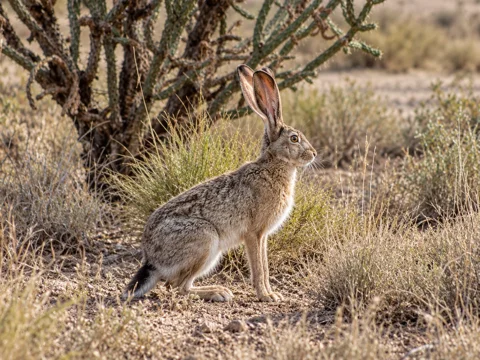
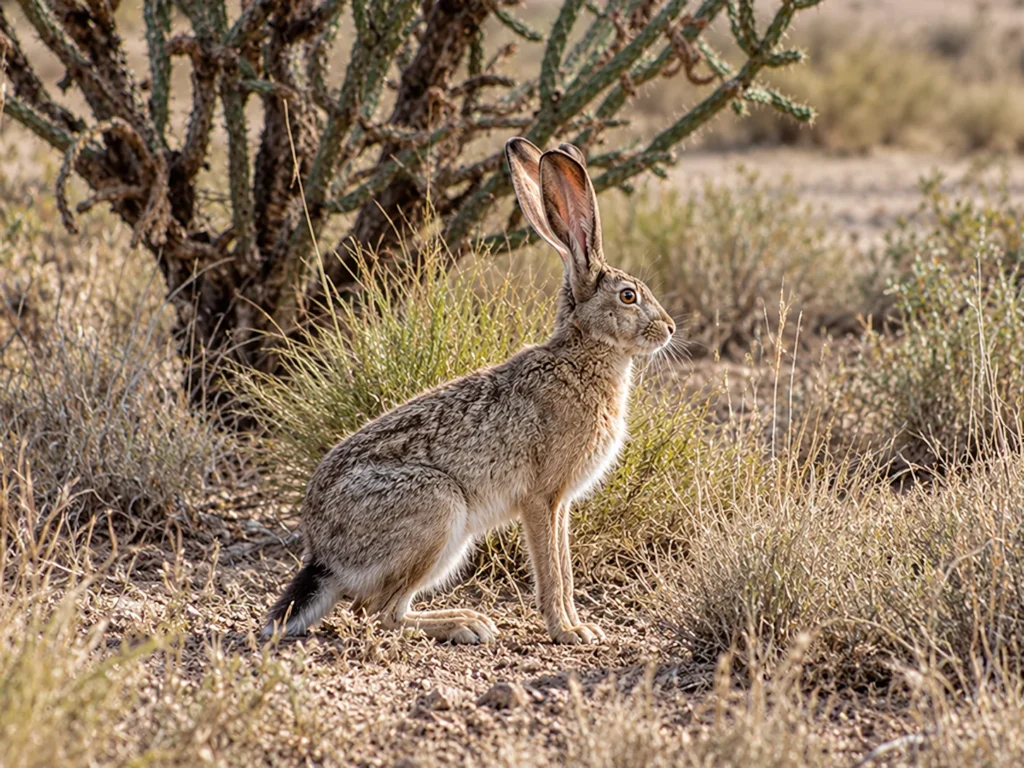
A hare is built as one long escape. Its back legs are enormous, its body is lean, and it runs at up to 45 mph in open country, swerving hard rather than hiding. The ears are the giveaway even at a distance. They are longer than the animal’s own head and most species carry black tips, so a hare in a field looks like a rabbit someone has stretched.
A rabbit is built as a short dash to a hole. It is rounder and lower, its ears are shorter, and it tops out around 35 mph, which is plenty when the burrow entrance is twenty feet away. Watch a rabbit in a field and it rarely strays far from cover. Watch a hare and it will be out in the middle of the open ground, which is a place no sensible rabbit goes.
Underground or Out in the Open
Rabbits dig. A warren is a network of tunnels and chambers worked on by many animals over many years, and a big one can run for hundreds of feet with dozens of entrances. Rabbits are social, live in groups with a pecking order, and thump a warning with a back foot that carries through the ground to everyone below.
Hares dig nothing. A hare makes a form, which is simply a shallow scrape in grass or soil shaped to its own body, and it sits in it with its ears flat, relying on stillness. Hares are mostly solitary. The famous boxing in spring is not two males fighting, it is a female hitting a male she is not interested in.
Why There Are No Pet Hares
Every pet rabbit on Earth descends from the European rabbit, an animal that already lived in groups in burrows and took to a hutch without much complaint. Thousands of years of that produced the lop, the Rex, the Flemish Giant and the rest.
Hares were never domesticated and almost certainly cannot be. A solitary animal whose whole survival plan is explosive flight does not settle into a cage, and hand-reared leverets rarely thrive. If the animal is living in a hutch, it is a rabbit.
The Names That Mislead
Common names are unreliable here. The jackrabbit of the American west is a hare, named for ears that reminded settlers of a donkey. The Belgian hare is a domestic rabbit bred to look like a hare. The snowshoe hare is a true hare, and so is the Arctic hare, both of which swap brown summer fur for white in winter.
Neither animal is a rodent, which surprises most people. Rabbits and hares sit in their own order, Lagomorpha, separated from rats and mice by an extra pair of small teeth tucked behind the top front ones. The split happened more than fifty million years ago.