Meet the Queen Angelfish
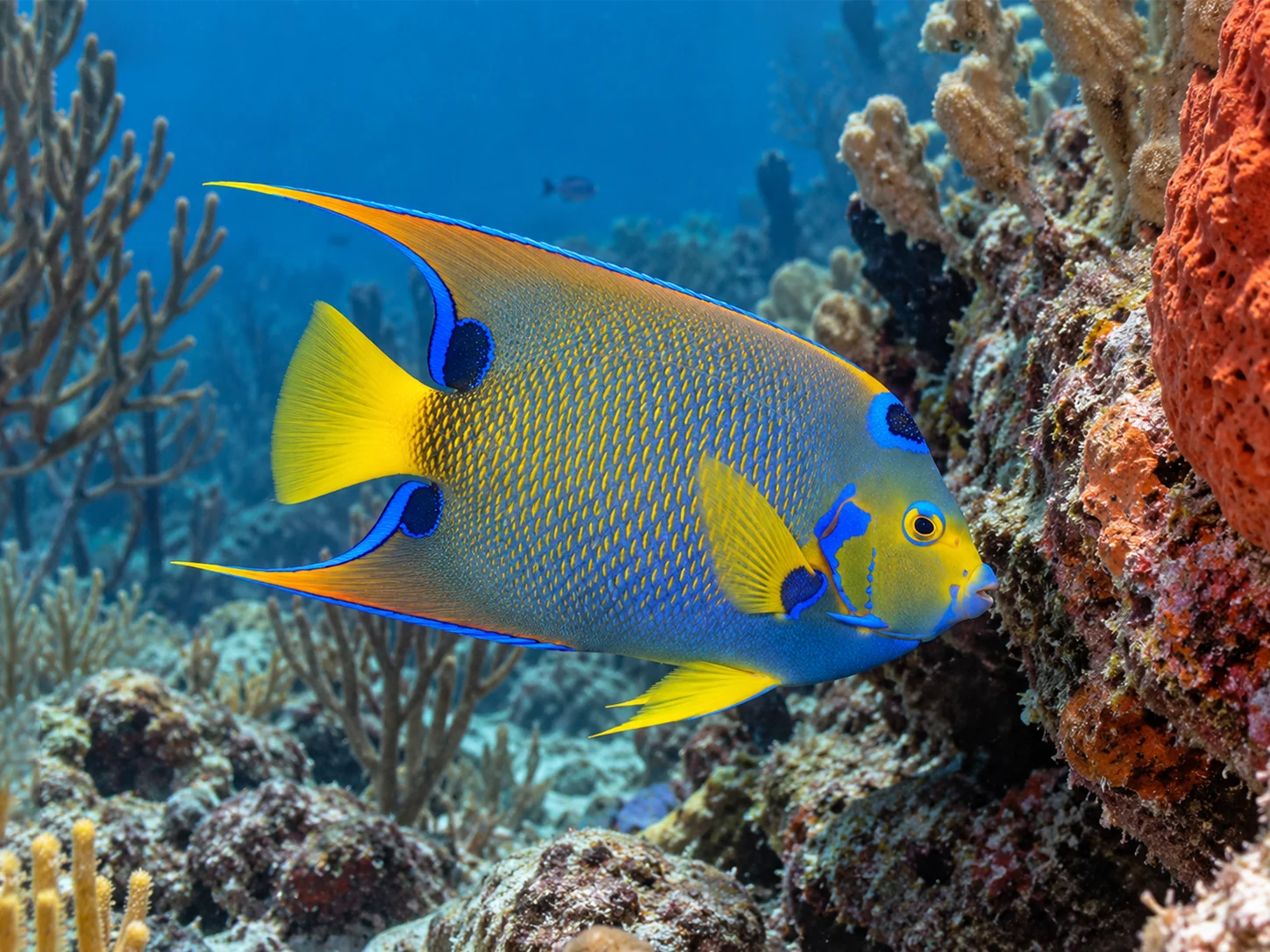
The queen angelfish is named for the thing on its forehead. Just above the eyes sits a dark blue spot ringed with electric blue, and with a little imagination it is a crown.
It is also a useful crown, because it is how you tell this fish from its close relative the blue angelfish, which looks similar and lacks the mark.
The rest of the animal lives up to the name: a tall, flattened, blue-green body edged in yellow, drifting over Caribbean reefs. And its diet is stranger than its looks. An adult queen angelfish lives mainly on sponges, which almost nothing else can eat.
Scientific Name and Classification
The queen angelfish is Holacanthus ciliaris, described by Linnaeus in 1758.
- Kingdom: Animalia
- Phylum: Chordata
- Class: Actinopterygii
- Order: Perciformes
- Family: Pomacanthidae
- Genus: Holacanthus
- Species: Holacanthus ciliaris
Pomacanthidae is the family of marine angelfish, and the name is a clue to their anatomy: it refers to the spine each of these fish carries on the gill cover, which they can raise when threatened or when squeezing into a crevice.
Despite the shared name, marine angelfish are not related to the freshwater angelfish kept in home aquariums; those are South American cichlids. The two groups simply ended up the same shape.
Appearance and Anatomy
Adults reach 18 inches (45 cm) and about 3.5 pounds (1.6 kg), with males often slightly larger than females. The body is a tall oval, flattened side to side, with a triangular tail.
- Blue-green scales, each tipped with yellow
- Bright yellow tail, pectoral fins and pelvic fins
- Cobalt blue forehead spot ringed with electric blue, the crown
- Spine on the gill cover
- Small mouth set at the front of a narrow face
That flattened shape is the whole design. A reef is a maze of narrow gaps, and a fish built like a dinner plate on edge can slip into a crack that a rounder fish of the same weight could never enter, then turn on the spot using its fins rather than its body.
The small mouth matters too. This is not a fish that gulps; it is one that nibbles precisely at things fixed to the rock.
Juveniles Look Like a Different Fish
A young queen angelfish is dark blue with bright curved blue stripes down its sides and a patch of yellow near the pectoral fins, so unlike the adult that early naturalists could be forgiven for filing them separately.
Juveniles also do a completely different job. They work as cleaner fish, setting up in one spot and picking parasites off the skin of larger fish that come to them and wait. The big fish gets rid of its pests, the young angelfish gets a meal, and both come away better off.
As the fish grows it gives up cleaning, changes color entirely, and moves on to sponges.
Habitat and Range
Queen angelfish live in the western Atlantic, from Florida and the Gulf of Mexico through the Caribbean and down to Brazil, and they reach Bermuda and remote mid-ocean islands too.
They are reef fish, living close to the bottom and favoring areas with plenty of soft coral, from shallow sunlit water down to about 230 feet (70 m).
Adults tend to stay in a known patch of reef rather than roaming, which suits an animal whose food does not move.
Diet and Feeding
Sponges are the main food of an adult, and in some places the proportion is extraordinary: studies off St. Thomas and Salvador found sponges making up about 90 percent of the diet.
Eating a sponge is harder than it sounds. Sponges defend themselves with tiny needles of glass-like material built into their bodies, and many are laced with unpleasant chemicals, so very few animals can make a living on them. A fish that can has a food supply it barely has to share.
It does take other things: tunicates, corals, plankton, algae, and even jellyfish. But the sponges are what make it unusual, and it is a selective feeder rather than an opportunist. It knows which ones it wants.
Reproduction and Life Cycle
A male holds a territory with two to four females in it. Each female feeds on her own part of the reef, and the male moves between them.
Spawning happens all year round and is often seen around the full moon. A pair rises together off the bottom and releases eggs and sperm into open water, and the numbers involved are enormous: a female may discharge between 25,000 and 75,000 eggs in a single day.
The eggs are transparent and float, hatching after only about 15 to 20 hours. The tiny larvae drift in open water before settling onto a reef, and the overwhelming majority never get that far, which is exactly why there are so many eggs to begin with.
Predators and Threats
Larger reef predators take queen angelfish: groupers, barracuda, snappers and reef sharks. The gill spine and the ability to vanish into a crevice are the fish’s answers to them.
People collect them too. The queen angelfish is caught for the aquarium trade, where its color makes it valuable, though adults grow far too large for most home tanks.
Even so, the species is doing reasonably well. The IUCN lists it as Least Concern, and the most recent assessment found the wild population appeared stable. The real long-term question is the reefs themselves: a fish that specializes in sponges on healthy coral has nowhere to go if the coral fails.
Role in the Ecosystem
By grazing steadily on sponges, queen angelfish keep them from overgrowing the reef. Sponges compete with corals for space, so a fish that eats sponges is indirectly helping coral hold its ground.
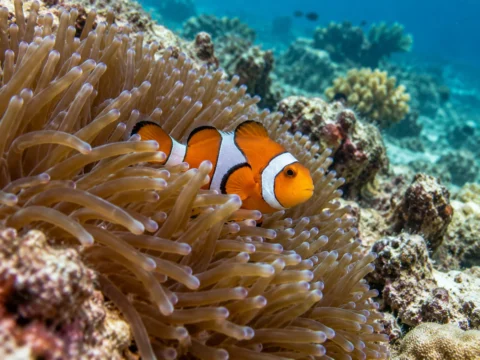
The young do a different service. Every juvenile running a cleaning station is removing parasites from other fish, which keeps the wider reef community healthier, the same arrangement the clownfish has with its anemone, built on an exchange rather than on either animal being generous.
So one species fills two roles across its own lifetime: parasite remover when small, sponge grazer when grown. It is a reminder that an animal is not one fixed thing, and that knowing what a fish does can depend entirely on how old it is.