Meet the Emu
The emu is the second-tallest bird on Earth, it cannot fly, and in 1932 the Australian army declared war on it and lost.
It is also a bird where the father does everything. The male sits on the eggs for eight weeks without eating, drinking or passing droppings, losing a third of his body weight, then raises the chicks alone for up to eighteen months.
Emus live only in Australia, and they make a sound like a drum being beaten inside a barrel.
Scientific Name and Classification
The emu’s scientific name is Dromaius novaehollandiae. The species name means “of New Holland”, an old European name for Australia.
- Kingdom: Animalia
- Phylum: Chordata
- Class: Aves
- Order: Casuariiformes
- Family: Dromaiidae
- Species: Dromaius novaehollandiae
The emu is a ratite, one of the flightless birds that also includes the ostrich, cassowary, rhea and kiwi. Its closest relative is the cassowary, and both live in Australia and New Guinea.
Three island populations of emu existed in Tasmania, Kangaroo Island and King Island. All three were hunted to extinction within decades of European settlement.
The Great Emu War
This genuinely happened, and the emus won.
In 1932, about 20,000 emus moved into farmland in Western Australia after harvest, trampling crops and breaking fences. Farmers asked the government for help, and the government sent soldiers with machine guns.
It did not work. The emus scattered the moment firing began, split into small groups and ran, and proved extremely hard to hit at distance. One ambush jammed the gun after a dozen birds. The commander reported that the emus had faced machine guns with the invulnerability of tanks and compared them to crack troops.
The operation was called off, restarted, and abandoned again. Out of roughly 10,000 rounds, estimates of emus killed range from a few hundred to under a thousand.
Australia switched to fencing and bounties instead. The episode is remembered as the Emu War, and it is one of the few wars a bird has ever won.
Appearance and Anatomy
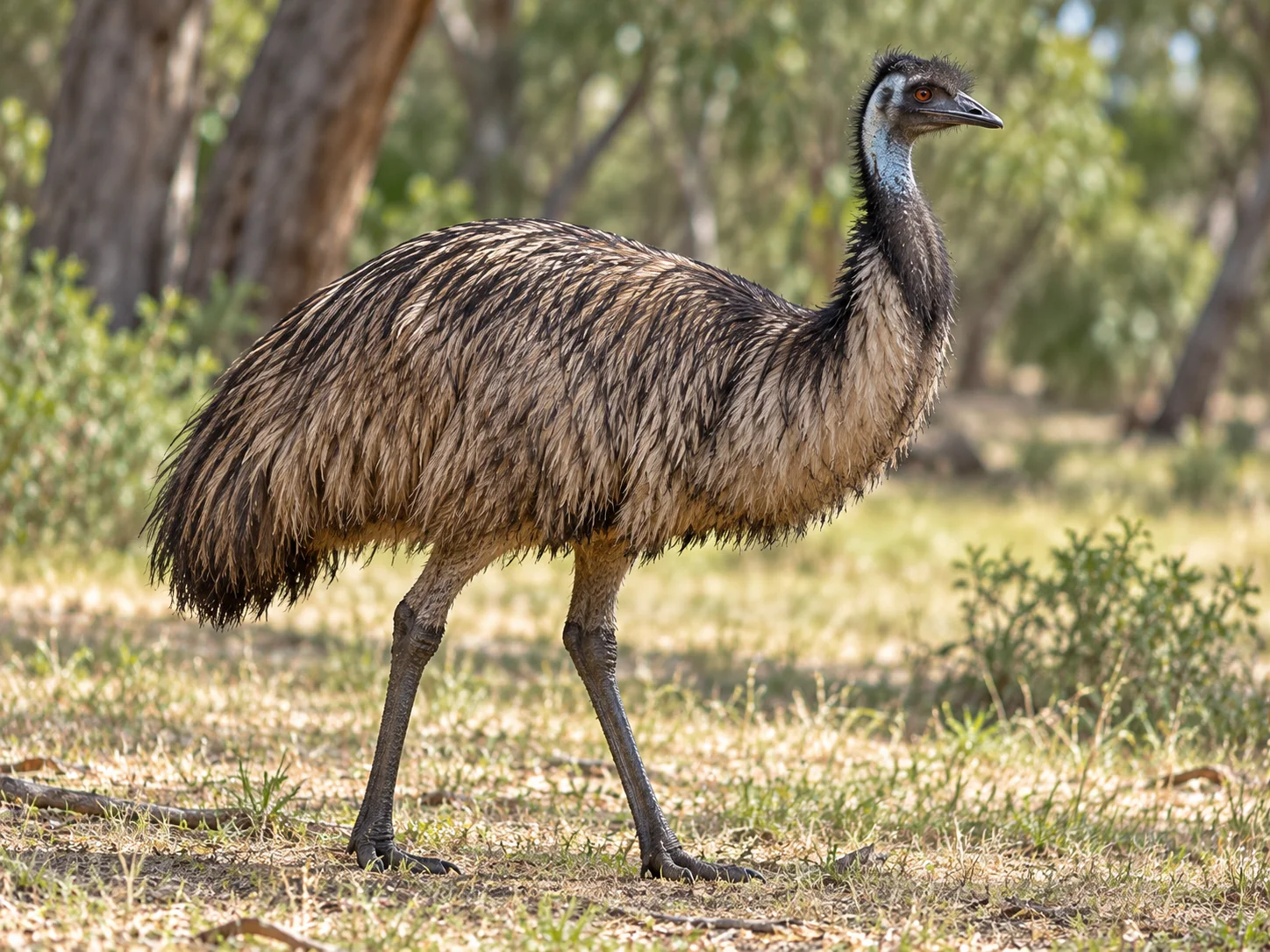
Emus stand 5 to 6.2 feet tall and weigh 40 to 130 pounds. Females are slightly larger than males, which is unusual among birds.
- Wings. Tiny, around 8 inches long, and useless for flight. Emus hold them out while running, apparently to help with steering and balance.
- Legs. Extremely powerful, with three toes. An emu can sprint at 30 miles an hour and kick hard enough to break bone.
- Feathers. Double-shafted, with two feathers growing from each quill, giving a shaggy, hair-like coat that insulates against both heat and cold.
- Neck. Bare blue skin showing through sparse feathers, which helps shed heat.
- Eyes. Large, with a third eyelid that sweeps across sideways to clear dust in a windy, dry country.
The sound is produced by an inflatable pouch in the neck: a deep booming drum that carries over a mile, mostly made by females.
Habitat and Range
Emus live across almost all of mainland Australia, in savanna woodland, scrub, grassland and desert fringe.
They avoid dense forest and the driest deserts, and are commonest in areas with reliable rainfall.
They travel enormous distances in search of food and water, sometimes hundreds of miles, following rainfall across the continent. Those movements are a large part of why they matter ecologically.
Diet and Feeding
Emus are omnivores, eating seeds, fruit, flowers, young shoots, grass, insects, spiders and small lizards.
They swallow stones deliberately, sometimes more than a pound of them, which sit in the gizzard and grind food up. Birds have no teeth, so the stones do the chewing.
They are opportunists and will also swallow unexpected items. Keys, coins and marbles have all been found inside emus, which explains some of their reputation around farms.
Emus drink rarely but heavily when water is available, and can go for long stretches without it.
Behavior and Lifestyle
Emus are usually solitary or in pairs, though they gather into loose flocks when traveling to new feeding grounds.
They are curious rather than fearful, and will approach people and vehicles to investigate, which is charming until a 100-pound bird decides to inspect your picnic.
They are strong swimmers, crossing rivers readily.
Running is their defense, and they are built entirely for it. An emu sprinting at 30 miles an hour can cover nearly 9 feet in a single stride.
Reproduction and Life Cycle
This is where emus become genuinely remarkable, because the male does everything.
The female lays 5 to 15 large dark green eggs, each weighing around a pound, in a rough nest on the ground. Then she leaves, and often goes off to mate with another male.
The male sits. For about eight weeks he incubates the eggs almost without moving, barely eating or drinking, living on stored fat and losing roughly a third of his body weight. He may lose a stone in weight over the period.
Chicks hatch striped brown and cream for camouflage. The father then raises them alone for up to eighteen months, defending them fiercely against anything, including the mother.
Emus live 10 to 20 years in the wild and longer in captivity.
Predators and Threats
Dingoes are the main predator of adults, and eagles take them too. Foxes, feral pigs, dingoes and goannas eat eggs and chicks.
An emu attacked by a dingo kicks, and a well-placed kick from those legs is dangerous.
Human pressures are road traffic, fences that block their long migrations, and competition with livestock for water. Emus are also farmed for meat, leather and oil, which is a different relationship rather than a threat to wild numbers.
Conservation Status
The emu is listed as Least Concern, with a large population spread across most of Australia.
In some ways farming has helped them. Water provided for livestock across the dry interior gave emus reliable drinking points they never had before, and numbers rose in parts of the country.
The island emus are the cautionary note. Tasmania, Kangaroo Island and King Island each had their own emu, and all three were gone within a few decades of European arrival. A widespread species can still lose entire populations quickly.
Role in the Ecosystem
Emus are among Australia’s most important seed dispersers, and the distances involved are what make them special. A bird that walks hundreds of miles carries seeds far beyond the reach of any other animal there.
Some Australian plants depend heavily on it, and emu droppings often contain large numbers of viable seeds, deposited in a ready-made pile of fertilizer.
They also eat large numbers of insects, including locusts and crop pests.
Culturally the emu runs deep in Australia. It appears in Aboriginal astronomy, where the Emu in the Sky is traced not from stars but from the dark dust clouds between them, and its position through the year marks the right time to collect emu eggs.