Meet the Guitarfish
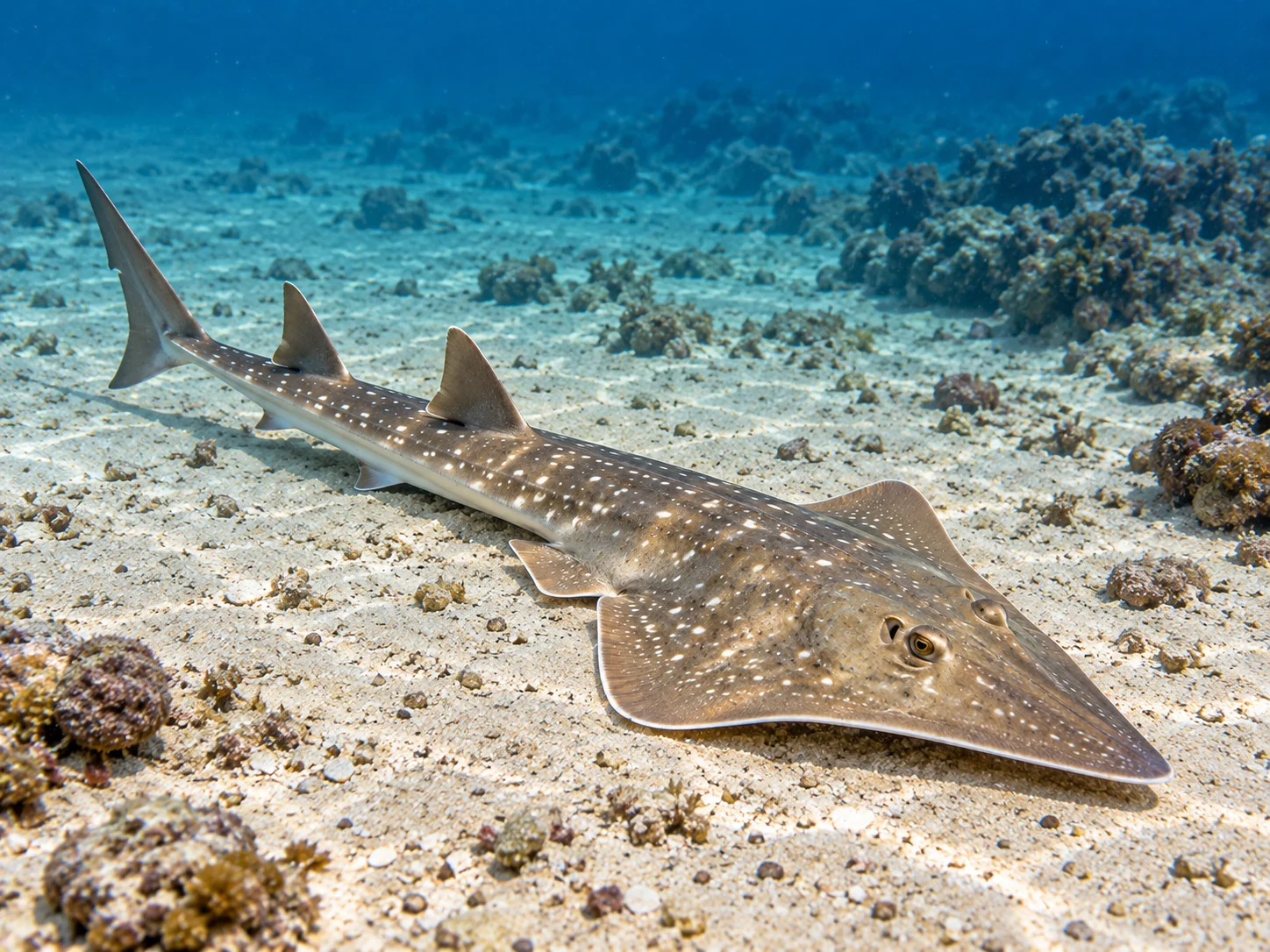
A guitarfish looks like someone started building a ray and finished with a shark. The front half is flat and wide with the body set into it; the back half is a muscular shark-like tail.
That is roughly what it is. Guitarfish are rays, close relatives of sharks, and they sit at the halfway point between the two shapes.
They are also in deep trouble. Rhino rays, the group guitarfish belong to, are among the most threatened families of fish in the sea, and almost nobody has heard of them.
Scientific Name and Classification
Guitarfish form the family Rhinobatidae and related families, with around 50 or so species, so there is no single two-word name.
- Kingdom: Animalia
- Phylum: Chordata
- Class: Chondrichthyes (cartilaginous fish)
- Order: Rhinopristiformes
- Family: Rhinobatidae and relatives
Like sharks and all rays, guitarfish have skeletons of cartilage rather than bone.
Their order also contains the sawfish, wedgefish and banjo rays, collectively known as rhino rays for their pointed snouts. The whole group sits between the flat bottom-dwelling rays and the streamlined sharks.
Is a Guitarfish a Shark or a Ray?
A ray, and the test is simple and anatomical.
In sharks the gill slits are on the sides of the head. In rays they are underneath, on the belly. A guitarfish has them underneath, so it is a ray.
Its pectoral fins are also fused to the head, which is the defining ray feature and why the front end is a flat disc.
So why does it look like a shark? Because it swims like one. Most rays fly through the water by flapping their huge pectoral fins. A guitarfish does not: it drives itself with side-to-side sweeps of the tail, the way a shark does, and has kept the muscular body that requires.
Rays evolved from shark-like ancestors, and guitarfish are essentially partway along that road: flat enough to lie on the bottom, powerful enough to swim like a shark.
Appearance and Anatomy
Guitarfish range from about 2 feet to over 10 feet depending on species, with most around 3 to 5 feet, and weigh from a few pounds to several hundred.
- Snout. Pointed and often translucent, giving the guitar shape.
- Gill slits. Five pairs, underneath the body, marking it as a ray.
- Spiracles. Openings behind the eyes that draw in clean water for breathing while the fish lies buried in sand. A bottom-dweller cannot breathe through its mouth without swallowing sediment.
- Eyes. On top of the head, so a buried guitarfish can still see.
- Teeth. Small, flat and blunt, arranged like a pavement for crushing shellfish rather than cutting.
- Tail. Muscular, with two dorsal fins and a proper tail fin. No sting, unlike a stingray.
They are harmless to people. A guitarfish has no venomous spine and no cutting teeth.
Habitat and Range
Guitarfish live in warm and temperate coastal waters worldwide, in the Atlantic, Pacific and Indian Oceans and the Mediterranean.
They stay shallow, usually in less than 300 feet of water, over sandy and muddy bottoms, in bays, estuaries, lagoons and surf zones.
That preference is exactly their problem. Shallow coastal water is where almost all fishing nets are set, so guitarfish and people overlap completely.
Many species have small ranges, confined to one coastline or sea, which makes them easy to overfish out of existence locally.
Diet and Feeding
Guitarfish are carnivores, eating crabs, shrimp, clams, worms, snails and small fish.
They feed on the bottom, and the method is efficient: a guitarfish settles over prey, pins it against the seabed, then works it into its mouth and crushes it with those flat pavement-like teeth.
They find buried prey without seeing it, using jelly-filled pores on the snout that detect the faint electrical fields given off by living muscle. Sharks have the same organs.
Shells are no defense against a mouth built to crush them.
Behavior and Lifestyle
Guitarfish spend much of their time half buried in sand, with only the eyes and spiracles exposed, which hides them from both predators and prey.
They are mostly active at night, and slow-moving by day.
Some species gather in large numbers in shallow bays in the breeding season, which is remarkable to see and makes them dangerously easy to catch.
They are not aggressive and will bury themselves or swim off rather than confront anything.
Reproduction and Life Cycle
Guitarfish do not lay eggs. The eggs develop inside the mother and the young are born live, fully formed and independent.
Litters are small, often under a dozen, and pregnancy can last nearly a year.
Pups are miniature adults from birth, with no parental care at all.
They grow slowly and do not breed for years. This matters enormously: a fish with few young, a long pregnancy and late maturity cannot replace losses quickly, which is why fishing pressure has hit them so hard. They may live 15 to 20 years or more.
Predators and Threats
Larger sharks are the main natural predator, along with big fish and occasionally seals.
The overwhelming threat is fishing. Guitarfish are caught in trawls, gillnets and beach seines, sometimes deliberately and often as bycatch, and because they live on the bottom in shallow coastal water they are caught constantly.
Their fins are valuable, and large guitarfish and wedgefish fetch some of the highest prices in the shark fin trade, which has made them a deliberate target.
Coastal development, trawling that destroys the seabed, and the loss of mangroves and estuaries used as nurseries all add to the pressure.
Conservation Status
This is where the page turns serious. Rhino rays, the group that includes guitarfish, wedgefish and sawfish, are among the most threatened families of marine fish in the world.
A large share of species are Critically Endangered, and several have vanished from parts of their former range entirely.
The reasons stack up badly: they live exactly where fishing happens, they are caught whether targeted or not, their fins are valuable, they breed slowly, and many species occupy small ranges.
They also get very little public attention. Sharks and turtles attract campaigns; a fish most people have never heard of does not, and that lack of attention is itself part of the problem. Some species now have international trade protection, but enforcement is difficult.
Role in the Ecosystem
Guitarfish are middle-ranking predators of the seabed, keeping crab, shrimp and shellfish populations in check in shallow coastal waters.
Their digging and feeding stirs the sediment, which mixes oxygen into it and helps the small creatures living there.
They are prey for larger sharks, linking small bottom-dwelling animals to the top of the food chain.
They are also a useful indicator, because they live in exactly the coastal waters that human activity affects most. Where guitarfish have disappeared from a coastline, it usually says something about how that coast has been fished.