Meet the Myna Bird
A myna can learn to say your name, copy a car alarm, reproduce a ringtone and imitate another bird well enough to fool it.
It does this without lips, teeth or anything like our vocal cords. Birds have a different sound organ entirely, and a few of them use it to copy human speech better than any parrot.
The common myna is also one of the most successful invaders on the planet, which is a far less charming achievement.
Scientific Name and Classification
The common myna’s scientific name is Acridotheres tristis. The name means “locust hunter”, which is how the bird earned its reputation before it earned its newer one.
- Kingdom: Animalia
- Phylum: Chordata
- Class: Aves
- Order: Passeriformes
- Family: Sturnidae
- Species: Acridotheres tristis
Mynas are starlings, in the same family as the European starling, which explains a great deal: the walking rather than hopping, the confidence around people, and the gift for mimicry.
The best talker of the group is a different bird, the hill myna, Gracula religiosa, which is widely considered the finest mimic of human speech of any animal.
How Do Mynas Copy Human Speech?
Not with a voice box like ours. Birds have an organ called the syrinx, sitting deep in the chest where the windpipe splits in two.
Because it has two branches, a bird can control each side separately. In effect it has two independent sound sources and can produce two notes at once, harmonizing with itself. That control is what allows such precise imitation.
A hill myna copying a person does not sound like a squawking bird saying words. It reproduces the pitch, accent and tone of the individual it learned from, so a myna taught by a particular person sounds like that person.
Mynas do not understand what they are saying. In the wild they mimic other birds and sounds around them, probably to enrich their own calls and defend territory, and human speech is simply another sound in the environment.
Appearance and Anatomy
Common mynas measure 9 to 10 inches long with a wingspan of around 16 inches, and weigh 3 to 5 ounces.
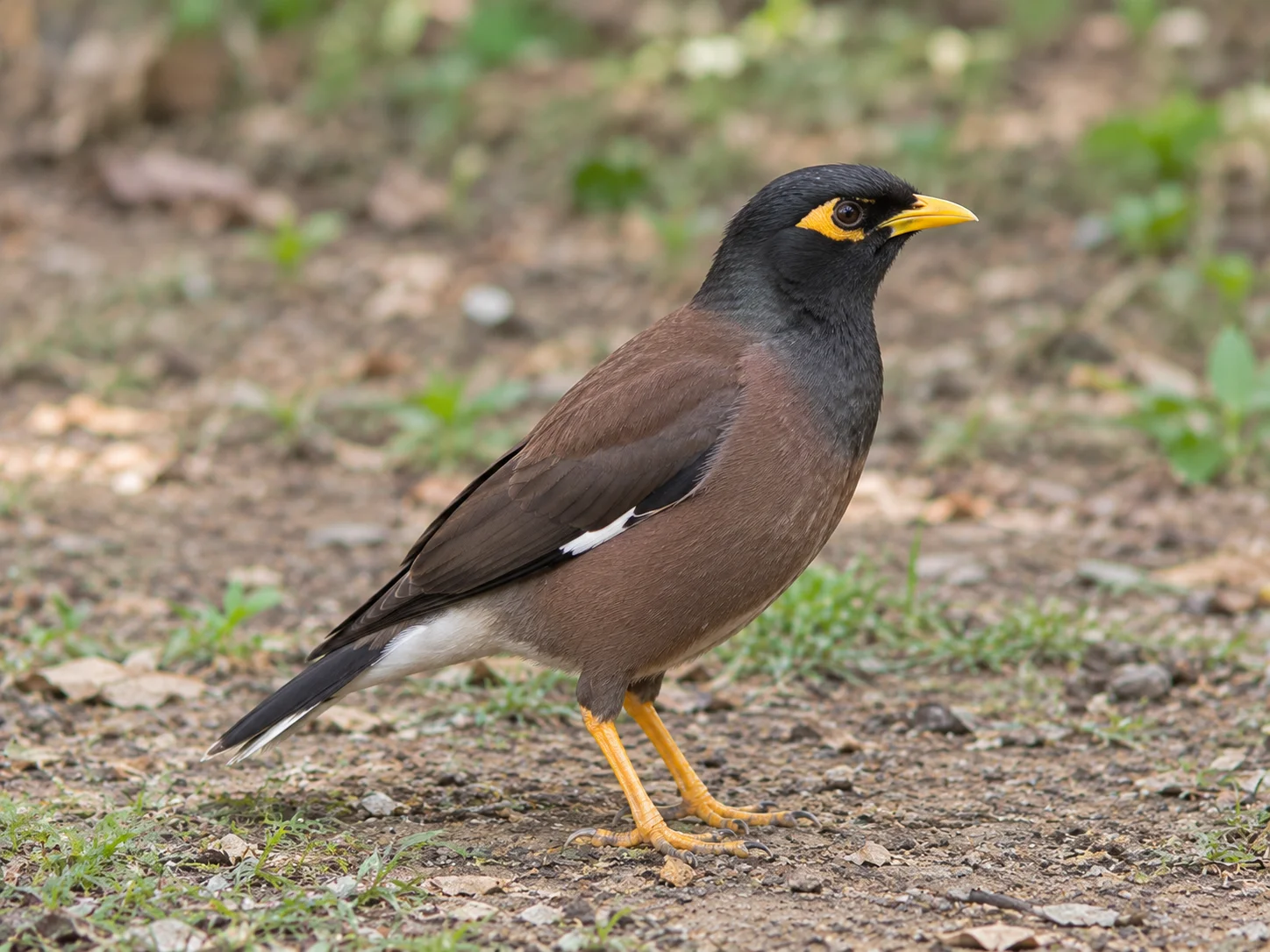
- Plumage. Rich brown body, glossy black head and neck, with a white wing patch that flashes conspicuously in flight.
- Eye patch. A bare triangle of bright yellow skin behind each eye, which makes the bird instantly recognizable.
- Beak and legs. Both bright yellow.
- Syrinx. The two-branched sound organ that does the mimicry.
- Feet. Strong, and mynas walk and strut rather than hop, like all starlings.
Males and females look alike, which is unusual for a bird this conspicuous.
Habitat and Range
The common myna is native to South and Central Asia, from Afghanistan and India through to Myanmar.
It has since spread across much of the world. Introduced deliberately in several places to control insects, it is now established in Australia, New Zealand, South Africa, the Middle East, Hawaii and many Pacific and Indian Ocean islands.
It thrives specifically where people are: cities, farmland, parks, garbage dumps and roadsides. Open country with buildings and scattered trees suits it perfectly, and dense forest does not.
Diet and Feeding
Mynas are omnivores, and their flexibility is exactly why they succeed.
They eat insects, worms, spiders, grain, fruit, nectar, lizards, eggs, small birds, scraps and food waste. They follow plows for turned-up insects, forage on lawns, and raid bins and market stalls.
Their original claim to fame was eating locusts and crop pests, which is why they were introduced to several countries in the first place.
They are bold about it. Mynas walk among people at outdoor cafes and will take food from a table.
Behavior and Lifestyle
Mynas are social, noisy and confident. They forage in pairs or small groups and gather at dusk in large communal roosts, sometimes hundreds of birds in one group of trees, calling loudly.
They are highly territorial around a nest, and this is where the trouble starts: a myna pair will aggressively drive other birds out of nesting holes, and they are persistent and effective at it.
They pair for life, and pairs stay close through the year, preening each other and calling back and forth.
They adapt remarkably quickly to new situations, learning traffic patterns, solving access to food containers and exploiting whatever people leave available.
Reproduction and Life Cycle
Mynas nest in cavities: tree holes, wall cavities, roof spaces, air conditioning units and street lights. Almost any hole will do.
The nest is an untidy pile of twigs, grass, feathers, paper and plastic.
Clutches run to 4 to 6 pale blue eggs, incubated for about 17 days, and both parents feed the chicks, which fledge at around three weeks. A pair may raise two or three broods a season.
Mynas live around 4 years in the wild, and captive birds have reached 12 or more.
Predators and Threats
Birds of prey, snakes, cats and rats take mynas, eggs and chicks, though the adults are alert and mob threats in groups.
They face very little pressure from people in their native range. Mynas are abundant and in no danger anywhere.
The hill myna is a different matter. Trapping for the cage-bird trade, driven by its talking ability, has reduced it badly in parts of its range.
Conservation Status
The common myna is listed as Least Concern, abundant, and expanding.
The concern runs entirely the other way. The common myna is on the IUCN list of the world’s hundred worst invasive species, one of only a handful of birds included.
Where introduced it takes over nesting holes that native birds depend on, evicting them and sometimes destroying eggs and chicks. On islands with vulnerable native species that pressure is serious, and several countries now run control programs against a bird they originally imported on purpose.
It is a good lesson in unintended consequences: a bird introduced to solve a pest problem became one.
Role in the Ecosystem
In its native range the myna is a useful bird. It eats large numbers of insects, including crop pests and locusts, disperses seeds in its droppings, and clears scraps that would otherwise rot.
It also pollinates some flowers while feeding on nectar.
Outside its range the same qualities cause harm. A bold, adaptable, hole-nesting omnivore that breeds fast outcompetes native birds, and the damage falls hardest on island species with nowhere else to go.
The myna is a clear example of a point worth making about wildlife generally: no animal is good or bad in itself. It depends entirely on whether it is where it evolved.