Meet the Alaskan Husky
The Alaskan husky is not a breed. There is no kennel club standard for it, no official appearance, and no pedigree you can register.
It is defined by what it can do. An Alaskan husky is a sled dog bred for pulling, and if it pulls well it is one, whatever it looks like.
That makes it one of the most capable endurance athletes in the animal kingdom. A racing team covers around 100 miles a day for over a week, in temperatures well below freezing, and the dogs finish able to do it again.
Scientific Name and Classification
The Alaskan husky is a domestic dog, Canis familiaris, like every other dog on Earth.
- Kingdom: Animalia
- Phylum: Chordata
- Class: Mammalia
- Order: Carnivora
- Family: Canidae
- Species: Canis familiaris
What it is not is a recognized breed. The American Kennel Club and its equivalents do not list the Alaskan husky, because it does not breed true to a standard and was never meant to.
The correct term is a landrace or a type: a population shaped by a job rather than by a written description. Working sheepdogs and farm cats are defined the same way.
Is the Alaskan Husky a Real Breed?
No, and understanding why explains the whole animal.
A recognized breed is defined by appearance. Judges measure a dog against a written standard: height, coat, head shape, color, the angle of the shoulder. Dogs are bred to match the description.
Mushers do not care what a dog looks like. They breed for the things that win races and get a team home safely: appetite while working, tough feet, an efficient trotting gait, a good coat, sense on a trail, and a willingness to pull. Any dog with those qualities is worth breeding from, regardless of its ancestry.
So Alaskan huskies carry whatever has proved useful. Behind a modern racing team you will find Siberian husky, Alaskan Malamute, village dogs from Alaskan and Canadian communities, and more recently German Shorthaired Pointer, setter and hound crosses added for speed and drive.
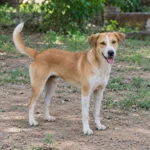
The result is a dog that is faster and lighter than a show husky, often with floppy ears, a less dramatic coat and no particular color, and it will outrun a pedigree Siberian over distance comfortably.
Difference Between Alaskan Husky, Siberian Husky and Malamute
| Alaskan husky | Siberian husky | Alaskan Malamute | |
|---|---|---|---|
| Recognized breed? | No, a working type | Yes | Yes |
| Bred for | Racing performance | Appearance and sledding | Hauling heavy freight |
| Weight | 35-60 lb | 35-60 lb | 75-100 lb |
| Appearance | Highly variable | Standardized; often blue eyes | Large, heavy-coated, brown eyes |
| Speed | Fastest of the three | Moderate | Slowest; built for power |
| Best at | Long-distance racing | Mid-distance, showing, family life | Heavy loads, short distances |
One quick field test: blue eyes are common in Siberian huskies, disqualifying in Malamutes, and simply unpredictable in Alaskan huskies because nobody selects for them.
Appearance and Anatomy
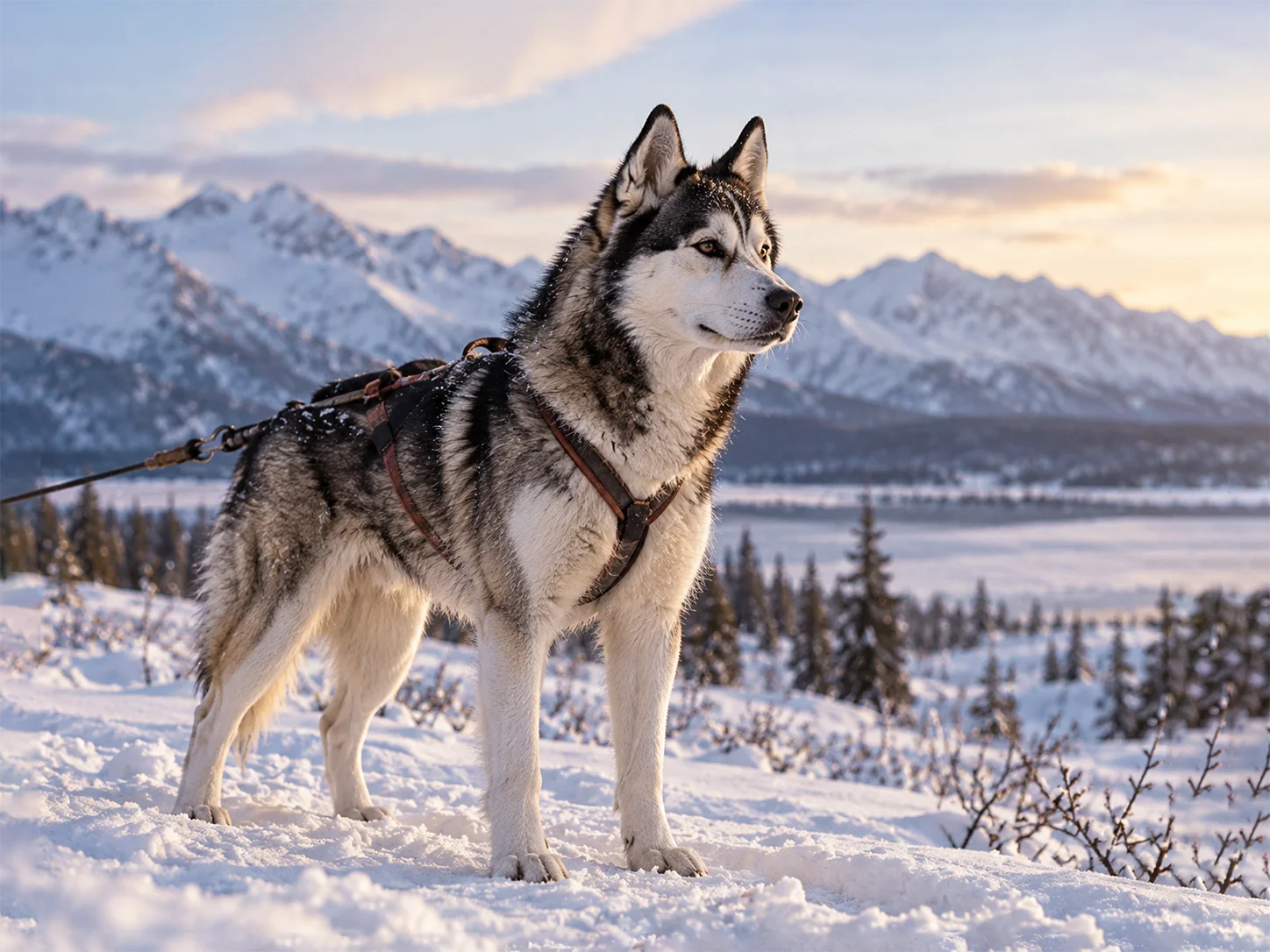
Alaskan huskies stand 20 to 26 inches at the shoulder and weigh 35 to 60 pounds, with racing dogs usually at the lighter end.
- Build. Lean, deep-chested and leggy, built for trotting rather than sprinting or hauling.
- Coat. A dense double coat in cold-weather dogs, though thinner in pointer-crossed lines, which is why racing dogs often wear coats and belly protectors in hard conditions.
- Feet. The most important part of the dog. Tough, compact and well-furred, and mushers check and treat them constantly. A team is lost to feet more often than to lungs.
- Ears. Anything from pricked to fully dropped. Nobody is selecting for them.
- Tail. Often carried low rather than curled over the back.
Their physiology is where they become genuinely extraordinary. Studies of racing sled dogs found they switch, within a day of starting a long race, into a metabolic state that lets them burn fat almost indefinitely without the muscle damage or exhaustion a human athlete would suffer. They effectively reset their bodies mid-race, and sports scientists have studied them for exactly this reason.
Origin and History
Sled dogs have worked the Arctic for thousands of years, and indigenous peoples of Siberia, Alaska, Canada and Greenland developed the dogs that everything modern descends from.
The Alaskan husky as a distinct type came out of the gold rush and the mail routes, when the ability to move people and freight across frozen country mattered enormously and the best dogs were bred to the best dogs without regard for pedigree.
The most famous episode is the 1925 serum run to Nome. Diphtheria broke out in a town cut off by winter ice, and antitoxin was relayed nearly 700 miles by 20 mushers and about 150 dogs in temperatures reaching minus 60. Balto gets the statue in Central Park, but the longest and most dangerous leg was run by Togo and his musher Leonhard Seppala, who covered roughly 260 miles, far more than any other team.
Racing kept the type alive after engines replaced dogs for transport, and the Iditarod, run since 1973 over about 1,000 miles, is now the event the breeding is aimed at.
Diet and Feeding
Alaskan huskies are omnivores, like all dogs, but a working sled dog’s diet is in a category of its own.
A racing dog burns an enormous number of calories a day, several times what a pet dog of the same size needs, and the food is extremely high in fat because fat delivers the most energy per mouthful.
On the trail they are fed often, in small amounts, usually as a warm soupy mixture of meat, fat and water. Getting water into them matters as much as food, because a dog that will not drink in the cold dehydrates fast, and a dog that will keep eating while working is worth more than a slightly faster one that will not.
Off-season, the same dog eats a normal maintenance diet and would get fat on racing rations.
Temperament and Behavior
Friendly, energetic, sociable with other dogs, and almost entirely focused on running.
- Enormous exercise needs. This is the defining fact. A dog bred to run 100 miles a day is not satisfied by a walk around the block, and an under-exercised one becomes destructive.
- Team animals. They are bred to work in a group and generally get on well with other dogs. Many are unhappy kept alone.
- Poor guard dogs. Friendly to strangers, which is a liability if you wanted a watchdog.
- Escape artists. They dig, climb and jump, and a husky that gets loose runs, often for miles. Secure fencing is essential.
- High prey drive. Cats and small pets are usually a poor match.
- Independent-minded. Intelligent, but bred to make decisions on a trail rather than to take orders, so training needs patience.
They howl rather than bark much, and a kennel of them in full voice is memorable.
Health and Life Span
Alaskan huskies live 10 to 15 years and are, on average, healthier than most pedigree dogs.
That is a direct consequence of not being a breed. Because they are bred for performance from a wide gene pool rather than for appearance within a closed one, they avoid much of the inherited disease that comes with a small pedigree population. A dog that cannot work does not get bred from, and most inherited problems show up as poor working ability.
Conditions that do occur include hip dysplasia, eye problems such as progressive retinal atrophy and cataracts, hypothyroidism, and a zinc absorption disorder found in husky lines.
Working dogs also get working injuries: shoulder and wrist strains, cut pads, and in hard racing conditions stomach ulcers and breathing problems from inhaling very cold air. Well-run races now have veterinary checks at every stage, and welfare in the sport remains a live debate.
Is an Alaskan Husky Right for Your Family?
For most households, honestly, no.
It suits people who run, cycle, skijor or hike seriously and want a dog to do it with, rural homes with secure fencing, households with another dog, and anyone willing to put in hours a day rather than minutes.
It suits badly flats and small gardens, hot climates, homes with cats or rabbits, anyone wanting an obedient or protective dog, and people who are out all day. Retired racing dogs are often rehomed successfully, but usually to active homes that understand what they are taking on.
They are good with children, being friendly and sturdy, but a 50-pound dog that wants to run is a lot of dog in a small space.
The Alaskan Husky’s Place Among Dogs
The Alaskan husky is the clearest demonstration of what dogs are actually for.
Most modern breeds were created in the last 200 years by selecting for appearance, and many carry health problems as a result. The Alaskan husky was shaped the older way, by whether the animal could do the job, and it is faster, tougher and healthier than the pedigree breeds it partly descends from.
It also represents one of the oldest working partnerships between people and animals. Dogs were pulling loads across Arctic ice thousands of years before anyone thought of a kennel club, and in 1925 a relay of these dogs carried medicine 700 miles to a town that nothing else could reach.
And they remain a serious subject of research. What a sled dog’s body does on day two of a long race is still not fully explained, and understanding it may yet teach us something about human endurance.