Meet the Xenopus
Think of a frog and you probably picture a long sticky tongue snapping out at a fly. Xenopus has no tongue at all.
It has hands instead. An African clawed frog grabs food in its front feet and shovels it into its mouth, which is a messy, oddly human way to eat and completely unlike the rest of its family tree.
This is also one of the most important animals in the history of science. Xenopus told women they were pregnant, became the first vertebrate ever cloned, and flew on the Space Shuttle. It also almost certainly helped carry a disease around the world that has pushed other amphibians toward extinction.
Scientific Name and Classification
Xenopus is a genus of about twenty-nine African frogs. This page is about the best-known of them, Xenopus laevis, the African clawed frog.
- Kingdom: Animalia
- Phylum: Chordata
- Class: Amphibia
- Order: Anura
- Family: Pipidae
- Genus: Xenopus
- Species: Xenopus laevis
The name means strange foot, which is a reasonable description. Pipidae is the family of tongueless frogs, a group of fully aquatic species in Africa and South America, relatives of the ordinary frog and toad that gave up land almost entirely.
Appearance and Anatomy
Females are much the larger sex: about 4 to 4.7 inches (10 to 12 cm) long and around 7 ounces (200 g), against roughly 2 to 2.4 inches (5 to 6 cm) and 2 ounces (60 g) for a male.
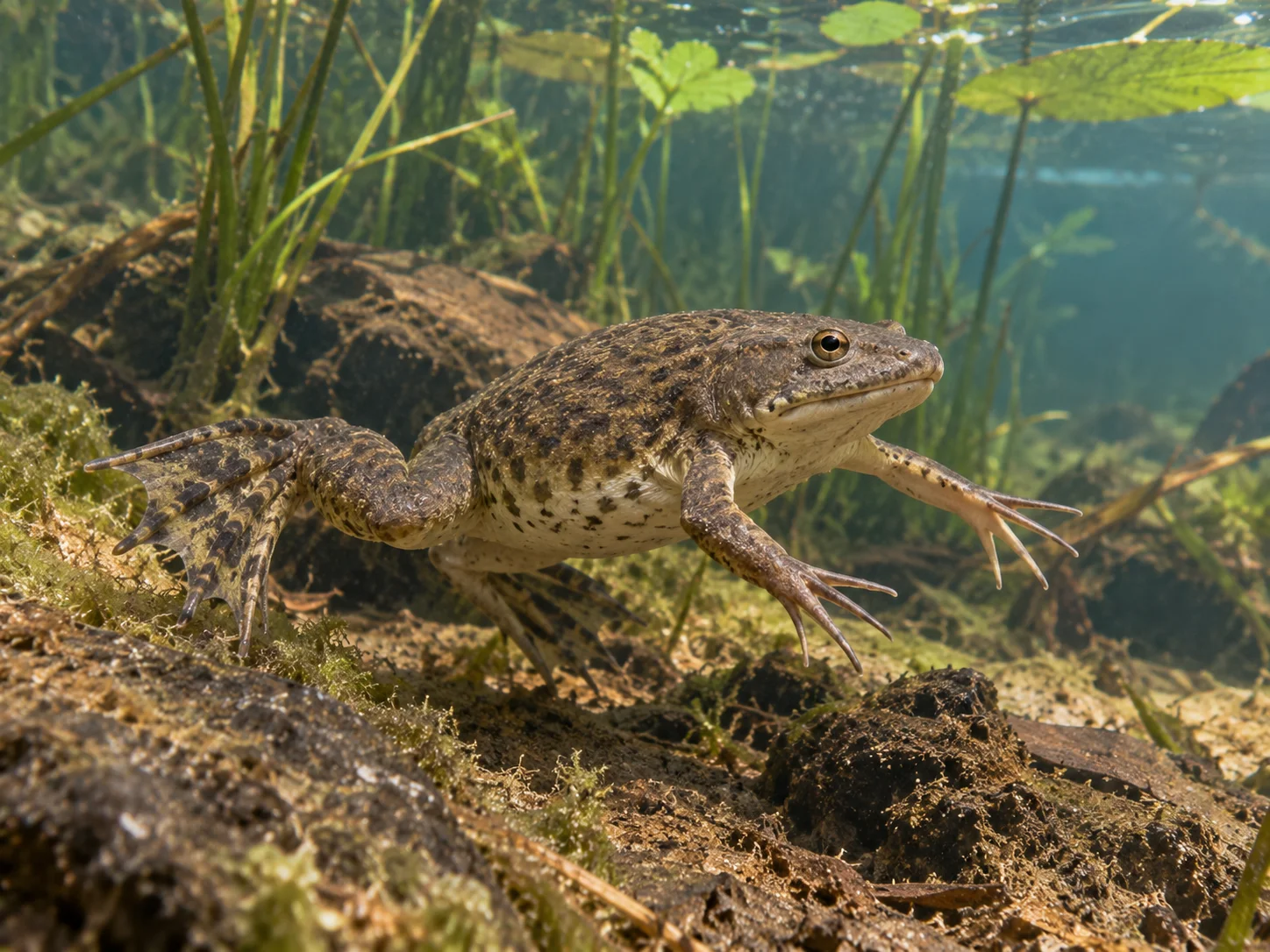
- Flattened body, smooth slippery skin, olive to gray-brown above
- Small upward-facing eyes with no eyelids
- No tongue and no external eardrum
- Large webbed hind feet with three black claws
- Thin unwebbed front fingers used like hands
- A row of stitch-like marks along each flank
Those stitch marks are the surprise. They are a lateral line, the same pressure-sensing organ fish use to feel movement in water. Most frogs lose it when they leave the tadpole stage; Xenopus keeps it for life, because it never leaves the water, and it uses it to feel prey rather than see it.
The claws give the animal its common name. Three hard black points on each hind foot are used to shred food and to rake at anything that tries to swallow the frog, which is unusual equipment for an amphibian.
Habitat and Range
The African clawed frog is native to southern Africa, where it lives in warm, still, often murky water: grassland ponds, ditches, slow streams and pools thick with green algae.
It is almost entirely aquatic. A Xenopus swims, feeds, breeds and hides in water, coming out only when it has to cross land to reach a different pool, and it tolerates a wide range of water conditions that would kill a fussier amphibian.
When the pond dries up, it does not die with it. The frog digs down into the mud, leaves a narrow tunnel open for air, and waits, able to lie dormant for as long as a year until the rain comes back.
Diet and Feeding
Xenopus is a carnivore and a scavenger, and it is not fussy. It takes insects, aquatic worms, crustaceans, small fish, tadpoles, the dead and dying, and plain organic waste off the bottom.
Without a tongue, feeding is hands-on. The frog finds food by smell and by the pressure-sensing line along its sides, stuffs it into its mouth with its front feet, and uses the claws on its hind feet to tear anything too large to swallow whole. It will also dig through mud with its hands to turn up worms.
Tadpoles do the opposite. They hang head-down in open water and filter tiny particles out of it, so a young Xenopus and an adult Xenopus make their living in entirely different ways.
Reproduction and Life Cycle
Breeding happens whenever the water is warm and full enough. The male grips the female around the waist and she releases hundreds of sticky eggs over three or four hours, which he fertilizes as they go and which attach to plants and stones.
The tadpoles hatch quickly and filter-feed as they grow, turning into small frogs over roughly six to eight weeks, with the final change from tadpole to froglet taking only four or five days.
They then live a remarkably long time for a frog. Wild and feral animals reach 15 or 16 years, and captive ones have lived past 20 and in some cases close to 30.
Xenopus in Science
In the 1930s two researchers found that injecting a pregnant woman’s urine into a female Xenopus made the frog lay eggs within 8 to 12 hours. A hormone in the urine triggered it, and the result was a living pregnancy test that hospitals used until the 1960s. Thousands of frogs were shipped around the world to serve as it.
The eggs turned out to be useful for far more than that. They are big, tough and easy to work with, which made Xenopus the standard animal for studying how a single cell becomes a body. In 1962 John Gurdon used African clawed frogs to produce the first cloned vertebrate, work that won him a share of the Nobel Prize fifty years later.
And on 12 September 1992, four female Xenopus launched aboard the Space Shuttle Endeavor on mission STS-47, so that scientists could find out whether eggs would develop normally in weightlessness.
Conservation Status and Threats
The IUCN lists the African clawed frog as Least Concern, and here the usual story runs backward: this amphibian is doing too well rather than too badly.
Escaped and released frogs have founded wild populations in California, Chile, Britain, China and elsewhere, where they eat native tadpoles, insects and small fish. One colony turned up in a pond in San Francisco’s Golden Gate Park in 2003 and the pond had to be drained and fenced.
The harder problem is invisible. Xenopus carries the chytrid fungus, the disease that has devastated frog populations on several continents, and it carries it without getting sick, which makes it an almost perfect spreader. Decades of shipping laboratory and pet frogs between countries is now thought to be one of the ways that fungus reached the rest of the world.
Role in the Ecosystem
At home in southern Africa, Xenopus is a middle link that works in both directions. It clears dead matter and controls insect larvae in standing water, and in turn it feeds herons, storks, otters, snakes and fish.
Its ability to sit out a drought in the mud also means it recolonizes ponds fast after they refill, so it is often the first predator back in a pool that has dried and returned, a useful trait in country where water comes and goes.
Away from home it is a warning instead. The same toughness that makes Xenopus easy to keep, easy to study and easy to ship is exactly what makes it dangerous once it gets loose, and the lesson is the one that applies to any animal moved across the world: the traits that make a species convenient are rarely the traits that make it harmless.