One Species, Two Animals
Most biologists now treat the domestic dog as a subspecies of the wolf, written Canis lupus familiaris, and the two share more than 99 percent of their DNA. They can breed together and the puppies are fertile, which is usually the test for one species.
Even so, a dog is not a tame wolf. Dogs and today’s wolves both descend from an ancient wolf population that has since died out, so the two are cousins who separated somewhere between fifteen and forty thousand years ago. Everything since then has pushed them apart, and most of that pushing was us.
Read the Ears, Eyes and Tail
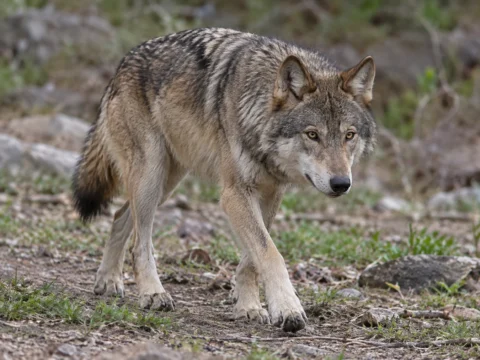
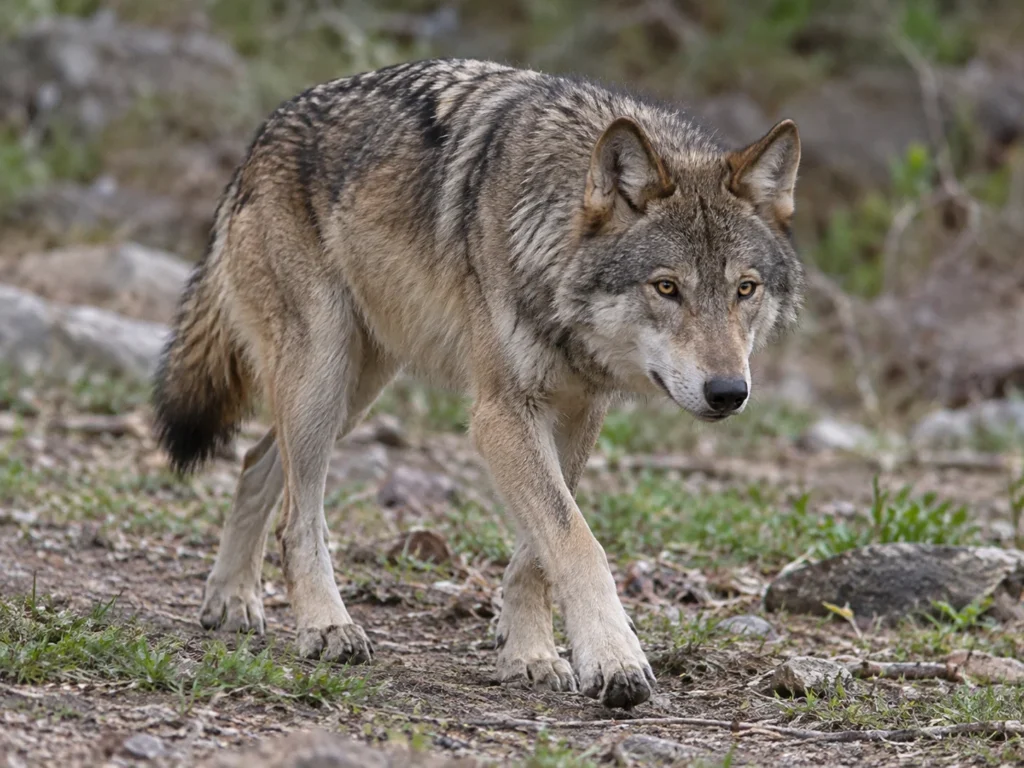
Wolves are remarkably consistent, which is what makes identification possible at all when dogs range from a chihuahua to a mastiff. A wolf’s ears are always upright, rounded at the tip and packed with fur against the cold. They never flop. Its tail is straight and hangs low, and it never curls over the back the way a husky’s does.
The eyes are the detail people miss. A wolf’s are almond shaped and set at a slight angle, and in an adult they are amber, yellow or pale brown. An adult wolf with blue eyes essentially does not exist, so a blue-eyed animal that looks like a wolf is a husky or a wolfdog.
Then there is the hardware. A wolf’s head is larger and longer than any similar-sized dog’s, its canine teeth reach two inches, and its paws are roughly the size of a human hand, with the two middle toes set noticeably forward.
Built for Forty Miles a Day
A wolf pack is a traveling family, and it can cover thirty or forty miles in a day while hunting, moving at a steady trot that costs it very little. The legs are long, the chest is narrow and deep, and the front feet turn slightly inward so the hind feet drop into the prints the front ones made, which saves effort in deep snow.
A pack is not the ladder of dominance that older books described. It is a mated pair and their young of the last two or three years, so what looks like rank is mostly just parents and offspring. The idea of an alpha fighting its way to the top came from studying unrelated captive wolves, and the researcher who popularized it spent years afterwards trying to correct it.
Barking, Howling and Why Dogs Talk More
Wolves can bark but rarely do, and when they do it is a short warning rather than a conversation. Their long-range signal is the howl, which carries several miles and tells other packs where the territory line is.
Dogs bark constantly by comparison, and that looks like something we selected for. A barking animal is useful to a human camp, and dogs have gone further still: they read our faces, follow a pointed finger, and hold eye contact in a way wolves raised by people never quite learn. Dogs also have facial muscles that lift the inner eyebrow. Wolves do not, which is why only a dog can give you that look.
Why a Wolf Cannot Be a Pet
Wolf puppies hand-reared from birth still grow into wolves. They become destructive at about six months, test everything, and cannot be housetrained reliably, because a wolf marks territory as a matter of instinct. They need space measured in square miles, not a yard.
Wolfdogs, the crosses sold as pets, are harder still, because an animal with a mix of wolf and dog instincts is unpredictable in a way neither parent is. Many end up in sanctuaries. The honest answer is that the dog already is the version of this animal that lives with people. That took thousands of years and cannot be shortcut in one lifetime.