Meet the Nightjar
For two thousand years people believed nightjars drank milk from goats. Aristotle wrote it down, and the belief was still alive in the nineteenth century. Nightjars are a family of night-flying insect eaters, the Caprimulgidae, found on every continent except Antarctica.
The name records the accusation. The genus Caprimulgus comes from the Latin for nanny goat and to milk, and English called the bird a goatsucker. German, Polish and Italian all say the same thing.
What nightjars were actually doing was eating the insects that gather around livestock at dusk. They were hanging around goats, and when a goat went dry or blind, the odd-looking bird with the enormous mouth got the blame.
Scientific Name and Classification
Nightjars make up the family Caprimulgidae, which holds 22 genera. This page uses the European nightjar, Caprimulgus europaeus, for its figures, because it is the best-documented member.
- Kingdom: Animalia
- Phylum: Chordata
- Class: Aves
- Order: Caprimulgiformes
- Family: Caprimulgidae
- Genus: Caprimulgus and 21 others
They live on every continent except Antarctica, and on islands as scattered as the Seychelles and New Caledonia, from sea level to 13,800 feet (4,200 m). Because the family covers so many species, there is no single conservation status for nightjars as a whole.
Appearance and Camouflage
The European nightjar is 9.6 to 11 inches (24.5 to 28 cm) long with a wingspan of 20 to 23 inches (52 to 59 cm), and weighs 1.8 to 3.6 ounces (51 to 101 g).
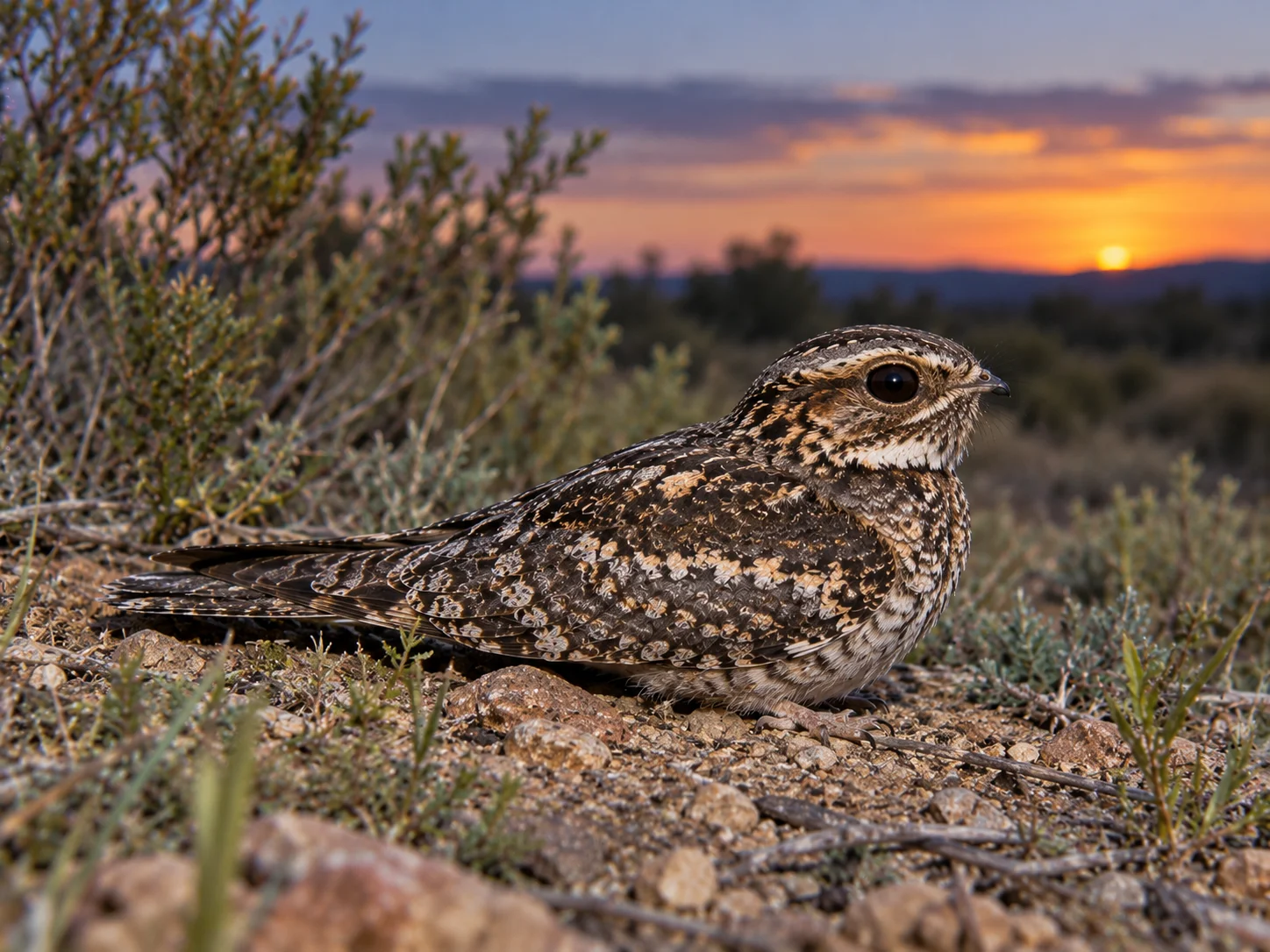
- Grayish-brown plumage streaked and barred like bark or dead leaves
- A very small bill opening into a very wide mouth
- Long bristles around the mouth
- Large eyes
- Long wings and short legs
- A serrated comb-like edge on the middle claw, used for preening
The camouflage is the best thing about them, and it is behavioral as much as visual. A nightjar spends the day on the ground or lying lengthwise along a branch rather than perching across it, so it reads as a lump of bark, and it will turn to face the sun in order to cast less shadow.
Males carry white patches on the wings and white tips on the outer tail feathers, which females lack. Those flashes only show in flight, so the bird can signal to its own kind at night and still disappear completely by day.
Hunting in the Dark
A nightjar hunts flying insects (moths, beetles, dragonflies, mantises, cockroaches, flies) and it does it by sight, not by sound.
Each eye has a tapetum lucidum, a reflective layer behind the retina that bounces light back through it for a second chance at being seen. The retina is packed with rod cells and has few cones, which trades color vision away for sensitivity in the dark.
The technique is to silhouette prey against the night sky and take it from below. That makes moonlight worth a great deal: feeding activity more than doubles on moonlit nights. On bright nights a nightjar will sally out from a perch like a flycatcher; on dark ones it flies continuously instead.
It does not use hearing to locate insects, and it does not echolocate, unlike a bat, which is doing a similar job in the same air at the same hour by entirely different means.
It even drinks and bathes on the wing.
The Churring Song
The male’s song is unlike anything else in European birdsong: a sustained mechanical churring trill that runs continuously for as long as ten minutes, shifting speed and pitch now and then.
It carries. The churr is audible at 650 feet (200 m) and in good conditions can be heard from 2,000 feet (600 m) away, which is how a bird nobody can see announces that it is there.
Nesting on Bare Ground
Nightjars build nothing at all. One or two whitish eggs, blotched in brown and gray, are laid straight onto the ground among leaf litter, plants or tree roots.
Incubation takes 17 to 21 days, the chicks fledge in 16 or 17, and they are independent about 32 days after hatching. An early pair may raise a second brood.
There is a story that nightjars carry their eggs and chicks away in their mouths when disturbed. It is often repeated, but surveys have found very little evidence for it, one of those claims that has traveled further than its proof.
The Bird That Hibernates
Birds are not supposed to hibernate. Migration is the usual answer to winter, and a small warm-blooded animal that shuts down is taking an enormous risk.
The common poorwill of western North America, a nightjar, does it anyway. It becomes torpid, drops its body temperature a long way, and stays like that for weeks or even months, the only bird known to manage anything properly comparable to hibernation.
Other nightjars can enter torpor for shorter spells, which suggests the poorwill did not invent the ability so much as extend one the family already had.
Migration and Lifespan
Every European nightjar population migrates, most of them wintering in sub-Saharan Africa, chiefly in the east and southeast. They leave in August and September and are back on the breeding grounds by May.
They travel at night, and most birds set off around a full moon, the same light that makes their hunting easier.
Nightjars breed at a year old and typically live about four years, with roughly 70 percent of adults surviving any given year. The oldest wild bird on record was just over twelve.
Conservation and Threats
The European nightjar is listed as Least Concern, with a global population estimated at 3 to 6 million birds in 2020, though it has declined in places.
Across the family the picture varies, and some species are threatened with extinction. Vaurie’s nightjar is known from an estimated 10,000 birds, and several species simply lack the data for an assessment at all.
One threat is a direct consequence of the camouflage. Nightjars rest and roost on roads, where the surface holds the day’s heat and insects gather, and a bird that relies on sitting absolutely still and being invisible is in the worst possible position in front of a car. Roadkill is thought to be a major cause of death.
Role in the Ecosystem
Nightjars take large flying insects at night in considerable numbers, filling a role at dusk and after dark that the owl does not. An owl is hunting mice, not moths.
They need open ground to nest on, which makes them a signal of a particular kind of habitat: heathland, woodland clearings, young plantations. Tidy, closed-over, fully grown forest holds no nightjars.
And they are a standing example of how a strange-looking animal attracts strange explanations. The enormous mouth, the night habits and the company of livestock produced two millennia of goat-milking stories, when the bird was only ever after the flies.