Meet the Gharial
A crocodile’s jaw is built to hold and crush. The gharial’s is built to do the opposite.
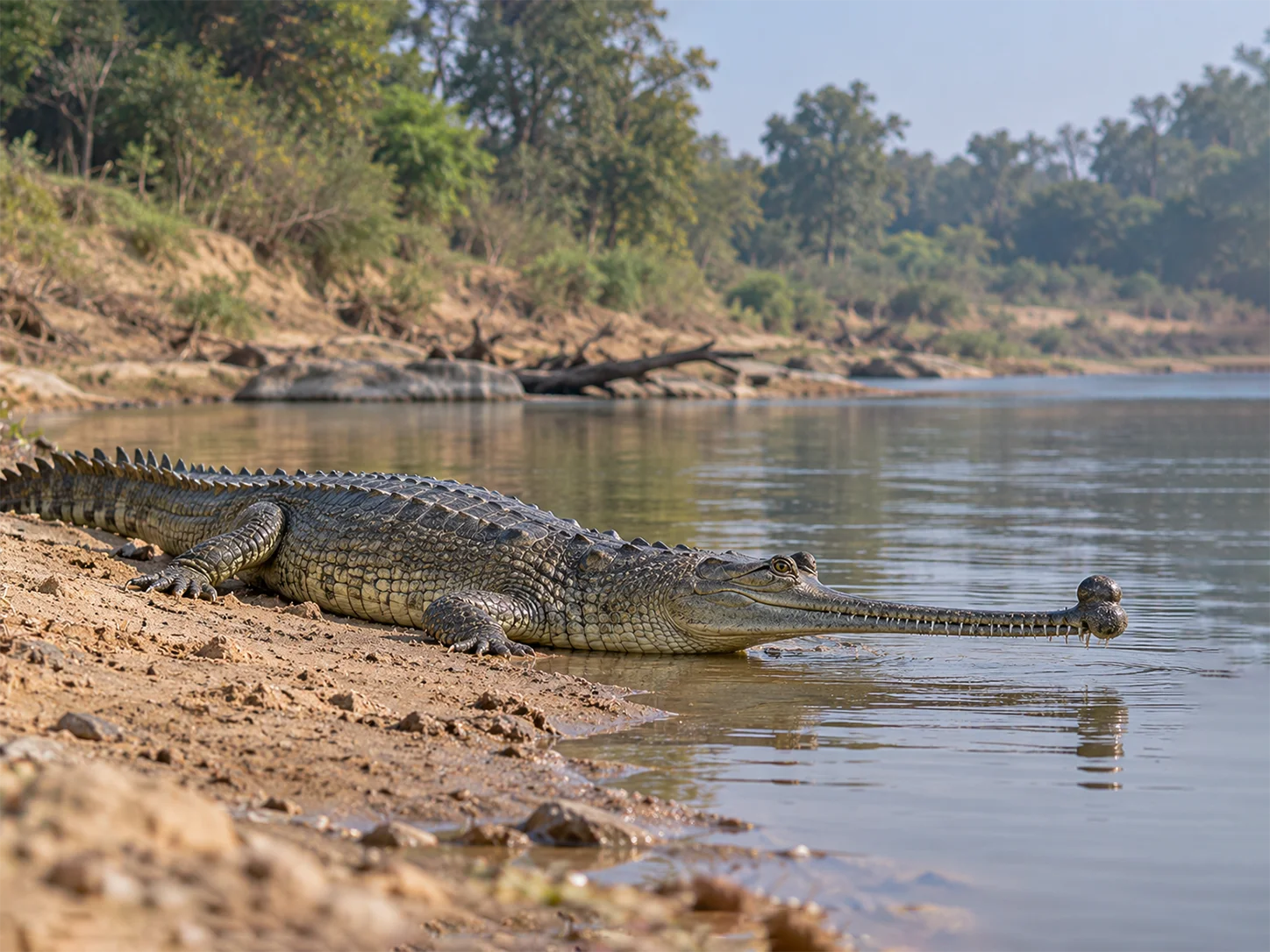
Its snout is extraordinarily long and so narrow that it is barely wider than the bone inside it, lined with over a hundred thin interlocking teeth. A jaw that shape offers almost no water resistance, so the gharial can swing it sideways through water faster than it could ever swing a heavy one, and the teeth close on a fish like a trap.
It is a specialist, and the specialization is total. A gharial cannot take large land prey and does not try, which makes it one of the very few crocodilians that is no danger to people at all.
Scientific Name and Classification
The gharial is Gavialis gangeticus, the only living member of its genus and one of only two species left in the family Gavialidae, the other being the false gharial of Southeast Asia.
- Kingdom: Animalia
- Phylum: Chordata
- Class: Reptilia
- Order: Crocodilia
- Family: Gavialidae
- Species: Gavialis gangeticus
This is an ancient and nearly emptied branch. Gavialids were once diverse and widespread, including species in South America and Africa, and the gharial is close to the last of them.
The name comes from ghara, the Hindi word for an earthenware pot, after the bulbous growth on the end of a mature male’s snout.
It is not a crocodile or an alligator, and the three are different families within the same order.
What Is the Pot on Its Nose?
Only mature males have it. The ghara is a hollow cartilaginous bulb that grows over the nostrils once a male reaches breeding size, and no other crocodilian has anything comparable, which makes it one of the most distinctive structures in the whole order.
It does three jobs, as far as anyone can tell:
- It makes sound. The male produces a loud buzzing hiss through it, audible over considerable distance, used during courtship.
- It blows bubbles. Males force air through it underwater as part of display.
- It advertises. Because only sexually mature males grow one, the ghara is an unmistakable signal of status that a female can read at a glance.
It is also an unusually convenient feature for conservation work, since a survey team counting gharials can identify breeding males from a boat without catching anything.
Appearance and Anatomy
Gharials are among the largest crocodilians. Males reach 13 to 20 feet and 350 to 550 pounds (160 to 250 kg), with historical records of larger animals; females are considerably smaller at 8 to 15 feet.
- Snout. The narrowest of any crocodilian, with 106 to 110 teeth, all thin, sharp and slightly angled outward, interlocking when the jaws close.
- Legs. Weak. A gharial cannot do the high walk other crocodilians manage, and on land it slides on its belly, which is why it almost never leaves the water except to bask and nest.
- Tail. Deep and powerfully muscled, built for a fish-hunter that swims constantly.
- Feet. Extensively webbed hind feet.
The trade-off is stark and worth stating plainly: the gharial is magnificently equipped for catching fish in a river and almost helpless at anything else. That is fine while the rivers hold fish and have sandbanks, and catastrophic when they do not.
Habitat and Range
Gharials live in deep, fast-flowing rivers of the northern Indian subcontinent, and they need two things in the same place: deep pools with fish, and high sandbanks for basking and nesting.
They once ranged across the river systems of Pakistan, India, Nepal, Bangladesh and Myanmar, from the Indus to the Irrawaddy. They are now effectively gone from Pakistan, Bangladesh, Bhutan and Myanmar.
What remains is a handful of populations in India and Nepal, and the great majority of all breeding gharials in the world are in one place: the Chambal River, a tributary of the Yamuna, protected as the National Chambal Sanctuary. A species’ entire future resting on one river is a precarious arrangement.
Smaller populations hold on in the Girwa, Son and Ramganga rivers and in Nepal’s Rapti and Narayani.
Diet and Feeding
Adult gharials are carnivores and almost entirely fish eaters, which is unusual even among crocodilians.
The technique is sideways. The gharial holds its head loosely in the water, waits, and sweeps the snout sideways when a fish comes within range, the interlocking teeth gripping rather than cutting. It then maneuvers the fish round and swallows it head first.
Juveniles start on insects, tadpoles, frogs and small fish and move up as their snouts grow.
Like other crocodilians they swallow stones, which sit in the stomach and may help with digestion or ballast, and gharials have been found with jewelry in them, which fed stories of man-eating. The explanation is that gharials scavenge human remains from the funeral practices of the rivers they live in, not that they attack people.
Behavior and Lifestyle
Gharials are social for crocodilians, basking in groups on sandbanks through the cool months and tolerating each other closely.
They are almost wholly aquatic, hauling out only to bask and nest, and because their legs cannot support a proper walk they are awkward and vulnerable on land.
Males hold territories containing several females, and the breeding display involves the ghara buzz, bubble-blowing and jaw-slapping on the water.
They are harmless to people. There is no reliable record of a gharial killing a human, which makes it one of the few large crocodilians anywhere that fishermen can work alongside, and that fact is central to the argument for protecting it.
Reproduction and Life Cycle
Females nest in the dry season, digging a hole in a high sandbank well above the waterline and laying 30 to 60 eggs, among the largest eggs of any crocodilian.
Incubation takes 70 to 90 days, and like other crocodilians the sex of the hatchlings is set by nest temperature.
When the eggs are ready the hatchlings call from inside, and the female digs them out. She then guards them, and the behavior is unexpected given her jaws: she cannot carry her young in her mouth as a crocodile does, because the snout is the wrong shape, so hatchlings ride on her head and back instead.
Several females often share a male’s protection, and he stays in the area, which is unusual among crocodilians.
Gharials mature slowly, at around 8 to 15 years, and live 50 to 60 years. Slow maturity plus a single river is a bad combination for recovery.
Predators and Threats
Eggs and hatchlings are taken by jackals, mongooses, monitor lizards, birds and catfish. Adults have no predators.
The gharial’s decline was one of the steepest recorded for any large animal: from perhaps 5,000 to 10,000 in the 1940s to fewer than 250 by the mid-1970s, a fall of around 98 percent in three decades. The causes are all about rivers:
- Fishing nets. Gharials drown in gill nets, and this is the single biggest killer of adults today.
- Dams and barrages. They change flow, drown sandbanks or dry them out, and cut populations off from each other.
- Sand mining. Removing sandbanks removes the only places they can nest.
- Irrigation withdrawal. Rivers reduced to shallow channels have neither deep pools nor fish.
- Egg collection and historic hunting for skins.
In the winter of 2007 to 2008 more than 100 gharials died in the Chambal, a devastating loss for a species that small. Investigations pointed to a combination of toxins and kidney damage, and the cause has never been established with certainty, which is itself unsettling.
Conservation Status
The gharial is Critically Endangered, with roughly 650 to 1,000 adults left in the wild, most of them in the Chambal.
India began Project Crocodile in 1975 with UN support, collecting wild eggs, rearing hatchlings in captivity past the vulnerable stage, and releasing them. Thousands have been released over the decades.
The results are mixed in an instructive way. The program almost certainly prevented extinction, but survival of released animals has often been poor, because releasing young gharials into a river that still has gill nets, no sandbanks and too little water does not produce breeding adults. Numbers have improved since the 1970s low and the species remains Critically Endangered.
The lesson drawn from it is now standard in conservation: captive breeding buys time, and only habitat protection converts that time into a population.
Role in the Ecosystem
Gharials are top fish predators in their rivers, and by taking fish they help keep those populations in balance. Fishermen have sometimes reported better catches where gharials are present, which is consistent with a predator removing sick fish and competitors.
They are also an unusually good indicator species, because they need deep water, abundant fish and intact sandbanks simultaneously. A river with breeding gharials is a river that is still functioning as a river, and that matters to the dolphins, turtles, otters and skimmers that need the same conditions.
Their nesting and basking areas overlap with those of the Indian skimmer and several turtle species, so protecting a gharial sandbank protects a good deal else.
And the gharial is the clearest answer on this site to the question of why a strange-looking animal matters. It is the last of a family that once spanned continents, it is harmless to people, it eats only fish, and it is down to a few hundred breeding adults in one Indian river. Nothing about it is dangerous or inconvenient. It is disappearing because the rivers it needs are being taken apart for sand, water and nets.