
Meet the Alaskan Shepherd
An Alaskan Shepherd is an Alaskan Malamute crossed with a German Shepherd. It is not a breed, and there is no such thing as a typical one.
That is the honest and most useful thing to say about it. Two puppies from the same litter can end up noticeably different in size, coat, ear shape and temperament, because each one inherits a different mix from two very different parent breeds.
What you can rely on is that it will be large, heavily coated, highly intelligent and in need of a great deal more exercise than most people expect.
Scientific Name and Classification
The Alaskan Shepherd is a domestic dog, Canis familiaris, like every dog.
- Kingdom: Animalia
- Phylum: Chordata
- Class: Mammalia
- Order: Carnivora
- Family: Canidae
- Species: Canis familiaris
It is a first-generation crossbreed, not a recognized breed. No major kennel club lists it, because it has no standard and does not breed true.
It is worth being clear about the three different things that get confused here:
- A breed, like the German Shepherd, has a written standard and breeds true, so puppies reliably resemble their parents.
- A landrace or type, like the Alaskan husky, is defined by the job it does rather than its looks, and has been shaped over generations.
- A crossbreed, like this, is the first-generation offspring of two different breeds. It has no history of its own and no predictable outcome.
What Do You Actually Get from This Cross?
It depends entirely on which traits each puppy inherits, and the two parent breeds, the Alaskan Malamute and the German Shepherd, are not similar animals.
| Alaskan Malamute | German Shepherd | |
|---|---|---|
| Bred for | Hauling heavy freight | Herding, then police and military work |
| Temperament | Friendly, stubborn, independent | Trainable, focused, handler-oriented |
| Trainability | Difficult; thinks for itself | Among the most trainable of all dogs |
| Guarding | Poor; friendly to strangers | Strong protective instinct |
| Coat | Very thick double coat | Medium double coat |
| Weight | 75-100 lb | 50-90 lb |
So an Alaskan Shepherd might be a biddable dog that learns fast, or an independent one that decides for itself. It may guard the house or welcome burglars. Both are normal results of this cross.
Anyone selling puppies with confident promises about temperament is overstating what a first cross can deliver.
Appearance and Anatomy
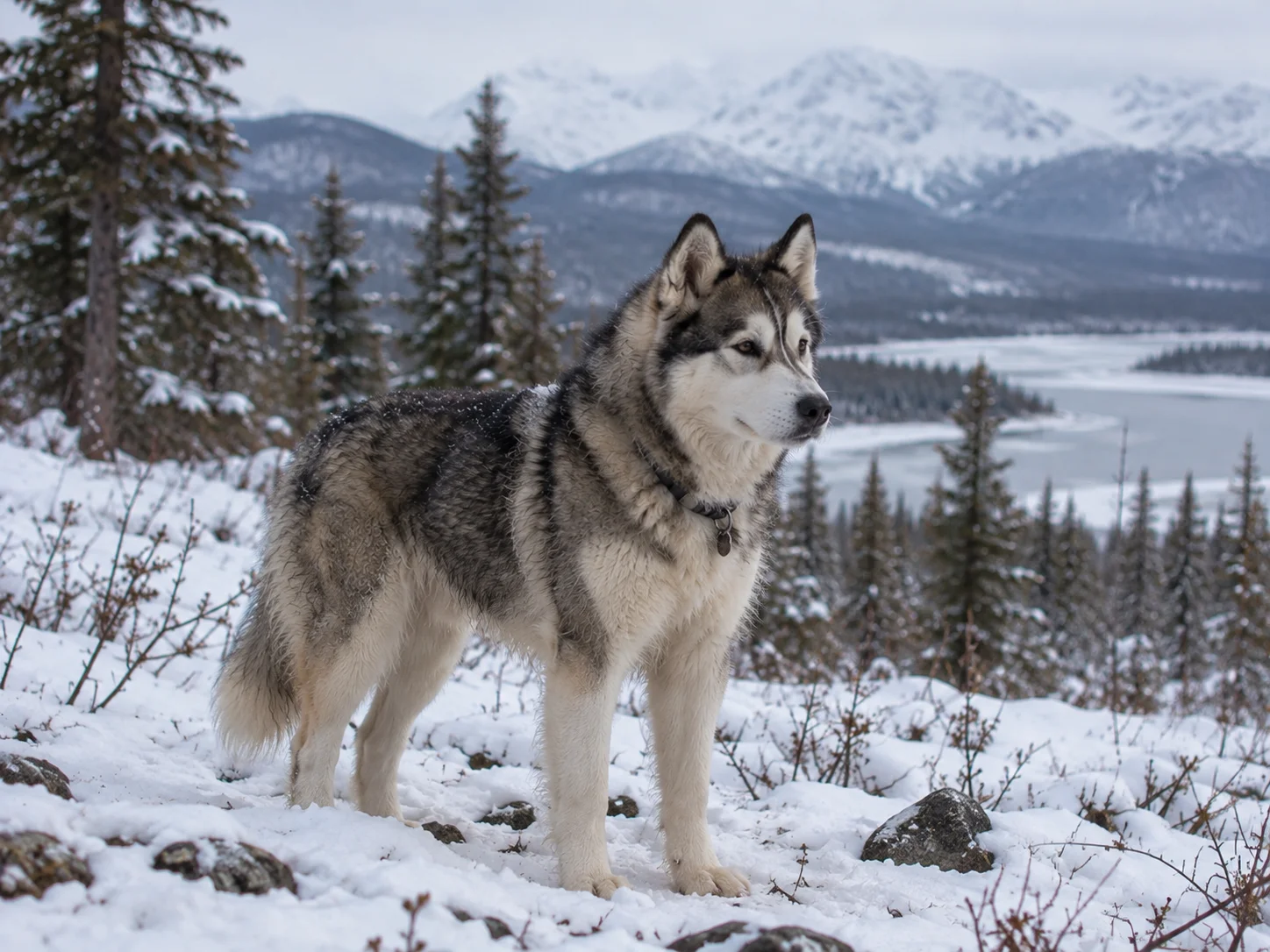
Alaskan Shepherds stand 22 to 26 inches at the shoulder and weigh 70 to 100 pounds, making this a genuinely large dog.
- Coat. A thick double coat in almost any combination of black, gray, sable, tan, white and cream. Expect heavy shedding twice a year and steady shedding in between.
- Ears. Usually upright, sometimes semi-dropped, and the two can differ on the same dog.
- Build. Powerful and deep-chested, somewhere between the Malamute’s bulk and the Shepherd’s athletic frame.
- Eyes. Usually brown. Blue eyes are possible but uncommon, since Malamutes do not carry them.
- Tail. Often carried high and sometimes curled, depending on which parent it favors.
That coat is built for Alaska, not for heat. These dogs cope badly with hot climates and should never be shaved, since the coat insulates against heat as well as cold.
Origin and History
The Alaskan Shepherd has no long history, because it is a deliberate modern cross rather than a developed breed.
Its parent breeds do. The Alaskan Malamute is an ancient freight dog of the Mahlemut people of northwest Alaska, built for hauling heavy loads over distance rather than for speed. The German Shepherd was created in Germany from the 1890s by Max von Stephanitz, who wanted a standardized herding dog and ended up producing the most widely used working dog in the world.
Crossing the two became popular as part of the broader fashion for designer crossbreeds, with the hope of combining the Malamute’s hardiness and the Shepherd’s trainability.
Sometimes that works. Sometimes you get the Malamute’s stubbornness and the Shepherd’s energy, which is a harder dog to live with than either parent.
Temperament and Behavior
Variable by individual, but some things are reliable because both parents share them.
- Very high exercise needs. Both parent breeds are working dogs. An hour a day is a minimum, and two is better.
- Highly intelligent. Which means easily bored. A bored dog of this size is genuinely destructive.
- Strong bond with family. They dislike being left alone for long periods and can develop separation anxiety.
- Vocal. Malamutes howl and talk rather than bark, and many of these dogs inherit that.
- Prey drive and digging. Both inherited from the Malamute side, so secure fencing matters.
- Strength. A 90-pound dog that decides to pull will pull. Lead training from puppyhood is not optional.
They are usually good-natured and affectionate with their own household, and often friendly rather than aggressive, which is worth saying given how imposing they look.
Diet and Feeding
Alaskan Shepherds are omnivores, like all dogs, and need a diet suited to a large active breed.
Puppy feeding matters more in large breeds than small ones. Growing too fast on over-rich food increases the risk of joint problems later, so large-breed puppy food and controlled growth are genuinely important.
Both parent breeds are deep-chested, which carries a risk of bloat. Feeding two or three smaller meals rather than one large one, and avoiding hard exercise straight after eating, reduces that risk.
The usual toxic foods apply: chocolate, grapes and raisins, onions and garlic, and xylitol.
Health and Life Span
Alaskan Shepherds live 10 to 13 years, typical for a large dog.
There is a persistent claim that crossbreeds are automatically healthier than purebreds, and it needs qualifying. A cross avoids problems caused by inbreeding within one closed gene pool, which is a real benefit. But it inherits the risk of any condition both parent breeds carry, and these two share several.
Both Malamutes and German Shepherds are prone to hip and elbow dysplasia, so this cross is at meaningful risk of both. Also watch for bloat, eye conditions including progressive retinal atrophy, hypothyroidism, and degenerative myelopathy from the Shepherd side.
So the useful question for a buyer is not whether the puppy is a cross, but whether both parents have hip, elbow and eye screening results you can see. A cross from untested parents is not healthier than anything.
Is an Alaskan Shepherd Right for Your Family?
It suits active households in cool climates with a large secure garden, people home for much of the day, experienced dog owners who can handle a large strong-willed animal, and anyone who genuinely wants to spend two hours a day with a dog.
It suits badly flats and small gardens, hot climates, first-time owners, people out at work all day, households wanting a low-shedding dog, and anyone who needs to know in advance what temperament they are getting.
One more thing worth saying: large crossbreeds turn up in rescue centers in significant numbers, usually surrendered by owners who underestimated the exercise and the shedding. Checking a rescue before a breeder is a reasonable first step.
The Alaskan Shepherd’s Place Among Dogs
The Alaskan Shepherd is a good way to understand what a dog breed actually is, and what it is not.
Breeds exist because generations of selection made offspring predictable. That predictability is the whole point: you buy a German Shepherd knowing roughly what will arrive. A first-generation cross does not offer that, and no amount of marketing a name changes the genetics.
Which is not an argument against crossbreeds. Mixed-breed dogs make excellent companions, and the Alaskan husky shows that breeding for ability rather than looks can produce something superb. The point is simply to buy one with clear eyes: a healthy, well-raised crossbreed from tested parents is a fine dog, and a guarantee about how it will turn out is not on offer.