
Meet the Vicuña
The vicuña grows the finest wool in the world, and that fact has nearly destroyed it once and saved it once.
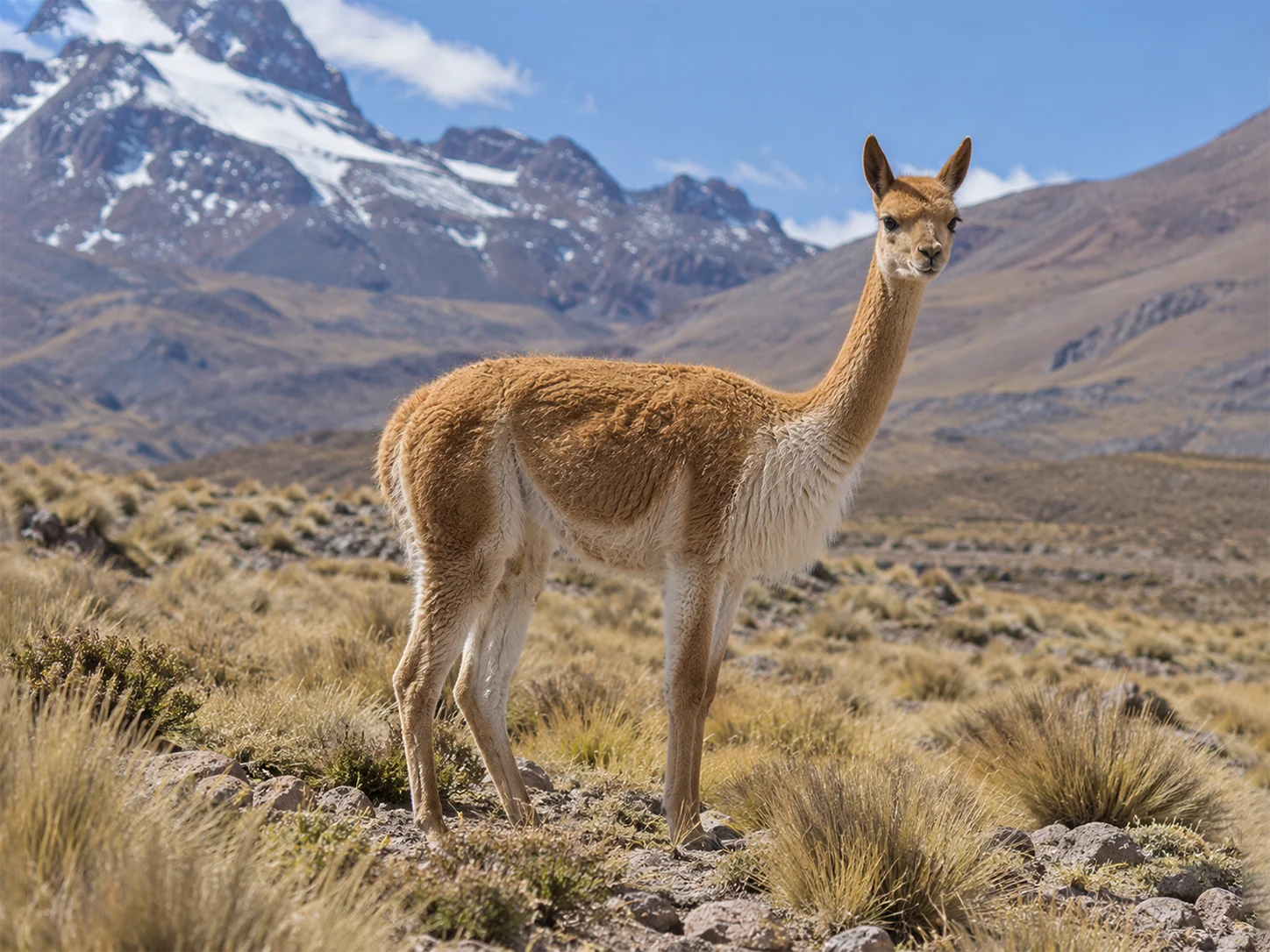
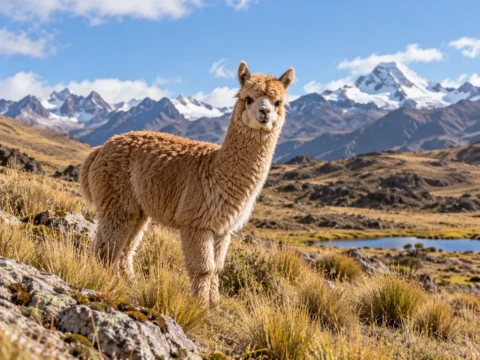
It is a slender wild camel relative, about the size of a large dog on long legs, living higher up the Andes than almost any other hoofed animal. Its coat is pale cinnamon, and the individual fibers are so thin that cashmere feels coarse beside them.
By the 1960s hunting had cut the species to roughly 6,000 animals. Today there are around 350,000. The vicuña is one of the clearest conservation recoveries anywhere, and it happened because people worked out that the wool is worth more from a living animal.
Scientific Name and Classification
The vicuña is usually written Vicugna vicugna, though recent work places it in the genus Lama as Lama vicugna. Both names refer to the same animal.
- Kingdom: Animalia
- Phylum: Chordata
- Class: Mammalia
- Order: Artiodactyla
- Family: Camelidae
- Species: Vicugna vicugna
Camelidae is the camel family, which is why a vicuña has the long neck and padded feet of a camel without the hump. South America has four camelids: two wild ones, the vicuña and the guanaco, and two domestic ones, the llama and the alpaca.
The relationship between them was argued over for a long time. A DNA study in 2001 indicated that the alpaca descends from the vicuña rather than the guanaco, so this wild animal is now regarded as the ancestor of the domestic one, which explains where the alpaca got its fleece.
Appearance and Anatomy
A vicuña stands 30 to 33 inches (75 to 85 cm) at the shoulder, measures 57 to 63 inches (1.45 to 1.6 m) in the body, and weighs 77 to 143 pounds (35 to 65 kg), the smallest of the four South American camelids.
- Pale cinnamon or light brown above, white below
- A bib of long white chest hair
- Long slender neck and legs
- Soft two-toed padded feet rather than hard hooves
- Large eyes set high on a small head
The padded feet matter at altitude. A soft two-toed foot grips loose rock and does far less damage to thin mountain turf than a hoof does, which is one reason heavy grazing by livestock is harder on these grasslands than grazing by the animals that evolved there.
The Finest Wool in the World
Vicuña fiber measures about 12 microns across. For comparison, cashmere runs 14 to 19 microns, so the difference is large enough to feel immediately.
The warmth comes from the structure. Each fiber is hollow and filled with air, and tiny scales on the surface interlock with neighboring fibers, trapping still air inside the cloth. That is exactly what insulation needs to do, and it is why a thin vicuña garment outperforms a thick one made of something coarser.
The price follows from the supply. An animal can only be shorn about once every three years, and it has to be caught in the wild first, so vicuña fiber sells for over 300 dollars a kilogram, among the most expensive natural materials there is.
Habitat and Range
Vicuñas live in the central Andes of Peru, Bolivia, northern Chile and northwestern Argentina, with an introduced population in Ecuador, at altitudes of 10,500 to 15,700 feet (3,200 to 4,800 m).
This is high alpine grassland: cold, dry, thin-aired country where the plants grow in scattered tough clumps. Vicuñas feed through the day and bed down on slopes at night.
Fossils show the species once ranged much further south, as far as the Strait of Magellan, until the early part of our present warm period. The high Andes are what is left of a much larger range.
Diet and Feeding
The diet is low, tough, nutrient-poor bunch grasses, the kind of vegetation that grows in hard clumps because nothing else survives the conditions.
Because that food supplies so little, vicuñas graze steadily through daylight rather than feeding in bursts. They also lick chalky stones and rock faces for the salts they cannot get from grass, a habit they share with the guanaco.
Social Life
Reproduction and Life Cycle
Mating happens in March and April, and the pregnancy runs about eleven months, so a female carries a single young through almost a whole year at high altitude.
One fawn is born. It nurses for roughly ten months and becomes independent somewhere between twelve and eighteen months old, by which time the next one is usually on the way.
The Vicuña and the Inca
The Inca understood exactly what they had. Vicuña cloth was the most precious textile in the empire, and the law reserved it: only royalty could legally wear it.
The animals themselves were protected by law rather than hunted freely, and the practice that survives today reflects that thinking. In a chaccu, a whole community forms a vast human chain across the mountain, walks the vicuñas gently into a funnel of corrals, shears them, and lets them go. The community at Lucanas in Peru still holds one every year.
It is a striking idea: a harvest that takes the valuable part and returns the animal to the mountain to grow more.
Conservation Status
Hunting went unrestricted until 1964, and by then the population had fallen to about 6,000. The species was declared endangered in 1974.
Then it came back. Peru alone counted 66,559 animals in 1994, 103,161 in 1997, and 208,899 by 2012. Across the range the total now stands near 350,000, and the IUCN moved the vicuña to Least Concern in 2018.
The reason is worth stating plainly. Protection was paired with a legal, community-run fiber industry, which gave the people living alongside vicuñas a direct reason to keep them alive and shear them rather than kill them for a single fleece. Conservation programs still run, because poaching for wool has not stopped. The incentive works only as long as the legal route pays better.
Predators and Role in the Ecosystem
The puma is the main natural predator, along with the culpeo (an Andean fox) and domestic dogs, which take young animals in particular.
As the main native grazer at these altitudes, the vicuña shapes the high grassland: cropping the bunch grasses, spreading seed and nutrients across the slopes, and doing all of it on soft feet that leave the fragile turf largely intact.
And it demonstrates something that matters well beyond the Andes. An animal valuable enough to be worth poaching can also be valuable enough to be worth protecting, but only if the people nearest to it are the ones who gain from it standing there alive.
Vicuñas live in family groups: one adult male with 5 to 15 females and their young. The male holds a territory of roughly 7 square miles (18 sq km), and the boundaries shift as the grazing changes through the year.
Young animals leave, and the two sexes leave differently. Young males gather into bachelor groups, drifting around the edges of the territories until one is strong enough to hold ground of his own. Young females go looking for an established group to join.
That arrangement does two useful things at once: it keeps competition between males spread out across the mountain, and it keeps close relatives from breeding with each other.