Meet the Yellowfin Tuna
A yellowfin tuna can swim at 47 miles an hour. It weighs as much as a refrigerator, it is warm-blooded, and it almost never stops moving.
Most fish are the temperature of the water around them. Tuna are not, and that one difference drives everything else about them: the speed, the size, the appetite and the constant swimming.
You have probably eaten one. Yellowfin is sold as ahi, and most of the commercial catch ends up canned.
Scientific Name and Classification
The yellowfin tuna is Thunnus albacares.
- Kingdom: Animalia
- Phylum: Chordata
- Class: Actinopterygii
- Order: Scombriformes
- Family: Scombridae
- Genus: Thunnus
- Species: Thunnus albacares
Scombridae is the mackerel family, which holds the tunas, the mackerels and the bonitos. It is a family built on one idea taken to extremes: a streamlined body, a stiff crescent tail, and a life spent swimming fast in open water.
The IUCN lists the yellowfin as Least Concern. That is an improvement rather than a constant: it was previously assessed as Near Threatened, and the reassessment reflects better stock management in several oceans rather than any change in the fish.
Appearance and Anatomy
Yellowfin reach 7 feet 10 inches (2.4 m) and weigh over 400 pounds (180 kg), with reported sizes up to 440 pounds (200 kg). The current all-tackle record is a 443-pound fish caught off Cabo San Lucas, Mexico, in 2024.
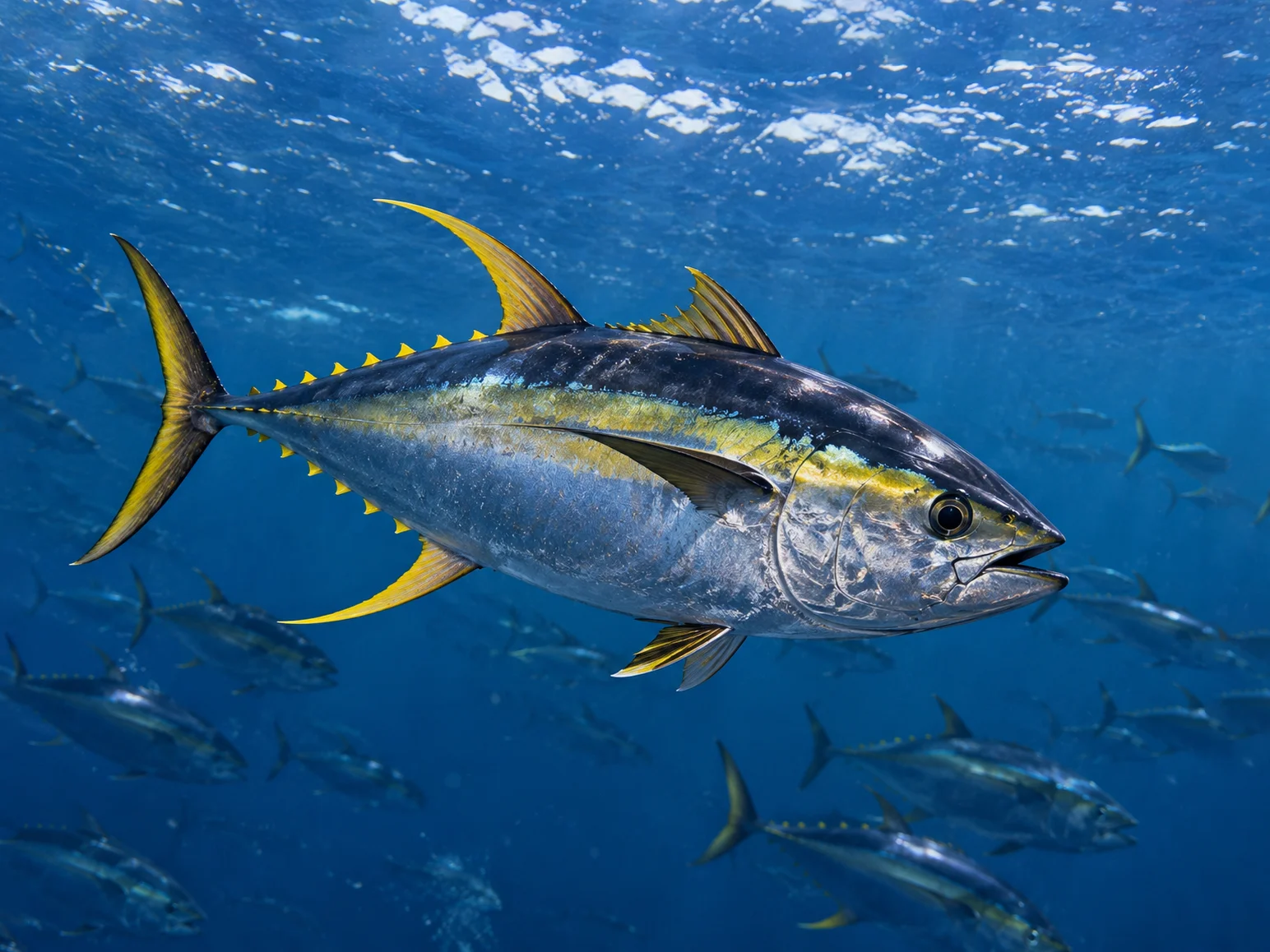
- Dark metallic blue back fading to silver below
- Bright yellow second dorsal fin, anal fin and finlets
- In mature fish, those fins grow long and curve like scimitars
- A stiff, narrow, crescent-shaped tail
- A body that tapers at both ends with almost no drag
The name comes from those yellow fins and the row of small yellow finlets running back toward the tail. In a big adult the second dorsal and anal fins stretch out into long sickles, which is the easiest way to pick a yellowfin out from the other tunas.
The tail does something unusual. It is stiff rather than flexible, so the fish holds its body nearly rigid and beats only the tail, which is a far more efficient way to move at speed than flexing the whole body the way most fish do.
A Warm-Blooded Fish
Almost every fish in the sea is the same temperature as the water it is in. Tuna break that rule, keeping parts of themselves warmer than their surroundings.
The advantage is power. Warm muscle contracts faster and harder than cold muscle, so a warm-bodied fish can accelerate and cruise in a way a cold one cannot, and it can follow prey into cooler water without slowing down.
The cost is that it has to keep moving. The arrangement depends on water flowing over the gills, which for a tuna means swimming constantly, so a yellowfin never really rests the way a reef fish does.
Habitat and Range
Yellowfin live in the open water of tropical and subtropical oceans worldwide, in the warm mixed layer near the surface, usually within the top 100 meters.
They are capable of far more than that. The deepest measured dive by a yellowfin reached 1,592 meters, which is 5,223 feet, well over a mile down. A fish that normally lives in sunlit water can drop into the cold dark and come back.
Schooling, and the Dolphin Problem
Yellowfin travel in schools of similarly sized fish, often mixed with other tunas, especially skipjack. They also associate with much larger animals: dolphins and porpoises, whales, and whale sharks.
That habit had a serious consequence. In parts of the Pacific, fishing crews learned that a visible group of dolphins at the surface often meant yellowfin underneath, so purse seine nets were set around the dolphins to catch the tuna below, and enormous numbers of dolphins drowned in the process.
This is where dolphin-safe labeling on tuna cans comes from. The label is about how the fish was caught rather than what is inside the can, and it exists because of a relationship between two animals that has nothing to do with people at all.
Diet and Feeding
Yellowfin eat fish, squid and pelagic crustaceans. The list of regular prey includes flying fish, sauries, mackerel, lanternfish, anchovies and sardines.
Big ones eat small tuna, including frigate mackerel and skipjack, which means a large yellowfin is feeding on the same species it schooled with when it was smaller.
A warm, fast, constantly swimming body is expensive to run, and that appetite is the price of it.
Predators
Young yellowfin are eaten by seabirds, larger tuna, wahoo, sharks and billfish, which is a dangerous start in life.
An adult has very few natural enemies, because almost nothing in the ocean can catch it. The short list is false killer whales, mako and great white sharks, and marlins: animals that are either faster or smarter about ambush.
The thing that actually kills adult yellowfin in numbers is industrial fishing, which is the main source of mortality for the species.
The Yellowfin and People
Yellowfin is one of the most commercially important fish in the world. It is sold as ahi, from the Hawaiian word, a name it shares with the bigeye tuna.
The scale is hard to picture. In 2010, 558,761 metric tons were caught in the western and central Pacific alone. Purse seining takes more of the catch than any other method, longlining supplies most of the sashimi trade, and the great majority of the fish ends up in cans.
Sport fishing is its own industry. Recreational fishing for yellowfin in the Gulf of Mexico has an estimated economic impact of 7 billion dollars a year.
Role in the Ecosystem
A yellowfin is a top predator in open water, a place with almost no structure and very little cover, where the only way to hunt is to be faster than everything else. Species like this set the shape of the whole food web beneath them.
Remove them in quantity and the fish they eat multiply, which changes what those fish eat in turn. This is why tuna stocks are watched as carefully as they are, and why the move from Near Threatened to Least Concern is worth noting: it is one of the few large-scale fisheries stories that has gone in the right direction.
It is also a reminder of how little most people picture when they open a can. The fish in it hunted at 47 miles an hour in the open Pacific, kept its own body warm, and could dive a mile straight down. Then it got canned, next to the codfish, in the same aisle.