Meet the Komodo Dragon
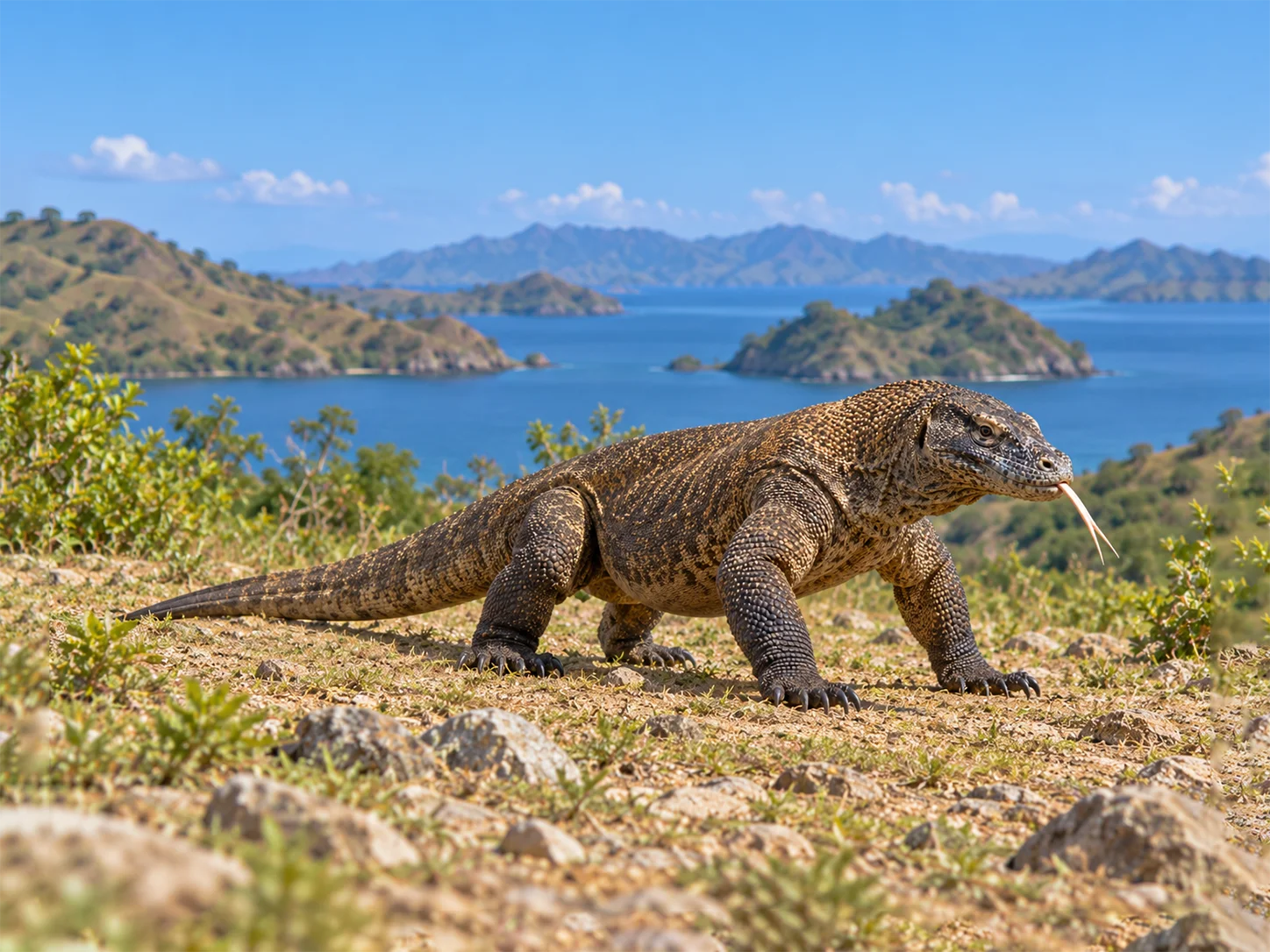
The Komodo dragon is the largest lizard alive, reaching 10 feet and 200 pounds, and it lives on five small Indonesian islands and nowhere else in the world.
For decades every book said the same thing about how it kills: its mouth is so full of rotting meat and septic bacteria that a bite poisons its prey.
That turned out to be wrong. In 2009 researchers found something more interesting in its jaw.
Scientific Name and Classification
The Komodo dragon’s scientific name is Varanus komodoensis, meaning the monitor lizard of Komodo.
- Kingdom: Animalia
- Phylum: Chordata
- Class: Reptilia
- Order: Squamata
- Family: Varanidae
- Species: Varanus komodoensis
It is a monitor lizard, the same family as the water monitors and goannas, just far bigger than any of them.
Despite the name it is not a dragon, and it is not a dinosaur relative in any close sense. Western science only learned of it in 1910, which is remarkably recent for an animal this size.
Is a Komodo Dragon Venomous?
Yes, and this is the correction worth making.
The old explanation was bacterial. Komodo dragons eat carrion, so the theory went that their mouths teem with dangerous bacteria, and a bitten animal dies of blood poisoning days later.
Research led by Bryan Fry in 2009 took a different approach and scanned the jaw. It found venom glands in the lower jaw, feeding venom along the teeth. The venom lowers blood pressure, prevents clotting and causes shock, so a bitten animal bleeds heavily and weakens fast.
The same work found that Komodo mouth bacteria are no worse than those of other carnivores. The septic-bite story had been repeated for fifty years without anyone checking it properly.
The teeth matter too. They are serrated and curve backwards, and the dragon pulls as it bites, opening deep wounds that the venom then keeps bleeding.
Appearance and Anatomy
Komodo dragons reach 8 to 10 feet in total length and weigh 150 to 200 pounds, with exceptional individuals heavier. Males are larger than females.
- Tongue. Long, yellow and forked, flicked out to collect scent particles and pressed to a sensory organ in the roof of the mouth. Each fork samples separately, so the dragon can tell which direction a smell came from.
- Smell. Astonishing. A Komodo dragon can detect carrion from several miles away.
- Skin. Gray-brown and armored with small bones embedded in it, called osteoderms, which form a natural chainmail.
- Tail. As long as the body, powerful enough to knock a deer down.
- Claws. Long and curved for tearing and digging.
They can sprint at around 12 miles an hour over short distances, swim well, and dive.
Habitat and Range
Komodo dragons live on just five islands in Indonesia: Komodo, Rinca, Flores, Gili Motang and Padar. That is their entire world range.
They occupy hot, dry savanna, open woodland and scrub, with temperatures regularly above 35 degrees Celsius.
They dig burrows to escape the heat at night and shelter in them, and they stay in a fairly small home range all their lives.
Their existence is an example of island gigantism, where a species isolated on islands with few competitors evolves to unusual size.
Diet and Feeding
Komodo dragons are carnivores, eating deer, wild boar, water buffalo, smaller dragons, birds, snakes and a great deal of carrion.
They are ambush hunters, lying still beside a trail and striking at the legs and throat as an animal passes.
Then they eat enormously. A Komodo dragon can consume up to 80 percent of its own body weight in a single meal, swallowing huge pieces whole and using a special tube under the tongue to keep breathing while its throat is full.
Afterward it is so heavy it can barely move, and basks in the sun to speed digestion. Having eaten that much, it may not need to feed again for a month.
They are efficient to an unpleasant degree, eating bone, hide, hooves and intestines, and leaving almost nothing behind.
Behavior and Lifestyle
Komodo dragons are mostly solitary and active by day, basking in the morning before they can hunt properly.
They gather at carcasses, and those gatherings follow a strict order: the largest animals feed first, and smaller ones wait. Fights between males are serious, fought upright on the hind legs with the tail as a prop.
They are cannibals, which shapes the whole life of a young dragon, as described below.
They are also more intelligent than their reputation suggests. Captive Komodo dragons recognize individual keepers, learn routines and play with objects, which is rare behavior in a reptile.
Reproduction and Life Cycle
Females lay around 20 eggs, often in an abandoned ground-nesting bird’s mound, and guard the nest for months. The eggs incubate for seven to eight months.
Hatchlings face an immediate problem: the adults eat them. So a baby Komodo dragon goes straight up a tree and spends its first few years living in the branches, eating insects, geckos and eggs, coming down only when it is too large to be easy prey.
They also roll in feces and carrion, and the smell appears to make them less appetising to adults.
Females can reproduce without a male. In 2006 a female at Chester Zoo, never housed with a male, laid eggs that hatched, through a process called parthenogenesis. It means a single female washed up on an empty island could in principle found a population.
Komodo dragons live around 30 years.
Predators and Threats
Adults have no predators except each other. Eggs and young are eaten by adult dragons, birds, snakes and wild boar.
Human pressures are the real danger. The islands are small, so there is no spare habitat: development, fire and farming all cut directly into the only range they have.
Poaching of deer, their main prey, is a serious problem, and dragons have been killed in retaliation for taking livestock.
Rising sea levels are the newest threat, and a particularly awkward one for an animal that lives on low-lying islands and has nowhere else to go.
Conservation Status
The Komodo dragon is listed as Endangered, with roughly 3,000 to 3,500 animals left, and the number of breeding females is far smaller than that total suggests.
Its entire population lives inside an area smaller than many city suburbs, which makes it exceptionally vulnerable. A single disease outbreak, severe fire season or sea-level change could affect most of the species at once.
Komodo National Park protects the core islands and has been reasonably effective, and the dragons draw tourism that gives local communities a direct reason to protect them.
Tourism cuts both ways, though: too many visitors disturb nesting and change dragon behavior, and managing that balance is an ongoing argument.
Role in the Ecosystem
The Komodo dragon is the apex predator of its islands, which is unusual in itself. On most land, that role belongs to a mammal; here it belongs to a reptile, and the whole system is arranged around it.
It controls deer and wild boar numbers, which protects island vegetation from being stripped.
It is also the islands’ cleaner. Because it eats carrion in quantity and leaves almost nothing, very little is left to rot, which on a small hot island genuinely matters.
Being cold-blooded makes it remarkably economical. A top predator that needs one large meal a month can sustain itself on an island far too small to support an equivalent mammal, which is part of why this particular animal exists where it does.