
Why Florida’s Manatees Starved, And What Conservation Got Wrong
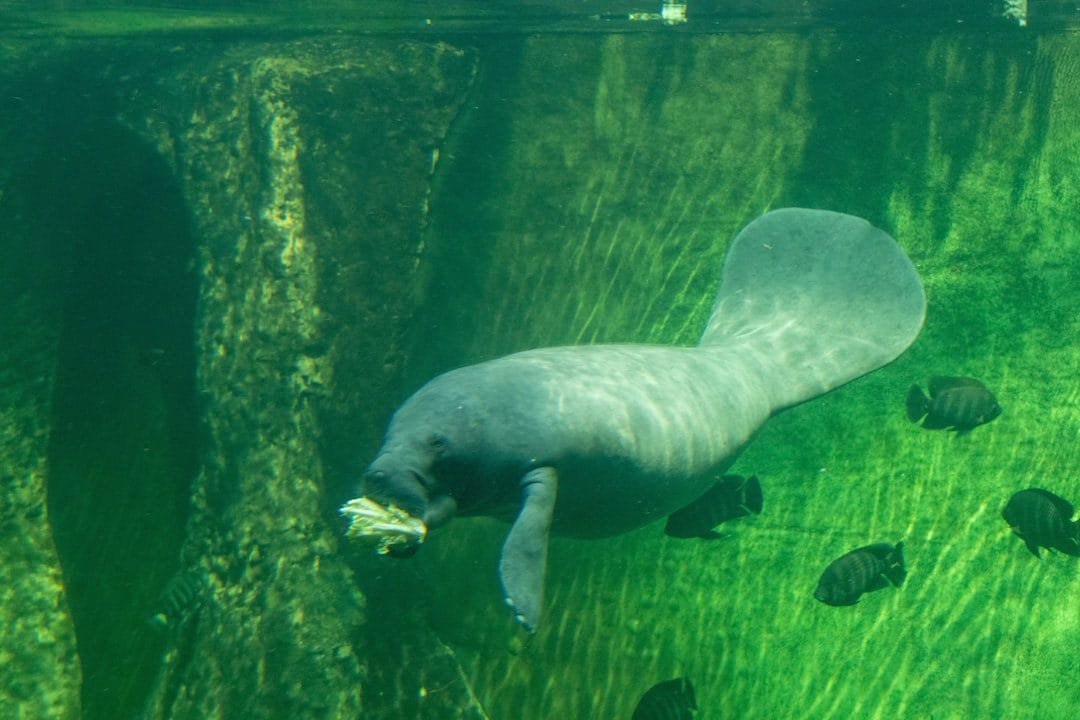
Between 2020 and 2022, more than 1,100 manatees died in Florida, around a fifth of the state’s population. They starved.
The cause was not hunting, boats or cold. Nutrient pollution running off land into the Indian River Lagoon had fed algal blooms, the blooms had blocked the sunlight, and without sunlight the seagrass died. Tens of thousands of acres of it were lost.
The manatees had nothing to eat, and wildlife officials ended up doing something they had always refused to do: feeding wild manatees by hand, throwing lettuce into the water at a power plant outflow, because the alternative was watching them die.
What A Manatee Is
Manatees are large, slow, entirely vegetarian marine mammals, and together with the dugong they make up the order Sirenia, which has only four living species.
Their closest living relative is the elephant, which they share a land ancestor with from roughly 50 million years ago, and the resemblance shows in small details: a prehensile upper lip, toenails on the flippers, and molars that are replaced from the back as the front ones wear out, exactly as an elephant’s are.
There are three species: the West Indian manatee, which includes the Florida population, the Amazonian manatee, which lives entirely in fresh water, and the West African manatee.
An adult reaches 9 to 13 feet and 800 to 1,200 pounds, eats around a tenth of its body weight in plants daily, and lives up to 60 years or more.
The Warm Water Trap
Manatees look fat and are not well insulated. Most of their bulk is gut rather than blubber, and they cannot survive long in water below about 68°F, where they develop a condition called cold stress syndrome.
In winter they gather at warm water sources: natural springs that stay at a constant temperature year-round, and the outflows of power stations.
That second habit has created a genuine conservation dilemma. Generations of Florida manatees have learned to winter at industrial outflows, and have abandoned some of the natural springs they used before. As aging power plants are retired, the manatees that depend on them have nowhere to go, and there is no straightforward way to teach a wild population to change where it spends the winter. Some plants now run warm water specifically to keep manatees alive.
Boats, And Why Scars Are Useful
Watercraft collisions are the leading direct human cause of manatee deaths. A manatee is slow, surfaces to breathe, feeds in shallow water where boats run, and cannot hear a propeller clearly, because boat noise falls partly outside its best hearing range and the hull masks the sound.
Almost every adult manatee in Florida carries propeller scars, and researchers use those scar patterns to identify individuals, which is how long-term tracking of the population works. A catalog of scarred animals has followed some individuals for decades.
Speed zones work. Slow-speed areas in manatee habitat measurably reduce deaths, because a boat traveling slowly gives the animal time to move and does far less damage if it does not. They are also consistently unpopular, and enforcement is the difference between a zone that works and a sign in the water.
The Recovery That Came Before The Crash
It is worth being clear that manatee conservation worked for decades before the starvation event, because that history is what makes the recent losses so frustrating.
Florida manatees were down to a few hundred animals in the 1970s. Protection under the Endangered Species Act and the Marine Mammal Protection Act, sanctuaries at the springs, speed zones, and a rescue and rehabilitation network took the population to several thousand.
In 2017 the West Indian manatee was downlisted from Endangered to Threatened in the United States, which was presented as a success and was heavily criticized at the time as premature.
The starvation event began three years later. The critics were right in a specific way: the population had recovered, but the habitat it depended on had not been protected alongside it, and a protected animal in a degraded habitat is only safe until the habitat fails.
What Actually Helps
The manatee is a good case study because the interventions are specific and their effects are measurable.
- Fix the water, not just the animal. The starvation was caused by nutrient runoff from fertilizer, septic systems and wastewater. Seagrass restoration is underway, and it cannot succeed while the nutrients keep arriving, which makes this a sewage and agriculture problem rather than a wildlife one.
- Protect the natural springs so manatees have somewhere to winter that does not depend on a power company’s business decisions.
- Enforced speed zones, not just designated ones.
- Rescue and rehabilitation, which is expensive and saves individual animals. Hundreds have been rehabilitated and released, and in a population this size individuals matter.
- Cut fishing gear losses, since manatees become entangled in monofilament line and crab trap ropes, sometimes losing flippers.
If you are in manatee country, the practical list is short: obey speed zones, never feed or give water to manatees, which teaches them to approach boats, keep your distance in the springs, and take your fishing line home.
Why It Matters Beyond The Manatee
Manatees graze seagrass meadows, and seagrass is worth protecting for reasons that have nothing to do with charismatic mammals. It is a nursery for the fish and shellfish coastal fisheries rely on, it stabilizes sediment and buffers shorelines against storms, and it stores carbon in its sediments at rates per acre comparable to forest.
So the seagrass that starved was already doing several jobs, and the manatee deaths were the visible symptom of losing it. The animal is the part people noticed.
There is also the warning from the family. The manatee’s closest relative, Steller’s sea cow, was described by science in 1741 and hunted to extinction by about 1768 — 27 years. These are slow-breeding animals: a female manatee produces one calf every two to five years after a year-long pregnancy, and nurses it for up to two years. Nothing about them can absorb a sudden loss quickly.
The encouraging part is that the manatee has already been brought back from a few hundred animals once. The problem this time is not the animal. It is the water.
Keep Reading
More from the blog
-
 Conservation An A To Z Of Endangered Animals, And What Is Actually Killing Them
An A to Z of endangered animals, each with the specific thing threatening it. What comes out is a list where famous species are…
-
 Conservation WWF Explained: The Panda, The Work, And The Criticism
The panda on the WWF logo was a real animal: Chi Chi, at London Zoo in 1961, chosen partly because she printed cheaply in black…
- Conservation How India Doubled Its Tigers: What Conservation Actually Looks Like In 2006 India counted its tigers properly for the first time and found 1,411, not the 3,600 it had been claiming. What happened…